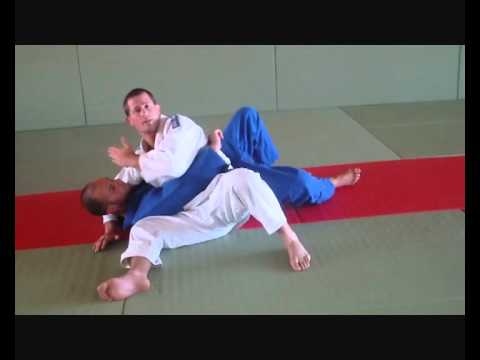
Kesa gatame - in depth instruction by Matt D’Aquino
0
Standard Kesa Gatame·BeyondGrappling·Added by Admin
Kesa gatame is a super common hold down in Judo, but it is often taught wrong. In this video I show you how to hold your…
Перевод: standard kesa gatame
The Standard Kesa Gatame wraps one arm around the opponent's head, controls the near arm with the other hand, and turns the hips to face the opponent's head, with the near hip pressing against the opponent's side. [1] The standard kesa gatame provides crushing pinning pressure through the hip drive and head-wrap control, making it one of the most effective pinning positions in all of grappling. [1],[2] From standard kesa, the controlling fighter can attack with head-and-arm chokes, arm cranks, and transitions to mount. [2],[3]
Kesa gatame is one of the fundamental osaekomi-waza (pinning techniques) in Kodokan judo. [1]
Kesa gatame is one of the most commonly scored pins in judo competition, holding for 20 seconds scores ippon. [1]
Изображений для этой техники пока нет.
Войдите, чтобы предложить изображение.
Kesa gatame is a super common hold down in Judo, but it is often taught wrong. In this video I show you how to hold your…
Учебных курсов по этой технике пока нет.
Войдите, чтобы предложить курс.
Риск травмы для человека, к которому применяется техника
Top positions enable pressure and striking; rib compression risk under heavy pressure
Уровень мастерства, необходимый для надёжного выполнения техники
Разрешена ли техника по основным соревновательным правилам
Mastering Jujitsu (Renzo Gracie & John Danaher, 2003)
Alias sources — [1] Kodokan Judo (Kano, 1986) [2] UWW Wrestling Rules [3] UWW Wrestling Rules
Effectiveness sources — [1] Kodokan Judo (Kano, 1986) [2] Mastering Jujitsu (Gracie & Danaher, 2003)
Mixed Japanese-Western terminology — combines traditional Japanese terms with katakana loanwords
Alias sources — [1] Kodokan Judo (Kano, 1986) [2] UWW Wrestling Rules [3] UWW Wrestling Rules
Effectiveness sources — [1] Kodokan Judo (Kano, 1986) [2] Mastering Jujitsu (Gracie & Danaher, 2003)
base stability, heavy hips, ride ability
heavier build with strong hips for pressure
hip adductors, core, glutes, quadriceps
According to Matt D'Aquino, you should place your strongest parts—your body weight—on your opponent's weakest part, which is the side of the ribs. This makes the position very uncomfortable for them and prevents you from bearing down on their strongest areas.
Matt D'Aquino identifies several key errors: keeping your foot elevated causes you to push your opponent away rather than hold them down, putting your head too far forward helps them bridge and escape, and not spreading your feet wide enough allows them to trap your leg or take your back. Keep your feet in a good spread and maintain a forward base position.
Matt D'Aquino recommends grasping your own leg instead of the opponent's gi. This helps you remember to keep your foot in a forward position for a solid base, keeps their head elevated to prevent bridging, and helps you maintain proper pressure without leaning too far back.
Matt D'Aquino emphasizes adjusting dynamically: if your opponent tries to sit up, pull your head down to counterbalance; if they bridge to one side, lean back slightly. It requires constant feeling and adjustment rather than static positioning.
The Standard Kesa Gatame wraps one arm around the opponent's head, controls the near arm with the other hand, and turns the hips to face the opponent's head, with the near hip pressing against the opponent's side. The standard kesa gatame provides crushing pinning pressure through the hip drive and head-wrap control, making it one of the most effective pinning positions in all of grappling.
Standard kesa gatame is one of the most fundamental judo pins, dating back to the art's founding by Jigoro Kano. It is one of the first pinning techniques taught in judo and has been adopted across all major grappling systems.
IBJJF: разрешён — Legal, mount scores 4 points — highest-scoring position; IJF: разрешён — Legal, osaekomi (pin) — 10-19 seconds scores waza-ari, 20 seconds scores ippon; ADCC: разрешён — Legal, mount scores 2 points; Unified MMA: разрешён — Legal dominant position; UWW: разрешён — Legal, back exposure scores points, pin ends match by fall; FIAS Sport Sambo: разрешён — Legal, pin scores points
Оценка опасности 3/10. Moderate — top positions enable pressure and striking; rib compression risk under heavy pressure
Стандартная цепочка подготовки: Pass the Guard → Settle Weight → Control Arms → Threaten Submissions.
Стандартные контрприёмы: Bridge (Upa) — explosive hip elevation to off-balance the top player / Elbow-Knee Escape (Shrimp) — create space by driving elbow to knee and hip-escaping / Frame — establish forearm frames to prevent the top player from settling weight.
Распространённые варианты: Low mount (hips heavy on the opponent's belly, grapevines in for sta…); High mount (knees under the armpits, arms isolated for submissions); S-mount (one knee high under the armpit, other leg across for arm …); Technical mount (one leg hooked, one knee posted, modified for back-take t…).
Kesa gatame is one of the most commonly scored pins in judo competition, holding for 20 seconds scores ippon.
Основные ошибки, на которые стоит обратить внимание: Not hugging the head tightly — the head wrap must be tight with the head pressed against the ribs / Sitting too far from the opponent's body — the hip must be flush against their side / Not controlling the near arm — the arm must be clamped or gripped to prevent bridging / Keeping the legs together — spread the legs wide for base and stability.
Standard Kesa Gatame также известен как Sutandādo Kesa-gatame, Hon Kesa Gatame (本袈裟固め), Scarf Hold, Head-and-Arm Pin.