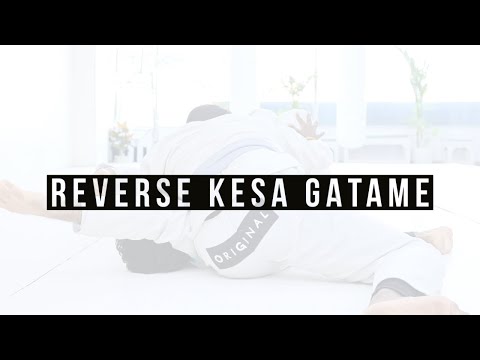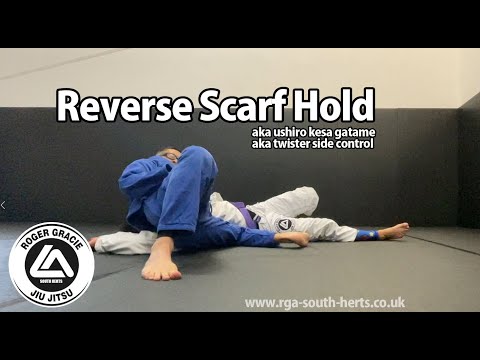
Reverse Scarf Hold - aka twister side control or ushiro kesa gatame
0
Reverse Kesa Gatame·RGA South Herts·Added by Admin
The reverse scarf is a useful tool to have if you can't access regular side control or regular kesa gatame fully. It may…
Перевод: reverse scarf hold
The Reverse Kesa Gatame positions the controlling fighter facing the opponent's legs rather than the head, with the arm wrapping around the opponent's waist or hip area. [1] Reverse kesa gatame provides different submission and transition options than standard kesa, particularly access to leg attacks and knee-on-belly transitions. [1],[2] The reversed orientation changes the control dynamics, making certain escapes easier but providing unique attacking angles. [2],[3]
Reverse kesa gatame provides excellent control while facing away from the opponent's head, offering access to arm locks and leg attacks that are unavailable from standard kesa gatame. [1]
Reverse kesa gatame (ushiro-kesa-gatame or gyaku-kesa-gatame) is a traditional Kodokan judo pinning technique. [1]
Reverse kesa gatame (gyaku kesa gatame) is used in judo and BJJ competition. [1]
Изображений для этой техники пока нет.
Войдите, чтобы предложить изображение.
The reverse scarf is a useful tool to have if you can't access regular side control or regular kesa gatame fully. It may…
In this comprehensive Jiu-Jitsu tutorial, 00:08 Understanding the Threats 04:26 Survival Tips 06:00 Escape Join us fo…
Reverse Kesa Gatame (also called reverse scarf hold, twister side control, or ushiro kesa gatame) is a top-side-control position entered after guard passing when the passer cannot achieve a traditional cross-face side control. Both Knots and Collar and RGA South Herts emphasize that control of the upper-body space—particularly the opponent's armpit—is the defining feature of the position. Knots and Collar prioritizes defensive survival, teaching that the bottom player must maintain elbow position to protect the armpit space and prevent the top player from establishing a dominant shoulder-head control. The instructor details two defensive approaches: fighting directly by keeping the elbow outside, or filling the armpit space by placing the elbow on the mat. Escape relies on hip movement rather than shrimping; the bottom player turns slightly toward the top player, establishes heel-to-buttock positioning, points knees toward the opponent, then executes a sideways hip escape to reclaim space before using a knee frame and hand replacement to escape or take the back. RGA South Herts provides technical entry details, demonstrating the knee-slide guard pass transition into reverse kesa gatame, emphasizing proper weight distribution and knee placement for stability. Both instructors agree that the position offers strong control and threat potential but requires precise technical execution to maintain dominance—any error leaves the top player vulnerable to escape or reversal.
Сформировано на основе 2 инструкторов
Учебных курсов по этой технике пока нет.
Войдите, чтобы предложить курс.
Риск травмы для человека, к которому применяется техника
Top positions enable pressure and striking; rib compression risk under heavy pressure
Уровень мастерства, необходимый для надёжного выполнения техники
Разрешена ли техника по основным соревновательным правилам
Jiu-Jitsu University (Saulo Ribeiro, 2008)
Alias sources — [1] Kodokan Judo (Kano, 1986) [2] Dynamic Kodokan Judo (Kudo, 1967) [3] Dynamic Kodokan Judo (Kudo, 1967)
Effectiveness sources — [1] Kodokan Judo (Kano, 1986)
Standard Japanese martial arts terminology (kanji/hiragana)
Established Japanese martial arts naming convention — native Japanese term (和語/漢語)
Alias sources — [1] Kodokan Judo (Kano, 1986) [2] Dynamic Kodokan Judo (Kudo, 1967) [3] Dynamic Kodokan Judo (Kudo, 1967)
Effectiveness sources — [1] Kodokan Judo (Kano, 1986)
body awareness, stability, control of weight distribution
athletic build with good proprioception
core, hips, legs for base stability
According to Knots and Collar, survival comes first by maintaining armpit space—this keeps you safe against arm attacks and side control switches before you can attempt an escape.
Knots and Collar teaches a two-step process: first establish survival by controlling the armpit space, then perform a hip escape by moving your hips sideways (not diagonally back) and fill the gap with your knee to regain position.
Knots and Collar explains that 'hip escape' is used because moving your hips sideways gives you the room to move in multiple angles, whereas 'shrimp' implies a different direction of movement.
Knots and Collar warns that any mistake in maintaining proper position control can result in you being mounted or submitted, so you must be very tight with your positioning.
The Reverse Kesa Gatame positions the controlling fighter facing the opponent's legs rather than the head, with the arm wrapping around the opponent's waist or hip area. Reverse kesa gatame provides different submission and transition options than standard kesa, particularly access to leg attacks and knee-on-belly transitions.
Reverse kesa gatame is a traditional judo pinning variation, part of the broader osaekomi-waza system. It has been adapted in BJJ for its unique attacking angles and transition options.
IBJJF: разрешён — Legal, mount scores 4 points — highest-scoring position; IJF: разрешён — Legal, osaekomi (pin) — 10-19 seconds scores waza-ari, 20 seconds scores ippon; ADCC: разрешён — Legal, mount scores 2 points; Unified MMA: разрешён — Legal dominant position; UWW: разрешён — Legal, back exposure scores points, pin ends match by fall; FIAS Sport Sambo: разрешён — Legal, pin scores points
Оценка опасности 3/10. Moderate — top positions enable pressure and striking; rib compression risk under heavy pressure
Стандартная цепочка подготовки: Achieve Position → Stabilize → Maintain → Attack.
Стандартные контрприёмы: Posture Control — maintain strong posture to limit the opponent's offensive options / Escape to Neutral — work back to standing or a neutral position.
Распространённые варианты: Standard variation (primary positioning for control and attack); Offensive variation (configured for submission or striking opportunities); Transitional variation (positioned for quick movement to the next position); Defensive variation (prioritising stability and control over attack).
Reverse kesa gatame (gyaku kesa gatame) is used in judo and BJJ competition.
Основные ошибки, на которые стоит обратить внимание: Facing the legs without controlling the near arm — the near arm must still be managed to prevent frames / Sitting too far from the opponent — the hip must be tight against their side / Not using the chest to drive pressure — the chest presses into the lower ribs for control / Staying in reverse kesa without attacking — the position is designed for arm attacks and transitions.
Reverse Kesa Gatame также известен как Ura Kesa-gatame, Reverse Scarf Hold, Gyaku Kesa Gatame (逆袈裟固め), Ushiro Kesa Gatame (後袈裟固め).