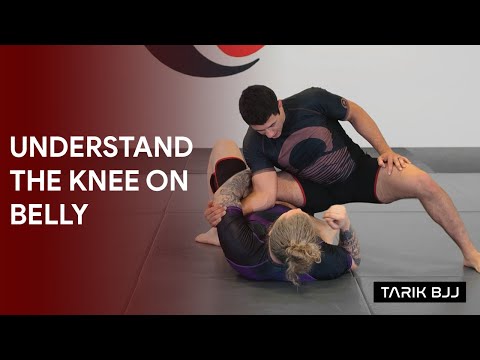
Knee on Belly Fundamentals
0
Knee On Belly·Tarik BJJ
🔗 Links: Follow me on Instagram for more jiu-jitsu content: https://www.instagram.com/tarik_bjj/ Discover top-qualit…
Перевод: knee on belly
The Knee On Belly family covers the top position where the controlling fighter places one knee on the bottom fighter's torso while the other foot is posted on the mat for base, creating a mobile and aggressive pinning position. [1] Knee-on-belly is one of the most versatile top positions because it provides excellent mobility for transitioning to other positions, generates significant pressure on the bottom fighter, and allows a wide variety of submissions. [1],[2] In IBJJF competition, achieving knee-on-belly scores two points, reflecting its recognition as a dominant position. [2],[3]
Knee on belly is a highly mobile dominant position that scores two points in IBJJF competition and provides the top fighter with excellent submission access while maintaining the option to disengage to standing. [1] The position generates intense pressure through concentrating the top fighter's weight through a single knee, creating an urgent defensive reaction that opens submissions. [2]
Knee on belly is a transitional dominant position emphasised in BJJ, where the attacker places their knee on the opponent's torso while standing on the other foot. [1]
Knee on belly scores 2 points in IBJJF competition and is a common transitional position in BJJ. [1]
Изображений для этой техники пока нет.
Войдите, чтобы предложить изображение.
🔗 Links: Follow me on Instagram for more jiu-jitsu content: https://www.instagram.com/tarik_bjj/ Discover top-qualit…
Учебных курсов по этой технике пока нет.
Войдите, чтобы предложить курс.
Риск травмы для человека, к которому применяется техника
Top positions enable pressure and striking; rib compression risk under heavy pressure
Уровень мастерства, необходимый для надёжного выполнения техники
Разрешена ли техника по основным соревновательным правилам
Jiu-Jitsu University (Saulo Ribeiro, 2008)
Alias sources — [1] Jiu-Jitsu University (Ribeiro, 2008) [2] Jiu-Jitsu University (Ribeiro, 2008) [3] IBJJF Rules and Regulations
Effectiveness sources — [1] IBJJF Rules and Regulations [2] Jiu-Jitsu University (Ribeiro, 2008)
Standard katakana transliteration of Western martial arts terminology (外来語) — used in Japanese MMA, boxing, and BJJ communities
Alias sources — [1] Jiu-Jitsu University (Ribeiro, 2008) [2] Jiu-Jitsu University (Ribeiro, 2008) [3] IBJJF Rules and Regulations
Effectiveness sources — [1] IBJJF Rules and Regulations [2] Jiu-Jitsu University (Ribeiro, 2008)
body awareness, stability, control of weight distribution
athletic build with good proprioception
core, hips, legs for base stability
Каждое движение в любом боевом искусстве обладает рядом универсальных свойств. Комбинируйте параметры ниже, чтобы найти нужный инструмент или сравнить аналоги из разных стилей.
The Knee On Chest subfamily covers the variation where the knee is placed higher on the opponent's body — on the chest or sternum rather than the belly — creating more pressure on the ribcage and greater posture control. [1] Knee-on-chest generates more discomfort and breathing restriction than standard knee-on-belly because the weight is applied to the ribcage, compressing the lungs. [1,2] The higher knee placement also provides better control for certain submissions and transitions. [2,3]
The Reverse Knee On Belly subfamily covers the variation where the top fighter faces the opponent's legs rather than their head, placing the knee on the belly while looking toward the opponent's feet. [1] Reverse knee-on-belly provides different submission and transition options than standard knee-on-belly, particularly access to leg attacks and transitions to leg entanglements. [1,2] The reversed orientation also provides a different escape-prevention dynamic as the bottom fighter must defend from a different angle. [2,3]
The Standard Knee On Belly subfamily covers the classic knee-on-belly position where the top fighter faces the opponent's head with one knee on the belly/midsection and the other foot posted for base. [1] Standard knee-on-belly is the primary version of this position, providing a balanced platform for pressure, submissions, and transitions. [1,2] The position allows the top fighter to use gravity and bodyweight to create significant pressure while maintaining mobility for transitions to mount, side control, or the opposite side. [2,3]
Knee on belly scores 2 points in IBJJF competition and is one of the most pressure-intensive positions — the attacker's entire body weight drives through the knee into the opponent's stomach or chest. (IBJJF Rules v6.0; Ribeiro, Jiu-Jitsu University)
The angle is critical for stability—if your leg points too far forward, your opponent can sweep you backwards, and if it points too far back, you lose control. Tarik BJJ emphasizes finding the right angle to maintain pressure and prevent easy sweeps.
Take your foot off the floor so you can surf on top of them as they move, then plant your foot back down when you want to apply full weight and stop following. This keeps you mobile and reactive rather than getting left behind.
You have several options depending on the situation—you can control with an underhook on the tricep, lead their arm higher to prevent pushing distance, or transition to techniques like the window wiper movement. The key is staying reactive to what your opponent does.
The Knee On Belly family covers the top position where the controlling fighter places one knee on the bottom fighter's torso while the other foot is posted on the mat for base, creating a mobile and aggressive pinning position. Knee-on-belly is one of the most versatile top positions because it provides excellent mobility for transitioning to other positions, generates significant pressure on the bottom fighter, and allows a wide variety of submissions.
Knee-on-belly has been used as a controlling position in various grappling traditions, but BJJ developed it into a comprehensive attacking position with specific submission chains and transition options. It is scored as a distinct positional achievement in BJJ competition.
IBJJF: разрешён — Legal, knee on belly scores 2 points; IJF: разрешён — Legal, osaekomi (pin) — 10-19 seconds scores waza-ari, 20 seconds scores ippon; ADCC: разрешён — Legal, knee on belly scores 2 points; Unified MMA: разрешён — Legal dominant position; UWW: разрешён — Legal, back exposure scores points, pin ends match by fall; FIAS Sport Sambo: разрешён — Legal, pin scores points
Оценка опасности 3/10. Moderate — top positions enable pressure and striking; rib compression risk under heavy pressure
Стандартная цепочка подготовки: Achieve Position → Stabilize → Maintain → Attack.
Стандартные контрприёмы: Posture Control — maintain strong posture to limit the opponent's offensive options / Escape to Neutral — work back to standing or a neutral position.
Распространённые варианты: Standard knee on belly (knee across the midsection, far foot posted for base); Knee on chest (knee higher toward the chest for more pressure); Reverse knee on belly (facing the opponent's legs instead of their head); Floating knee (light, mobile knee ride allowing quick transitions).
Knee on belly scores 2 points in IBJJF competition and is a common transitional position in BJJ.
Основные ошибки, на которые стоит обратить внимание: Placing the knee without driving pressure — the knee must press into the abdomen with the body weight behind it / Not posting the far foot for base — the posting foot is essential for balance and mobility / Staying static on the knee — knee on belly requires constant adjustment as the opponent moves / Not using the grips to control — collar and sleeve/wrist grips complement the knee pressure.
Knee On Belly также известен как Nī On Berī, Knee On Stomach, Knee Ride, KOB.