Удар и защитаЗамкиБлижний бойБой против нескольких
Дистанция
БлижняяСредняяДальняя
Обзор
The One-Sleeve Spider Guard uses the spider guard on one side only — one foot on the bicep with sleeve control — while the other leg is positioned differently (on the hip, in DLR, or on the mat). [1] The single-sided spider guard provides asymmetric control that opens up different sweep and submission angles compared to the full spider guard. [1],[2] It is frequently used as a transitional position between spider guard and other guard configurations. [2],[3]
The one-sleeve spider guard developed as a practical variation used when the full spider guard grip is not achievable or when the guard player wants to combine spider control with other guard elements. [1] It is widely used in gi competition. [2],[3]
Страна происхождения· показано в случайном порядке
One-sleeve spider guard controls one bicep with the foot while the other leg plays De La Riva, lasso, or another open guard system, creating hybrid attacks. [1]
Родословная
One-sleeve spider is a hybrid guard variant developed in modern BJJ competition. [1]
Соревновательные результаты
Hybrid spider guard variants are used at all levels of BJJ competition. [1]
Изображения
Изображений для этой техники пока нет.
Войдите, чтобы предложить изображение.
Биомеханический механизм
Primary Action — Using the legs and hips to control the opponent from the bottom — maintaining distance management and attack angles
Joints Involved — Hips (primary engine for sweeps and attacks), knees (framing and hooking), ankles (secondary hooks)
Force Vector — Pulling, framing, and hip-escaping — creating angles for attacks while preventing passing
Positional Mechanic — The guard is an active offensive position — leg control compensates for bottom positioning by threatening sweeps and submissions
Позиция и вход
From seated or supine position — Maintain distance with feet on the opponent's hips or legs, hands controlling grips or collars
From closed guard break — When the opponent opens the closed guard, transition to open guard by establishing foot and grip controls
Варианты
Spider guard — gripping both sleeves with feet on the biceps for distance control
De la Riva guard — one hook behind the opponent's lead leg with opposite foot controlling
Lasso guard — lasso grip wrapping the leg around the opponent's arm
Collar-sleeve guard — controlling collar with one hand and sleeve with the other, feet active
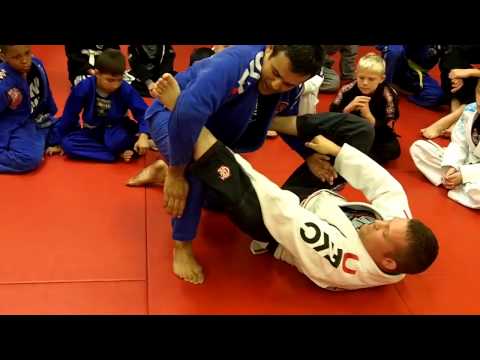
This week Master Ricardo Cavalcanti shows how to break the grips and pass the spider guard.
If you have any questions or…
1 / 2
3 videos
Что говорят инструкторы
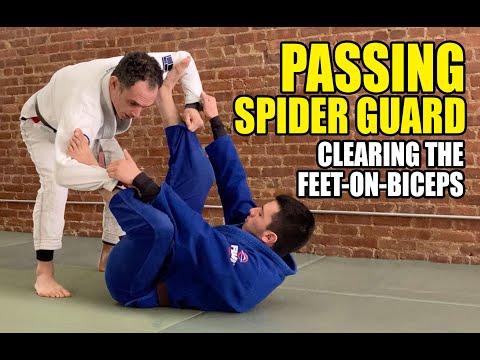
One-sleeve spider guard refers to a variation of spider guard where the bottom player controls one sleeve of the top player while maintaining foot pressure on the biceps—a position distinct from the double-sleeve variant. Pedro Ramalho emphasizes that grip control is paramount in spider guard variations; the defender must prevent the top player from securing pants grips, as allowing this creates a chain of defensive problems (Toreando handles, frame losses, lasso compromises) that ultimately break positional control. Ramalho stresses maintaining elbow-to-rib positioning and following the opponent's movement via shoulders and hips to preserve grip dominance. Brian Glick approaches spider guard from the passer's perspective, detailing two clearing methods: the primary technique involves squaring up, closing elbows inward, stepping back, and snapping the feet to the mat via a circling action; the secondary method uses a knee wedge behind the hamstring combined with an elbow flip to neutralize leg mobility when one foot remains on the biceps. Ricardo Cavalcanti similarly emphasizes knee-wedge placement behind the opponent's hand combined with downward hand pressure to break grip and disable the spider hook, then transitioning to passing positions like the sit-up pass. All three instructors agree that spider guard effectiveness derives from the combination of sleeve grips and foot pressure; neutralizing either component (grips or leg posts) significantly diminishes the position's defensive utility.
Сформировано на основе 3 инструкторов
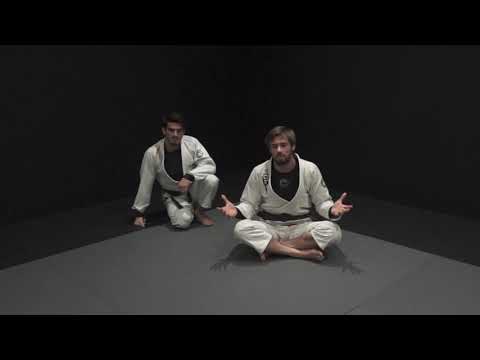
Pedro Ramalho — Key Details to not having your guard passed from Double Sleeve/Spider Guard: Detailed grip-first defensive strategy emphasizing sleeve control, maintaining elbows on ribs, and following opponent movement to prevent pants grabs and Toreando passes
Brian Glick — Passing Spider Guard - Clearing Feet on Biceps (BJJ / Jiu Jitsu): Provided two passing techniques from top position: snap-down heel drive method and knee-wedge-plus-elbow-flip method for clearing biceps pressure and regaining inside position control
Ricardo Cavalcanti BJJ — Jiu Jitsu Techniques - Passing The Spider Guard: Demonstrated knee-wedge placement behind opponent's hand combined with downward pressure and wrist-lock mechanics to break grips and transition into sit-up passes
Изучить технику
Учебных курсов по этой технике пока нет.
Войдите, чтобы предложить курс.
Оценки
Уровень опасности
Риск травмы для человека, к которому применяется техника
2
Низкий2/10
Guard positions are defensive; injury risk comes from transitions, not the position itself
Сложность
Уровень мастерства, необходимый для надёжного выполнения техники
Средний
Допустимость на соревнованиях
Разрешена ли техника по основным соревновательным правилам
Ограничено
— IJF — Guard pulling penalized as non-combativity — ground...
✓One-sleeve spider guard uses one foot on the opponent's bicep with a sleeve grip while the other leg controls differently (foot on hip, lasso, or de la Riva hook) — creating a hybrid guard with varied attack options (Leandro Lo, competition analysis)
✓One-sleeve spider is more practical than full spider: it maintains one strong arm control while freeing the other leg for hooks and sweeps
✓Common one-sleeve spider hybrids: spider-lasso (one spider foot, one lasso wrap), spider-DLR (one spider foot, one DLR hook), spider-collar-sleeve (one spider foot, one foot on hip with collar grip)
✓From one-sleeve spider, the primary attacks depend on the other leg: lasso side enables omoplata, DLR side enables berimbolo, hip side enables triangle
✓One-sleeve spider is the modern evolution of full spider guard: elite competitors use hybrids rather than pure double-spider
✓The sleeve-grip side controls one arm completely while the other leg creates sweeping angles
✓One-sleeve spider is more mobile than double spider: the free leg allows more transitions and guard adjustments
Типичные ошибки
!Losing the one sleeve grip without immediately recovering — the sleeve grip is the anchor of the position
!Not utilizing the free leg effectively — the free leg must contribute hooks, frames, or sweeps
!Playing one-sleeve spider without a hybrid second leg position — the other leg must actively control
!Using one-sleeve spider without transitioning — it should flow into specific attack sequences
!Keeping the spider foot on the bicep without pushing — the foot must actively control the arm
!Not developing multiple hybrid combinations — one-sleeve spider to lasso, DLR, and collar-sleeve should all be trained
!Playing one-sleeve spider at the wrong distance — adjust range based on the second leg position
1Achieve Guard Contact — establish leg control around or against the opponent
2Control Grips — secure sleeve, collar, or wrist control for manipulation
3Manage Distance — use legs and grips to control the range and prevent passing
4Threaten Submissions/Sweeps — create offensive threats to keep the opponent reactive
Источники и ссылки
Основной источник
Jiu-Jitsu University (Saulo Ribeiro, 2008)
1КнигаThe Guard (Moreira & Beneville, 2008)
Alias sources — [1] IBJJF Rules (2024) [2] Jiu-Jitsu University (Ribeiro, 2008) [3] The Guard (Moreira & Beneville, 2003)
2КнигаJiu-Jitsu University (Ribeiro, 2008)
Effectiveness sources — [1] Jiu-Jitsu University (Ribeiro, 2008)
3ДругоеJapanese Combat Sports Katakana Convention
Standard katakana transliteration of Western martial arts terminology (外来語) — used in Japanese MMA, boxing, and BJJ communities
4ЦитатаThe Guard (Moreira & Beneville, 2008)
Alias sources — [1] IBJJF Rules (2024) [2] Jiu-Jitsu University (Ribeiro, 2008) [3] The Guard (Moreira & Beneville, 2003)
5ЦитатаJiu-Jitsu University (Ribeiro, 2008)
Effectiveness sources — [1] Jiu-Jitsu University (Ribeiro, 2008)
Сообщество
Атлетизм
Requires
hip flexibility, active legs, grip management
Favours
long legs for distance control and guard retention
Key muscles
hip flexors, adductors, quadriceps, core, grip
Часто задаваемые вопросы
What's the biggest mistake people make defending double sleeve guard?
According to Pedro Ramalho, the biggest mistake is focusing too much on leg positioning and not enough on maintaining grip control. People neglect to prevent the opponent from grabbing their pants, which is the foundation that allows the pass to develop—once the opponent controls your leg, they can progress to a Tori handle and eventually break your grips and lasso.
How do I prevent my opponent from passing my double sleeve guard?
Pedro Ramalho emphasizes that you must not let your opponent grab your pants in the first place. Keep your legs near your hips and maintain control of both sleeve grips—if you control the grips, your opponent cannot pass the guard no matter what they do. Once your grips are solid, you can breathe, think clearly, and start attacking rather than just defending.
Why should I keep my elbows tight to my ribs in double sleeve guard?
Pedro Ramalho explains that keeping your elbows on your ribs makes it much harder for your opponent to extend your arms and break your grips. If your opponent walks backward and extends your arms, they can more easily loop out and progress their pass.
What should I do if my opponent tries to pass to one side from double sleeve?
Pedro Ramalho states that if your opponent moves to one side, you can easily block it, and if they move to the other side, you can follow them or even take them down, as long as you maintain your grip control on both sleeves.
Как работает One-Sleeve Spider Guard?
The One-Sleeve Spider Guard uses the spider guard on one side only — one foot on the bicep with sleeve control — while the other leg is positioned differently (on the hip, in DLR, or on the mat). The single-sided spider guard provides asymmetric control that opens up different sweep and submission angles compared to the full spider guard.
Откуда происходит One-Sleeve Spider Guard?
The one-sleeve spider guard developed as a practical variation used when the full spider guard grip is not achievable or when the guard player wants to combine spider control with other guard elements. It is widely used in gi competition.
Разрешён ли One-Sleeve Spider Guard на соревнованиях?
IBJJF: разрешён — Legal — guard is fundamental to BJJ, sweeps from guard score 2 points; IJF: ограничен — Guard pulling penalized as non-combativity — groundwork from guard permitted …; ADCC: разрешён — Legal, guard pull penalized -1 point in points portion; Unified MMA: разрешён — Legal — no penalty for playing guard; FIAS Sport Sambo: разрешён — Legal
Насколько опасен One-Sleeve Spider Guard?
Оценка опасности 2/10. Low — guard positions are defensive; injury risk comes from transitions, not the position itself
Стандартные контрприёмы: Guard Pass — systematically work to clear the legs and establish a dominant position / Leg Pin — control one or both legs to neutralize guard retention / Pressure Passing — use heavy chest pressure to flatten and immobilize the guard player.
Какие есть варианты One-Sleeve Spider Guard?
Распространённые варианты: Spider guard (gripping both sleeves with feet on the biceps for distanc…); De la Riva guard (one hook behind the opponent's lead leg with opposite foo…); Lasso guard (lasso grip wrapping the leg around the opponent's arm); Collar-sleeve guard (controlling collar with one hand and sleeve with the othe…).
Насколько эффективен One-Sleeve Spider Guard на соревнованиях?
Hybrid spider guard variants are used at all levels of BJJ competition.
Какие типичные ошибки при выполнении One-Sleeve Spider Guard?
Основные ошибки, на которые стоит обратить внимание: Losing the one sleeve grip without immediately recovering — the sleeve grip is the anchor of the position / Not utilizing the free leg effectively — the free leg must contribute hooks, frames, or sweeps / Playing one-sleeve spider without a hybrid second leg position — the other leg must actively control / Using one-sleeve spider without transitioning — it should flow into specific attack sequences.
Какие ещё названия есть у One-Sleeve Spider Guard?
One-Sleeve Spider Guard также известен как Wan Surību Supaidā Gādo, One-Grip Spider, Single Sleeve Spider, Half Spider Guard.