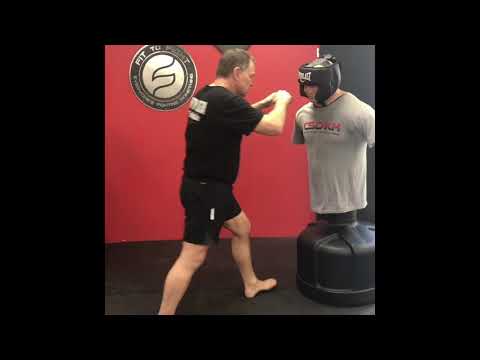
Technique: Stabbing Knees
0
Standard Knee Knot·CAROLINA SELF DEFENSE & KRAV MAGA Cary, NC·Added by Admin
Level 2-3
Перевод: knee knot
The knee knot is a leg entanglement control position originating from sambo where the attacker intertwines their legs around the opponent's trapped leg — placing one leg over the opponent's hip (knee reaping) and wedging the other underneath — creating an extremely tight 'knot' that is nearly impossible to escape. [1] From this position, ankle locks, heel hooks, and toe holds are readily available. The position is banned in IBJJF competition due to the knee reaping involved. [2] Reilly Bodycomb (sambo/BJJ black belt) is one of the practitioners who has taught this position in the context of sambo leglocks for no-gi grappling.
Originates from sambo leglock systems. Brought into modern submission grappling by sambo-trained athletes. Reilly Bodycomb is a notable teacher of the position. [1]
One of the tightest leg entanglement control positions available. Nearly impossible to escape once fully established. [1]
Sambo leglock tradition. Taught in modern context by Reilly Bodycomb and other sambo-trained grapplers.
Used in sambo competition and no-gi submission events. Banned in IBJJF due to knee reaping rules.
Изображений для этой техники пока нет.
Войдите, чтобы предложить изображение.
Level 2-3
Учебных курсов по этой технике пока нет.
Войдите, чтобы предложить курс.
Риск травмы для человека, к которому применяется техника
Extremely dangerous — the submissions accessible from this position (heel hooks, toe holds) can cause catastrophic knee ligament damage with minimal warning
Уровень мастерства, необходимый для надёжного выполнения техники
Разрешена ли техника по основным соревновательным правилам
Sambo Leg Locks for No-Gi Grappling (Bodycomb)
[2] Bodycomb — sambo leglock systems for no-gi
BJJ World — Leg Locks 101: Guide to Positions (bjj-world.com) || Sambo Leg Locks for No-Gi Grappling (Bodycomb, instructional) || Grapplearts — Reilly Bodycomb on Sambo Leglocks
Standard katakana transliteration of Western martial arts terminology (外来語) — used in Japanese MMA, boxing, and BJJ communities
[1] BJJ World — identifies knee knot as one of 5 main leglock control positions
[2] Bodycomb — sambo leglock systems for no-gi
understanding of leg entanglement hierarchy, hip flexibility
hip adductors, hamstrings, core
Yes. Get the knee up as high as you want to stab, then execute the strike from that position. This creates the necessary structure before the actual stabbing motion, rather than trying to generate power from a rising movement.
The stabbing does not come from any kind of rising force. Instead, drive through the target rather than just striking it, and pull your opponent forward simultaneously to create a double impact effect.
As you drive the knee out, pull the target forward to create a double impact. This is especially important since the stabbing knee is typically executed from close range in a clinch position.
The knee knot is a leg entanglement control position originating from sambo where the attacker intertwines their legs around the opponent's trapped leg — placing one leg over the opponent's hip (knee reaping) and wedging the other underneath — creating an extremely tight 'knot' that is nearly impossible to escape. From this position, ankle locks, heel hooks, and toe holds are readily available.
Originates from sambo leglock systems. Brought into modern submission grappling by sambo-trained athletes.
IBJJF: разрешён — Legal — guard is fundamental to BJJ, sweeps from guard score 2 points; IJF: ограничен — Guard pulling penalized as non-combativity — groundwork from guard permitted …; ADCC: разрешён — Legal, guard pull penalized -1 point in points portion; Unified MMA: разрешён — Legal — no penalty for playing guard; FIAS Sport Sambo: разрешён — Legal
Оценка опасности 9/10. Extremely dangerous — the submissions accessible from this position (heel hooks, toe holds) can cause catastrophic knee ligament damage with minimal warning
Стандартная цепочка подготовки: Establish ashi garami control → Cross leg over opponent's hip (knee reap) → Wedge opposite leg underneath → Lock the knot → Attack: heel hook, toe hold, or ankle lock.
Стандартные контрприёмы: Prevent the knee reap from being established — fight the crossing leg / Pummel legs to create inside position / Boot defense — protect the foot from submission grips / Stand up before the knot is locked — base and posture before it's too late.
Распространённые варианты: Standard knee knot (classic sambo configuration); Deep knee knot (deeper intertwining for tighter control); Knee knot to heel hook (primary attack chain); Knee knot to toe hold (secondary attack).
Used in sambo competition and no-gi submission events. Banned in IBJJF due to knee reaping rules.
Основные ошибки, на которые стоит обратить внимание: Not crossing the leg fully over the hip — the reap must be complete for control / Not controlling the opponent's free leg — allows them to create base and escape / Attacking before the knot is secure — position before submission / Not managing the opponent's rotation — must prevent them from turning to escape.
Standard Knee Knot также известен как Nī Notto, Knee Knot, Leg Knot, Game Over Position.