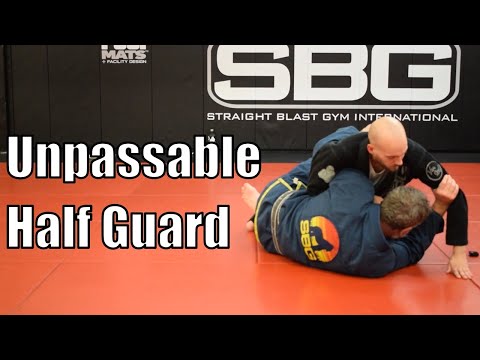
Make Your Half Guard Unpassable
0
Turtle To Half Guard·SBG PDX & Vancouver BJJ and MMA Videos
Try out SBG University for a month for free. Use the code: YOUTUBEFREE https://sbgu.samcart.com/referral/OD1DNOAi/vUiYFZ…
Перевод: turtle to half guard
The Turtle To Half Guard subfamily covers the specific transition from turtle to half guard, where the turtled fighter sits through to one hip while capturing one of the opponent's legs in a half guard. [1] This transition is one of the most common and practical turtle escapes in BJJ because half guard is a strong offensive position with numerous sweep options. [1],[2] The escape involves sitting the hip to the mat on one side while threading the inside leg to hook the opponent's leg, establishing half guard and immediately creating sweep and underhook opportunities. [2],[3]
Turtle to half guard transitions from turtle to half guard by sitting through and inserting the legs. [1]
A fundamental BJJ turtle recovery technique. [1]
Used in BJJ and judo competition. [1]
Изображений для этой техники пока нет.
Войдите, чтобы предложить изображение.
Try out SBG University for a month for free. Use the code: YOUTUBEFREE https://sbgu.samcart.com/referral/OD1DNOAi/vUiYFZ…
Учебных курсов по этой технике пока нет.
Войдите, чтобы предложить курс.
Риск травмы для человека, к которому применяется техника
Turtle escapes involve rolling and granby movements; neck strain risk
Уровень мастерства, необходимый для надёжного выполнения техники
Разрешена ли техника по основным соревновательным правилам
Jiu-Jitsu University (Saulo Ribeiro, 2008)
Alias sources — [1] Jiu-Jitsu University (Saulo Ribeiro, 2008) [2] Brazilian Jiu-Jitsu: Theory and Technique (Renzo Gracie & Royler Gracie, 2001)
Effectiveness sources — [1] Jiu-Jitsu University (Ribeiro, 2008)
Mixed Japanese-Western terminology — combines traditional Japanese terms with katakana loanwords
Alias sources — [1] Jiu-Jitsu University (Saulo Ribeiro, 2008) [2] Brazilian Jiu-Jitsu: Theory and Technique (Renzo Gracie & Royler Gracie, 2001)
Effectiveness sources — [1] Jiu-Jitsu University (Ribeiro, 2008)
timing, hip power, off-balancing skill
strong hips and active legs for sweeping leverage
hip flexors, glutes, quadriceps, core rotators
Каждое движение в любом боевом искусстве обладает рядом универсальных свойств. Комбинируйте параметры ниже, чтобы найти нужный инструмент или сравнить аналоги из разных стилей.
Immediately wrap up underneath with an underhook and try to keep your opponent flat. SBG PDX & Vancouver BJJ emphasizes that getting the underhook back is the most common and effective counter to the wizard position.
Get your hips underneath their hips and roll from your right hip to your left hip using a reverse shrimp or rolling motion. The key is getting underneath your opponent first—this powerful hip movement is what makes the roll effective when they're applying pressure.
Work on getting your underhook and positioning to reach your elbow while looking to take the back, but be prepared to execute a roll immediately if your opponent begins driving into you to flatten the position.
The Turtle To Half Guard subfamily covers the specific transition from turtle to half guard, where the turtled fighter sits through to one hip while capturing one of the opponent's legs in a half guard. This transition is one of the most common and practical turtle escapes in BJJ because half guard is a strong offensive position with numerous sweep options.
The turtle-to-half-guard transition became a standard BJJ escape as half guard play developed into a complete offensive system. With the half guard becoming one of the strongest guard positions, transitioning to it from turtle became a preferred escape route for many competitors.
Unified MMA: разрешён — Legal defensive technique; IBJJF: разрешён — Legal — escapes and sweeps are fundamental to BJJ, sweep from bottom scores 2…; IJF: разрешён — Legal; ADCC: разрешён — Legal, sweep scores 2 points (4 from mount/back); FIAS Sport Sambo: разрешён — Legal; FIAS Combat Sambo: разрешён — Legal
Оценка опасности 3/10. Moderate — turtle escapes involve rolling and granby movements; neck strain risk
Стандартная цепочка подготовки: Create Space → Disrupt Control → Execute Escape → Recover Position.
Стандартные контрприёмы: Maintain Pressure — keep consistent weight distribution to limit escape space / Anticipate Direction — read escape attempt direction and block early / Transition — flow to a new position when the current one is threatened.
Распространённые варианты: Standard sweep (primary off-balancing and reversal technique from the guard); Combination sweep (chaining two sweep directions to catch the opponent's adj…); Counter sweep (sweeping as the opponent initiates a guard pass attempt); Competition sweep (optimised for point-scoring in tournament settings).
Used in BJJ and judo competition.
Основные ошибки, на которые стоит обратить внимание: Sitting through without catching the leg — you end up in bottom side control instead of half guard / Sitting through too slowly — speed is essential; a slow sit-through lets the opponent follow to the back / Not getting the underhook immediately in half guard — half guard without the underhook is a passing position for the … / Turning the wrong direction — sit through in the direction that catches the opponent's nearest leg.
Turtle To Half Guard также известен как Kame kara Hāfu Gādo e, Turtle Half Guard Recovery, Turtle To Half Guard Pull.