How to Escape the Body Triangle
0
Posture Triangle Escape·Shawn Williams BJJ
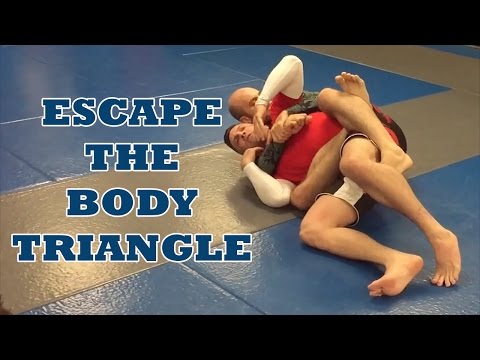
How to escape the body triangle. This video demonstrates how to get out of the body triangle when your opponent has you…
Перевод: posture triangle escape
The Posture Triangle Escape uses postural alignment to relieve the choking pressure of the triangle by straightening the spine, lifting the trapped shoulder, and creating distance between the defender's neck and the attacker's legs. [1] The defender postures up by extending the back, planting the hands on the attacker's hips, and driving the trapped arm's shoulder forward into the triangle gap. [1],[2] Good posture opens the triangle angle, reducing the compression on the carotid arteries and creating space to begin extracting the head. [2],[3]
Posture-based triangle defence is the most fundamental triangle escape, taught as the first response to triangle attacks in all grappling programmes. [1] The emphasis on posture as the primary triangle defence reflects the mechanical reality that the triangle requires the defender's posture to be broken to be effective. [2],[3]
The posture-based triangle escape relies on keeping strong upright posture and stacking before the triangle is fully locked. [1] It is most effective as an early defense — once the attacker has cut the angle and locked the triangle, posture alone is insufficient and additional escape mechanics are needed. [1],[2]
Posture-based triangle defence uses upright posture to prevent the triangle from being locked. [1]
Posture control is the primary triangle defence in competition. [1]
Изображений для этой техники пока нет.
Войдите, чтобы предложить изображение.
How to escape the body triangle. This video demonstrates how to get out of the body triangle when your opponent has you…
Most everyone’s favorite guard submission to catch is also most everyone’s least favorite to get caught with. The triang…
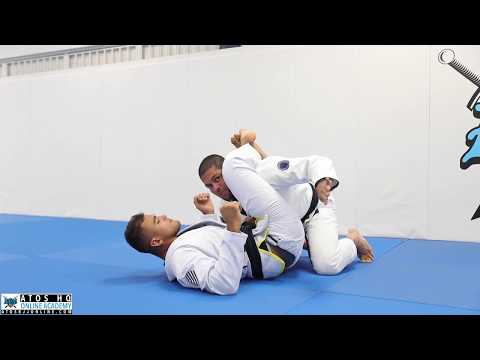
Legend of Jiu-Jitsu Andre Galvao teaches different ways to escape a triangle ttack! Learn from Andre Galvao daily at li…
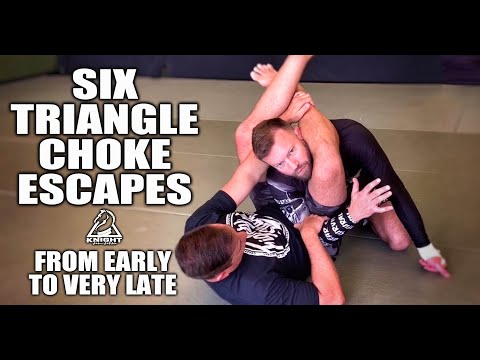
The posture triangle escape emphasizes proactive control and body positioning to prevent or neutralize the triangle choke before it fully locks. Andre Galvao (Atos Jiu-Jitsu HQ) stresses the importance of controlling the opponent's hips immediately upon sensing the triangle threat, using elbow-to-thigh framing and pants gripping to prevent hip adjustment and underhooking. He advocates standing up early with correct leg sequencing—stepping the leg on the same side as the trapped arm first—while maintaining chin-to-chest posture and shoulder-to-ear positioning to protect the neck. When the triangle is already locked, Galvao recommends stepping over with the same-side leg, grabbing one's own shin, and bridging or shimmying to escape. Eli Knight (Knight Jiu-Jitsu) categorizes escapes by timing: early escapes use hip clamps and elbow drives to keep the knees apart and prevent angle closure; middle escapes employ gable grips to pull hips off-angle and create space for knee-elbow combinations; late escapes use chest-through pressure and ankle stapling. Shawn Williams (Shawn Williams BJJ) approaches the related body triangle escape by emphasizing the principle of getting the hip past the opponent's heel through leg kicks, a mechanic applicable across varying opponent leg lengths. All three instructors agree on the criticality of hip control and angle disruption but differ in terminology and specific staging—Galvao focuses on early prevention and frame maintenance, Knight breaks timing into discrete phases with distinct mechanics, and Williams prioritizes the fundamental principle of hip-heel separation.
Сформировано на основе 3 инструкторов
Учебных курсов по этой технике пока нет.
Войдите, чтобы предложить курс.
Риск травмы для человека, к которому применяется техника
Submission escapes carry risk of injury if executed too late; timing-critical
Уровень мастерства, необходимый для надёжного выполнения техники
Разрешена ли техника по основным соревновательным правилам
Jiu-Jitsu University (Saulo Ribeiro, 2008)
Alias sources — [1] Jiu-Jitsu University (Saulo Ribeiro, 2008) [2] Brazilian Jiu-Jitsu: Theory and Technique (Renzo Gracie & Royler Gracie, 2001)
Effectiveness sources — [1] Jiu-Jitsu University (Saulo Ribeiro, 2008) [2] Mastering Jujitsu (Renzo Gracie & John Danaher, 2003)
Mixed Japanese-Western terminology — combines traditional Japanese terms with katakana loanwords
Alias sources — [1] Jiu-Jitsu University (Saulo Ribeiro, 2008) [2] Brazilian Jiu-Jitsu: Theory and Technique (Renzo Gracie & Royler Gracie, 2001)
Effectiveness sources — [1] Jiu-Jitsu University (Saulo Ribeiro, 2008) [2] Mastering Jujitsu (Renzo Gracie & John Danaher, 2003)
grip fighting ability, hip mobility for sliding to the mat, chin defence
strong hands for grip fighting, flexible hips
forearms (grip fighting), core, hip flexors, neck
Andre Galvao emphasizes stepping with the same side leg as your trapped arm—if your right arm is inside, step with your right leg. Escaping to the opposite side either makes it hard for your opponent to lock the triangle or puts their arm in a position to finish an armlock instead.
Andre Galvao recommends putting your chin to your chest and your shoulder toward your ear before your opponent pulls your head down, then control their pants with your free hand and keep your elbow out. Avoid letting them underhook your leg, as this gives them the angle to finish the triangle or transition to an armlock.
Andre Galvao teaches to push your chest away from your opponent's hips to create separation, then stand up on the leg on the same side as your trapped arm while keeping that elbow out and controlling their pants. You can then shimmy and work toward a guard pass once you get your head out.
Shawn Williams emphasizes that the basic escape principle is to get your hip out by creating a gap, which works as an easy escape in theory. However, he notes this doesn't mean you're completely out of danger—you've simply escaped the body lock control.
The Posture Triangle Escape uses postural alignment to relieve the choking pressure of the triangle by straightening the spine, lifting the trapped shoulder, and creating distance between the defender's neck and the attacker's legs. The defender postures up by extending the back, planting the hands on the attacker's hips, and driving the trapped arm's shoulder forward into the triangle gap.
Posture-based triangle defence is the most fundamental triangle escape, taught as the first response to triangle attacks in all grappling programmes. The emphasis on posture as the primary triangle defence reflects the mechanical reality that the triangle requires the defender's posture to be broken to be effective.
Unified MMA: разрешён — Legal defensive/transitional technique; IBJJF: разрешён — Legal; IJF: разрешён — Legal; ADCC: разрешён — Legal; UWW: разрешён — Legal; FIAS Sport Sambo: разрешён — Legal
Оценка опасности 4/10. Moderate — submission escapes carry risk of injury if executed too late; timing-critical
Стандартная цепочка подготовки: Create Space → Disrupt Control → Execute Escape → Recover Position.
Стандартные контрприёмы: Maintain Pressure — keep consistent weight distribution to limit escape space / Anticipate Direction — read escape attempt direction and block early / Transition — flow to a new position when the current one is threatened.
Распространённые варианты: Slide to side (choking-arm side) (fighting hands and sliding hips to the mat on the choking…); Peel-and-turn (stripping the seatbelt grip and turning into the opponent); Trap-arm escape (trapping one arm and rolling to pin the opponent's back); Body triangle escape (addressing the body triangle lock before escaping the hooks).
Posture control is the primary triangle defence in competition.
Основные ошибки, на которые стоит обратить внимание: Posturing with a rounded back — the back must be straight for effective posture / Posturing with extended arms — keep elbows in; extended arms invite armbar transitions / Not driving the hips forward — hip drive is the power source for posture recovery / Posturing and then relaxing — maintain the posture until you've escaped or passed.
Posture Triangle Escape также известен как Shisei Kuzushi Sankaku Nige, Posture Up Triangle Escape, Standing Triangle Defense.