How To Escape The Head & Arm Choke | Submission Grappling Escapes
0
Submission Escape·Knight Jiu-Jitsu
Don't get caught in head and arm chokes...or any submission, for that matter. But, since it is inevitable that you will …
Перевод: submission escape
The Submission Escape group encompasses all techniques for escaping submission attempts — joint locks, chokes, and compression holds — that have been initiated but not yet fully secured. [1] Submission escapes represent the last line of positional defence in grappling; once a fighter is caught in a submission, escape becomes a matter of survival with a narrow window of opportunity. [1],[2] This group covers armbar escapes (stacking, hitchhiker, rolling), choke escapes (guillotine, RNC, triangle), and leglock escapes (ankle lock, heel hook, kneebar), each requiring specific mechanical knowledge and timing to execute safely. [2],[3] The ability to escape submissions is what allows grapplers to compete at the highest levels without being forced to constantly concede via tap-out. [3],[4]
Submission escapes have been developed alongside submission attacks throughout the history of grappling, with every major submission developing corresponding defensive techniques. [1] Judo's katame-waza included escape drills (fusegi) as part of formal training. [2] BJJ dramatically expanded the submission escape curriculum due to its submission-focused competitive format, where matches frequently involve extended submission-escape exchanges. [2],[3] The rise of leglocks in modern no-gi grappling further expanded the escape curriculum to include sophisticated heel hook and kneebar defences. [3],[4]
Submission escape methodology is a core component of BJJ defensive training. [1]
Submission escape ability directly determines competitive survivability in BJJ and MMA. [1]
Изображений для этой техники пока нет.
Войдите, чтобы предложить изображение.
Don't get caught in head and arm chokes...or any submission, for that matter. But, since it is inevitable that you will …
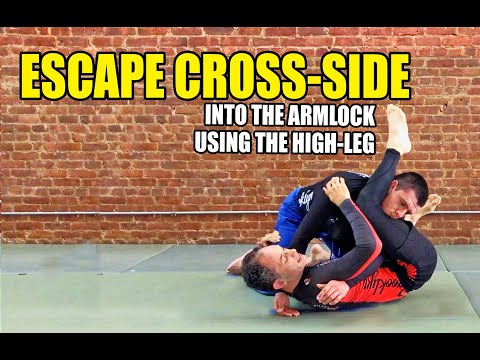
Cross-Side Escape into the Straight Armlock - the high-leg counter to the cross-side involves two jiu-jitsu essentials: …
Учебных курсов по этой технике пока нет.
Войдите, чтобы предложить курс.
Риск травмы для человека, к которому применяется техника
Submission escapes carry risk of injury if executed too late; timing-critical
Уровень мастерства, необходимый для надёжного выполнения техники
Разрешена ли техника по основным соревновательным правилам
Jiu-Jitsu University (Saulo Ribeiro, 2008)
Alias sources — [1] Jiu-Jitsu University (Ribeiro, 2008) [2] Mastering Jujitsu (Gracie & Danaher, 2003) [3] Jiu-Jitsu University (Ribeiro, 2008)
Effectiveness sources — [1] Mastering Jujitsu (Gracie & Danaher, 2003) [2] Jiu-Jitsu University (Ribeiro, 2008)
Standard Japanese martial arts terminology (kanji/hiragana)
Established Japanese martial arts naming convention — native Japanese term (和語/漢語)
Alias sources — [1] Jiu-Jitsu University (Ribeiro, 2008) [2] Mastering Jujitsu (Gracie & Danaher, 2003) [3] Jiu-Jitsu University (Ribeiro, 2008)
Effectiveness sources — [1] Mastering Jujitsu (Gracie & Danaher, 2003) [2] Jiu-Jitsu University (Ribeiro, 2008)
hip mobility, explosive bridge/shrimp power, timing
flexible hips and strong glutes for escape movements
glutes, hip flexors, core, triceps (framing)
Каждое движение в любом боевом искусстве обладает рядом универсальных свойств. Комбинируйте параметры ниже, чтобы найти нужный инструмент или сравнить аналоги из разных стилей.
The Armbar Escape family covers all techniques for escaping the juji-gatame (cross-body armbar) and its variants once the attack has been initiated. [1] The armbar is one of the most common and highest-finishing submissions in grappling and MMA, making armbar escapes among the most trained defensive techniques. [1,2] Armbar escape strategies are categorised by their primary mechanic: stacking (driving forward to compress the attacker), hitchhiker (rotating the arm to relieve the hyperextension angle), and rolling (using rotational momentum to extract the arm). [2,3]
The Choke Escape family covers all techniques for escaping choke and strangulation submissions once they have been initiated. [1] Choke escapes are among the most urgent defensive techniques in grappling because chokes can render a fighter unconscious in seconds, creating a much shorter escape window than joint locks. [1,2] This family covers escapes from the three most common choke categories: guillotine chokes (front headlock strangulations), rear naked chokes (back control strangulations), and triangle chokes (leg-assisted strangulations). [2,3]
The Leglock Escape family covers all techniques for escaping leg-based joint locks and compression holds, including ankle locks, heel hooks, kneebars, and toe holds. [1] Leglock escapes have become one of the most critical defensive skill sets in modern grappling due to the dramatic expansion of leg attack systems in no-gi competition. [1,2] Leglock escapes require specific knowledge because the mechanics of leg attacks differ fundamentally from upper-body submissions — the attacker controls the leg from a distance with their entire body, and improper escape attempts can worsen the position or cause injury. [2,3]
The Side Control Escape family within the Submission Escape group covers techniques for escaping submission attempts that are initiated from the side control position — combining submission defence with positional escape to simultaneously neutralise the submission threat and improve position. [1] When an opponent attacks with americanas, kimuras, arm triangles, or baseball bat chokes from side control, the defender must address both the immediate submission danger and the underlying positional disadvantage. [1,2] These escapes are distinct from pure positional side control escapes because they must neutralise a specific submission grip or angle before positional escape mechanics can be applied — for example, escaping an americana requires first defeating the figure-four grip before hip escaping to guard. [2,3] Understanding these combined submission-and-position escapes is critical because skilled grapplers chain submission attempts with positional control, making it impossible to address one without the other. [3]
Submission escapes are the last line of defense before tapping. Each submission has specific escape mechanics — the armbar requires hand-clasping and stacking, the triangle requires posture and hand-fighting, the RNC requires wrist control before the choke locks. Prevention is always better than escape. (Ribeiro, Jiu-Jitsu University; Danaher, Enter the System)
Knight Jiu-Jitsu teaches a 'hasty tourniquet' technique: wedge your arm into your opponent's elbow crook, clamp down tightly by flexing your lat, and reinforce with your other hand. This buys you time to escape even if the choke is being applied, though it's meant as a temporary defense while you work a more technical escape.
According to Knight Jiu-Jitsu, you need to first clear the knee before attempting to rock up. Push on the opponent's knee twice to dislodge it, fill that space with your own knee, and then proceed with the rocking and backstroke escape sequence.
Brian Glick emphasizes that attacking your opponent's arm during a cross-side escape is one of the best ways to escape any pin or submission, as it often allows you to latch onto their arm with enough control to create real danger before transitioning to your own offense.
Knight Jiu-Jitsu teaches a three-option sequence: first try to sit up and reverse; if that doesn't work, attempt a backward roll; if that fails, turn hard and wedge your arm between your heads to convert it into an easier-to-escape headlock position rather than staying in the arm triangle.
The Submission Escape group encompasses all techniques for escaping submission attempts — joint locks, chokes, and compression holds — that have been initiated but not yet fully secured. Submission escapes represent the last line of positional defence in grappling; once a fighter is caught in a submission, escape becomes a matter of survival with a narrow window of opportunity.
Submission escapes have been developed alongside submission attacks throughout the history of grappling, with every major submission developing corresponding defensive techniques. Judo's katame-waza included escape drills (fusegi) as part of formal training.
Unified MMA: разрешён — Legal defensive/transitional technique; IBJJF: разрешён — Legal; IJF: разрешён — Legal; ADCC: разрешён — Legal; UWW: разрешён — Legal, escape scores 1 point (freestyle), reversal scores 1 point; FIAS Sport Sambo: разрешён — Legal; NCAA Folkstyle: разрешён — Legal, escape scores 1 point, reversal scores 2 points
Оценка опасности 4/10. Moderate — submission escapes carry risk of injury if executed too late; timing-critical
Стандартная цепочка подготовки: Create Space → Disrupt Control → Execute Escape → Recover Position.
Стандартные контрприёмы: Maintain Pressure — keep consistent weight distribution to limit escape space / Anticipate Direction — read escape attempt direction and block early / Transition — flow to a new position when the current one is threatened.
Распространённые варианты: Standard escape (primary escape mechanic using frames, bridges, or hip mov…); Combination escape (chaining two escape directions or methods); Counter escape (using the opponent's attack attempt to create the escape …); Competition variation (modified for rule-set optimisation).
Submission escape ability directly determines competitive survivability in BJJ and MMA.
Основные ошибки, на которые стоит обратить внимание: Waiting until the submission is fully locked before defending — fight early, during the setup phase / Using strength to resist without technique — technical escapes are sustainable; muscling out works once then you're e… / Escaping the submission but remaining in the same bad position — the escape must improve your position / Panicking when caught — panic wastes energy and leads to worse decisions; stay calm and apply the technique you've dr….
Submission Escape также известен как Kime-waza Nige, Submission Defense, Sub Escape, Tap Prevention.