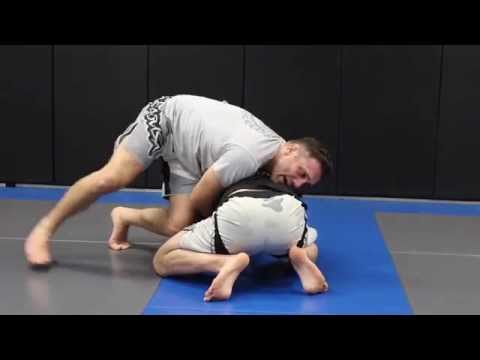
UFC 180 Guillotine Choke Breakdown /Quick Tutorial
0
Posture Guillotine Escape·Shawn Williams BJJ·Added by Admin
The inverted high elbow guillotine choke used by Benitez and front head arm choke used by Ricardo Lamas in UFC 180. The…
Перевод: posture guillotine escape
The Posture Guillotine Escape uses postural adjustment to relieve the choking pressure of the guillotine by extending the spine and lifting the chin line above the attacker's choking arm. [1] The defender drives the hips forward, straightens the back, and lifts the head, which changes the angle of the choke and reduces compression on the carotid arteries. [1],[2] Once posture is established, the defender can work to strip the grip, pass the guard, or disengage entirely. [2],[3]
The posture-based guillotine escape is the most fundamental guillotine defense, relying on posturing up and driving the chin toward the attacker's chest to relieve the choke pressure. [1] It is effective when executed early before the guillotine is fully locked, but becomes less reliable once the attacker has secured a deep grip and closed guard. [1],[2]
The posture escape uses head positioning and stack pressure to relieve guillotine pressure. [1]
Posture-based guillotine defence is the primary escape method in MMA. [1]
Изображений для этой техники пока нет.
Войдите, чтобы предложить изображение.
The inverted high elbow guillotine choke used by Benitez and front head arm choke used by Ricardo Lamas in UFC 180. The…
Учебных курсов по этой технике пока нет.
Войдите, чтобы предложить курс.
Риск травмы для человека, к которому применяется техника
Submission escapes carry risk of injury if executed too late; timing-critical
Уровень мастерства, необходимый для надёжного выполнения техники
Разрешена ли техника по основным соревновательным правилам
Jiu-Jitsu University (Saulo Ribeiro, 2008)
Alias sources — [1] Jiu-Jitsu University (Saulo Ribeiro, 2008) [2] Mastering Jujitsu (Renzo Gracie & John Danaher, 2003)
Effectiveness sources — [1] Jiu-Jitsu University (Saulo Ribeiro, 2008) [2] Mastering Jujitsu (Renzo Gracie & John Danaher, 2003)
Mixed Japanese-Western terminology — combines traditional Japanese terms with katakana loanwords
Alias sources — [1] Jiu-Jitsu University (Saulo Ribeiro, 2008) [2] Mastering Jujitsu (Renzo Gracie & John Danaher, 2003)
Effectiveness sources — [1] Jiu-Jitsu University (Saulo Ribeiro, 2008) [2] Mastering Jujitsu (Renzo Gracie & John Danaher, 2003)
grip fighting ability, hip mobility for sliding to the mat, chin defence
strong hands for grip fighting, flexible hips
forearms (grip fighting), core, hip flexors, neck
According to Shawn Williams, the high elbow position over the trap makes it extremely difficult to counter, and even if your opponent passes your guard on the same side, you're still applying choking pressure. This makes it effective because your opponent can't fully escape the threat even after advancing their position.
Shawn Williams emphasizes that you must yank all the slack out of your arm as you sit down—if you miss this, your opponent's head will pop out. Your hands need to be positioned all the way past the armpit, and your leg should go deep enough to touch your opponent's knee so your hip catches the tricep.
Shawn Williams notes that back control is a great position to hit this attack from because it's hard to see coming and feels subtle to your opponent, allowing the choke to go on rather quickly.
Shawn Williams explains that this version goes on more efficiently without requiring wrist or shoulder flexibility—you simply dive to the side, making it an immediate threat that doesn't depend on creating space for angle adjustments.
The Posture Guillotine Escape uses postural adjustment to relieve the choking pressure of the guillotine by extending the spine and lifting the chin line above the attacker's choking arm. The defender drives the hips forward, straightens the back, and lifts the head, which changes the angle of the choke and reduces compression on the carotid arteries.
Posture-based guillotine escapes represent the most fundamental defensive response to front headlock attacks, taught across all grappling and MMA programmes as the primary guillotine defence. Good posture is universally considered the first line of defence against the guillotine.
Unified MMA: разрешён — Legal defensive/transitional technique; IBJJF: разрешён — Legal; IJF: разрешён — Legal; ADCC: разрешён — Legal; UWW: разрешён — Legal, escape scores 1 point (freestyle), reversal scores 1 point; FIAS Sport Sambo: разрешён — Legal; NCAA Folkstyle: разрешён — Legal, escape scores 1 point, reversal scores 2 points
Оценка опасности 4/10. Moderate — submission escapes carry risk of injury if executed too late; timing-critical
Стандартная цепочка подготовки: Create Space → Disrupt Control → Execute Escape → Recover Position.
Стандартные контрприёмы: Maintain Pressure — keep consistent weight distribution to limit escape space / Anticipate Direction — read escape attempt direction and block early / Transition — flow to a new position when the current one is threatened.
Распространённые варианты: Slide to side (choking-arm side) (fighting hands and sliding hips to the mat on the choking…); Peel-and-turn (stripping the seatbelt grip and turning into the opponent); Trap-arm escape (trapping one arm and rolling to pin the opponent's back); Body triangle escape (addressing the body triangle lock before escaping the hooks).
Posture-based guillotine defence is the primary escape method in MMA.
Основные ошибки, на которые стоит обратить внимание: Posturing straight back instead of up — the head drives toward the ceiling, not backward / Not driving the hips forward — the hips provide the power for the posture recovery / Posturing but not stripping the grip — posture alone is temporary; the grip must be broken / Posturing with a rounded back — the back must be straight for effective posture.
Posture Guillotine Escape также известен как Shisei Kuzushi Girochin Nige, Posture Break Guillotine Defense, Head Pop Escape.