Using the UNDERHOOK to Escape Side Control
0
Underhook Side Control Escape·The Grapple Lab
Using the underhook to escape side control. In this video we look at finding the underhook then how to use it effectivel…
Перевод: underhook side control escape
The Underhook Side Control Escape subfamily covers escapes where the defender establishes an underhook on the near side from bottom side control, then uses the underhook to create a frame and generate the space needed to escape to the knees or recover guard. [1] The underhook from bottom side control provides inside position that allows the defender to drive into the opponent and create upward force, rather than relying solely on hip escaping away. [1],[2] The underhook escape can lead to single-leg takedowns, back takes, or simple positional improvement to the knees. [2],[3]
The underhook escape from side control was developed in BJJ and wrestling as an aggressive escape option that combines defensive escape with offensive positioning. [1] It became increasingly popular as grapplers recognised the value of using the underhook to drive into the opponent rather than away. [2],[3]
The underhook escape from side control secures an underhook and uses it to come up to the knees or take the back. [1]
Underhook escapes combine wrestling underhook principles with BJJ guard recovery. [1]
Used in BJJ and MMA competition. [1]
Изображений для этой техники пока нет.
Войдите, чтобы предложить изображение.
Using the underhook to escape side control. In this video we look at finding the underhook then how to use it effectivel…
To get out of side control, we have to control distance. One way we can do this is to get an underhook, which sets up a …
Учебных курсов по этой технике пока нет.
Войдите, чтобы предложить курс.
Риск травмы для человека, к которому применяется техника
Bottom escapes from mount/side control; bridge and hip escape mechanics (Ribeiro 2008)
Уровень мастерства, необходимый для надёжного выполнения техники
Разрешена ли техника по основным соревновательным правилам
Jiu-Jitsu University (Saulo Ribeiro, 2008)
Alias sources — [1] Jiu-Jitsu University (Saulo Ribeiro, 2008) [2] Wrestling Physical Conditioning Encyclopedia (John Jesse, 1974)
Effectiveness sources — [1] Mastering Jujitsu (Gracie & Danaher, 2003)
Mixed Japanese-Western terminology — combines traditional Japanese terms with katakana loanwords
Alias sources — [1] Jiu-Jitsu University (Saulo Ribeiro, 2008) [2] Wrestling Physical Conditioning Encyclopedia (John Jesse, 1974)
Effectiveness sources — [1] Mastering Jujitsu (Gracie & Danaher, 2003)
hip escape (shrimping) speed, framing strength, timing
flexible hips and quick lateral movement
hip flexors, obliques, triceps (framing), core
Каждое движение в любом боевом искусстве обладает рядом универсальных свойств. Комбинируйте параметры ниже, чтобы найти нужный инструмент или сравнить аналоги из разных стилей.
The Standard Underhook Escape establishes a near-side underhook from bottom side control, then uses the underhook to drive into the opponent while rotating to the knees, escaping the pin. [1] The defender threads the inside arm under the opponent's armpit, secures the underhook, then bridges and drives the underhook shoulder forward while rotating the hips to the knees. [1,2] The escape finishes with the defender on their knees facing the opponent, in a neutral position from which they can wrestle up or re-engage. [2,3]
The Underhook To Single Leg converts the underhook escape from side control into a single-leg takedown attempt, using the underhook to drive into the opponent and then switching the grip to attack one leg. [1] The defender establishes the underhook, drives to the knees, then transitions the underhook hand down to grab the opponent's near leg while maintaining forward pressure. [1,2] This escape exemplifies the grappling principle of transitioning seamlessly from defence to offence. [2,3]
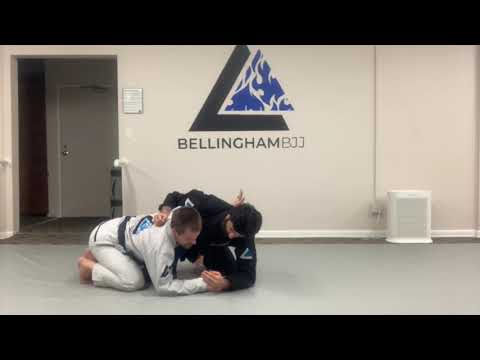
Side control is a dominating position that opponents usually pass through on their way to advance past your guard, making it a critical position to escape from. Additionally, once you develop solid escapes, you'll have more confidence to experiment with techniques you're not yet proficient at, because you know you can get out if your guard gets passed (Bellingham BJJ).
The underhook escape is useful when you can't get your normal frames against your opponent's neck—it gives you an alternative path out when the standard frame-bridge-shrimp-knee-elbow escape isn't possible (Bellingham BJJ).
Your underhook should be like a ramp with your knuckles pointed toward your opponent (not grabbing), and you should frame either against their hip or create distance to generate lifting power (Bellingham BJJ).
Pull your feet to your hips, bridge up to get on your side, then cup your opponent's hip and knee while driving forward to come on top or into a modified double-leg position (Bellingham BJJ).
The Underhook Side Control Escape subfamily covers escapes where the defender establishes an underhook on the near side from bottom side control, then uses the underhook to create a frame and generate the space needed to escape to the knees or recover guard. The underhook from bottom side control provides inside position that allows the defender to drive into the opponent and create upward force, rather than relying solely on hip escaping away.
The underhook escape from side control was developed in BJJ and wrestling as an aggressive escape option that combines defensive escape with offensive positioning. It became increasingly popular as grapplers recognised the value of using the underhook to drive into the opponent rather than away.
Unified MMA: разрешён — Legal defensive/transitional technique; IBJJF: разрешён — Legal; IJF: разрешён — Legal; ADCC: разрешён — Legal; UWW: разрешён — Legal, escape scores 1 point (freestyle), reversal scores 1 point; FIAS Sport Sambo: разрешён — Legal; NCAA Folkstyle: разрешён — Legal, escape scores 1 point, reversal scores 2 points
Оценка опасности 3/10. Moderate — bottom escapes from mount/side control; bridge and hip escape mechanics (Ribeiro 2008)
Стандартная цепочка подготовки: Create Space → Disrupt Control → Execute Escape → Recover Position.
Стандартные контрприёмы: Crossface — drive forearm across the face to prevent the hip escape / Underhook — thread arm under the far shoulder to control upper body rotation / Knee-on-Belly — transition to knee-on-belly to maintain pressure and mobility.
Распространённые варианты: Shrimp to guard (framing and hip-escaping to recover full guard or half guard); Underhook escape (winning the underhook and coming to knees or reversing); Bridge to knees (bridging into the opponent and transitioning to turtle or…); Ghost escape (inverting under the opponent to re-guard from the opposit…).
Used in BJJ and MMA competition.
Основные ошибки, на которые стоит обратить внимание: Attempting the underhook without sufficient space — if the opponent has tight crossface control, create space first w… / Getting the underhook but not turning into the opponent — the underhook must be accompanied by a body turn to be effe… / Reaching the underhook with a straight arm — the underhook should be deep with a bent arm; straight arms are weak / Coming to the knees without the underhook secured — you'll be flattened immediately without inside control.
Underhook Side Control Escape также известен как Andāfukku Yoko-shiho Nige, Underhook Escape, Inside Position Escape.