Kesa Gatame Escape - The Basics
0
Kesa Gatame Escape·The Grappling Academy
SALE SALE SALE OVER 50% OFF – BOX SET – ALL 4 COURSES 50% OFF CLICK HERE – https://bit.ly/2lAOHmp • The Blue Belt Sup…
Перевод: kesa gatame escape
The Kesa Gatame Escape family covers techniques for escaping the kesa gatame (scarf hold) position, where the opponent controls from the side with one arm wrapped around the defender's head and the other controlling the near arm. [1] Kesa gatame escapes must address the headlock control that distinguishes this position from standard side control — the wrapped head limits the defender's ability to turn and creates compression on the neck. [1],[2] Primary escape methods include bridging and rolling toward the opponent, and threading the leg over the opponent's head to create a reversal. [2],[3]
Kesa gatame escapes are critical because the scarf hold is one of the most oppressive pins in grappling, especially when applied by a larger opponent. [1] The position can generate enormous chest compression, making it both a control position and a potential submission. [2] Effective escapes require creating space by bridging toward the opponent's back and working to free the trapped arm. [1]
Kesa gatame escapes are essential in judo competition to avoid pin (osaekomi) losses. [1]
Изображений для этой техники пока нет.
Войдите, чтобы предложить изображение.
SALE SALE SALE OVER 50% OFF – BOX SET – ALL 4 COURSES 50% OFF CLICK HERE – https://bit.ly/2lAOHmp • The Blue Belt Sup…
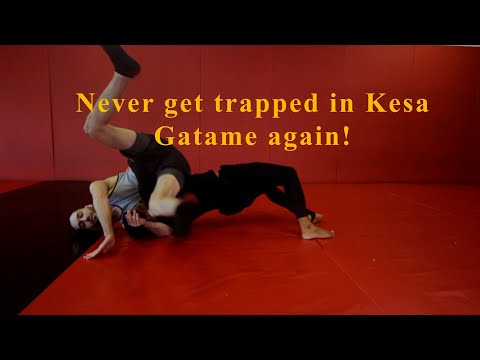
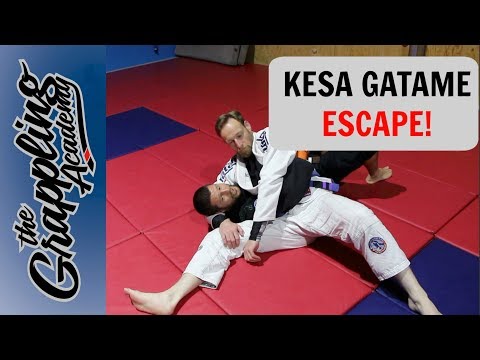
In Todays video we had a request to show what to do when you get stuck in Kesa Gatame. Coach Dom breaks down the escape …
Учебных курсов по этой технике пока нет.
Войдите, чтобы предложить курс.
Риск травмы для человека, к которому применяется техника
Bottom escapes from mount/side control; bridge and hip escape mechanics (Ribeiro 2008)
Уровень мастерства, необходимый для надёжного выполнения техники
Разрешена ли техника по основным соревновательным правилам
Jiu-Jitsu University (Saulo Ribeiro, 2008)
Alias sources — [1] Kodokan Judo (Kano, 1986) [2] Jiu-Jitsu University (Ribeiro, 2008)
Effectiveness sources — [1] Jiu-Jitsu University (Saulo Ribeiro, 2008) [2] Kodokan Judo (Jigoro Kano, 1986)
Standard Japanese martial arts terminology (kanji/hiragana)
Established Japanese martial arts naming convention — native Japanese term (和語/漢語)
Alias sources — [1] Kodokan Judo (Kano, 1986) [2] Jiu-Jitsu University (Ribeiro, 2008)
Effectiveness sources — [1] Jiu-Jitsu University (Saulo Ribeiro, 2008) [2] Kodokan Judo (Jigoro Kano, 1986)
hip escape (shrimping) speed, framing strength, timing
flexible hips and quick lateral movement
hip flexors, obliques, triceps (framing), core
Каждое движение в любом боевом искусстве обладает рядом универсальных свойств. Комбинируйте параметры ниже, чтобы найти нужный инструмент или сравнить аналоги из разных стилей.
The Bridge And Roll Kesa subfamily covers the escape from kesa gatame where the defender bridges explosively toward the opponent and rolls them over, using the opponent's headlock grip against them by converting it into a pivot point for the roll. [1] The bridge must be directed toward the opponent's head side, as this is the direction where the kesa gatame is weakest — the opponent's arm around the head creates an unstable base on that side. [1,2] The roll converts the defensive position into a top position as the opponent is rolled onto their back with the defender ending up in their guard or mount. [2,3]
The Leg Over Kesa Escape subfamily covers the kesa gatame escape where the defender threads the far leg over the opponent's head, using the leg as a lever to pry the opponent off and create a reversal or submission opportunity. [1] The leg-over escape exploits the fact that in kesa gatame, the opponent's head is typically positioned low and forward, within range of the defender's far leg. [1,2] By hooking the leg over the head and pulling back, the defender can force the opponent backward into an armbar or triangle-like position. [2,3]
Kesa gatame escapes are among the most critical skills in judo groundwork — the scarf hold is one of the tightest pins and requires specific escape mechanics (bridge toward the opponent's head, create space at the hip, then re-guard or take the back). (Kano, Kodokan Judo; Ribeiro, Jiu-Jitsu University)
The Grappling Academy teaches that you should first try to turn towards your opponent and rip your trapped arm out. Once you get the arm free, you then put your foot in to create space for the escape.
If you let your arm float, your opponent will push it down and can lock you into an Americana position, which becomes nearly impossible to escape unless you have exceptional strength. The Grappling Academy emphasizes keeping your arm controlled to avoid this predicament.
You need to run your hips underneath your opponent's butt, even if it takes you a full minute to get your feet under them. This hip positioning is essential to complete the escape.
Gracie Bradenton teaches that if your opponent has isolated your arm and is starting an Americana, you can use the hitchhiker escape, which is nearly identical to hitchhiking out of an armbar.
The Kesa Gatame Escape family covers techniques for escaping the kesa gatame (scarf hold) position, where the opponent controls from the side with one arm wrapped around the defender's head and the other controlling the near arm. Kesa gatame escapes must address the headlock control that distinguishes this position from standard side control — the wrapped head limits the defender's ability to turn and creates compression on the neck.
Kesa gatame escapes were developed in judo alongside the scarf hold itself, which is one of judo's fundamental pinning techniques (osaekomi-waza). BJJ adapted and expanded judo's kesa gatame escape techniques for no-gi and MMA contexts.
Unified MMA: разрешён — Legal defensive/transitional technique; IBJJF: разрешён — Legal; IJF: разрешён — Legal; ADCC: разрешён — Legal; UWW: разрешён — Legal; FIAS Sport Sambo: разрешён — Legal
Оценка опасности 3/10. Moderate — bottom escapes from mount/side control; bridge and hip escape mechanics (Ribeiro 2008)
Стандартная цепочка подготовки: Create Space → Disrupt Control → Execute Escape → Recover Position.
Стандартные контрприёмы: Maintain Pressure — keep consistent weight distribution to limit escape space / Anticipate Direction — read escape attempt direction and block early / Transition — flow to a new position when the current one is threatened.
Распространённые варианты: Shrimp to guard (framing and hip-escaping to recover full guard or half guard); Underhook escape (winning the underhook and coming to knees or reversing); Bridge to knees (bridging into the opponent and transitioning to turtle or…); Ghost escape (inverting under the opponent to re-guard from the opposit…).
Kesa gatame escapes are essential in judo competition to avoid pin (osaekomi) losses.
Основные ошибки, на которые стоит обратить внимание: Bridging away from the opponent — bridge toward them or toward their back; bridging away is ineffective against kesa / Trying to push the opponent off with your free hand — the opponent's weight distribution makes pushing insufficient / Lying flat without bridging — constant bridging movement is necessary to create escape opportunities / Not addressing the trapped arm — the arm must be freed or used as a lever for most kesa escapes.
Kesa Gatame Escape также известен как Kesa-gatame Nige, Scarf Hold Escape, Head And Arm Side Control Escape.