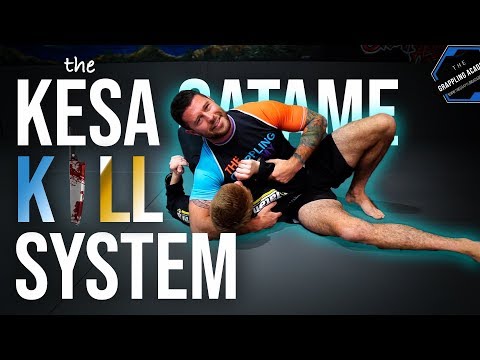
The Kesa Gatame Kill System
0
Leg Over Kesa Escape·The Grappling Academy
Control, pin and submit your partners with this versatile grappling position! SALE SALE SALE OVER 50% OFF – BOX SET – …
Перевод: leg over kesa escape
The Leg Over Kesa Escape subfamily covers the kesa gatame escape where the defender threads the far leg over the opponent's head, using the leg as a lever to pry the opponent off and create a reversal or submission opportunity. [1] The leg-over escape exploits the fact that in kesa gatame, the opponent's head is typically positioned low and forward, within range of the defender's far leg. [1],[2] By hooking the leg over the head and pulling back, the defender can force the opponent backward into an armbar or triangle-like position. [2],[3]
The leg over kesa escape brings the far leg over the opponent's head to break the pin and create an armbar opportunity. [1]
A classical kesa gatame escape found in judo and BJJ. [1]
Used in judo and BJJ competition. [1]
Изображений для этой техники пока нет.
Войдите, чтобы предложить изображение.
Control, pin and submit your partners with this versatile grappling position! SALE SALE SALE OVER 50% OFF – BOX SET – …
Учебных курсов по этой технике пока нет.
Войдите, чтобы предложить курс.
Риск травмы для человека, к которому применяется техника
Bottom escapes from mount/side control; bridge and hip escape mechanics (Ribeiro 2008)
Уровень мастерства, необходимый для надёжного выполнения техники
Разрешена ли техника по основным соревновательным правилам
Jiu-Jitsu University (Saulo Ribeiro, 2008)
Alias sources — [1] Kodokan Judo (Jigoro Kano, 1986) [2] Jiu-Jitsu University (Saulo Ribeiro, 2008) [3] Judo Formal Techniques (Tadao Otaki & Donn Draeger, 1983)
Effectiveness sources — [1] Kodokan Judo (Kano, 1986)
Standard Japanese martial arts terminology (kanji/hiragana)
Established Japanese martial arts naming convention — native Japanese term (和語/漢語)
Alias sources — [1] Kodokan Judo (Jigoro Kano, 1986) [2] Jiu-Jitsu University (Saulo Ribeiro, 2008) [3] Judo Formal Techniques (Tadao Otaki & Donn Draeger, 1983)
Effectiveness sources — [1] Kodokan Judo (Kano, 1986)
hip escape (shrimping) speed, framing strength, timing
flexible hips and quick lateral movement
hip flexors, obliques, triceps (framing), core
Каждое движение в любом боевом искусстве обладает рядом универсальных свойств. Комбинируйте параметры ниже, чтобы найти нужный инструмент или сравнить аналоги из разных стилей.
You must pull up on your opponent's head before bridging—never bridge without this step. The Grappling Academy emphasizes this is critical to avoid giving them an escape opportunity.
No, you should crunch instead of bench pressing. The Grappling Academy teaches that while you're targeting their rotator cuff, crunching is the proper pressure application since they're fighting for their life.
Get an underhook on your opponent, which is advantageous for maintaining control. The Grappling Academy notes that securing this underhook with proper hand placement is an important part of headlock control.
If they clasp their hands together, they can walk their hips and throw you over. The Grappling Academy demonstrates that preventing this problem is important when setting up your attacks from the position.
The Leg Over Kesa Escape subfamily covers the kesa gatame escape where the defender threads the far leg over the opponent's head, using the leg as a lever to pry the opponent off and create a reversal or submission opportunity. The leg-over escape exploits the fact that in kesa gatame, the opponent's head is typically positioned low and forward, within range of the defender's far leg.
The leg-over kesa escape has been taught in judo and BJJ as an alternative to the bridge and roll, particularly effective when the opponent maintains a strong base that prevents the rolling escape. It is valued for its ability to convert directly into offensive submissions.
Unified MMA: разрешён — Legal defensive/transitional technique; IBJJF: разрешён — Legal; IJF: разрешён — Legal; ADCC: разрешён — Legal; UWW: разрешён — Legal; FIAS Sport Sambo: разрешён — Legal
Оценка опасности 3/10. Moderate — bottom escapes from mount/side control; bridge and hip escape mechanics (Ribeiro 2008)
Стандартная цепочка подготовки: Create Space → Disrupt Control → Execute Escape → Recover Position.
Стандартные контрприёмы: Maintain Pressure — keep consistent weight distribution to limit escape space / Anticipate Direction — read escape attempt direction and block early / Transition — flow to a new position when the current one is threatened.
Распространённые варианты: Shrimp to guard (framing and hip-escaping to recover full guard or half guard); Underhook escape (winning the underhook and coming to knees or reversing); Bridge to knees (bridging into the opponent and transitioning to turtle or…); Ghost escape (inverting under the opponent to re-guard from the opposit…).
Used in judo and BJJ competition.
Основные ошибки, на которые стоит обратить внимание: Not walking the hips close enough to the opponent's head — the leg can't reach if the hips are too far / Throwing the leg over without hip movement first — the hip walk is the setup; the leg-over is the finish / Putting the leg over the opponent's face without applying downward pressure — the leg must push their head to create … / Not transitioning after getting the leg over — the position offers triangle, armbar, and back-take opportunities.
Leg Over Kesa Escape также известен как Ashi-goe Kesa Nige, Leg Over Head Escape, Kesa Gatame Leg Reversal, Step Over Kesa Escape.