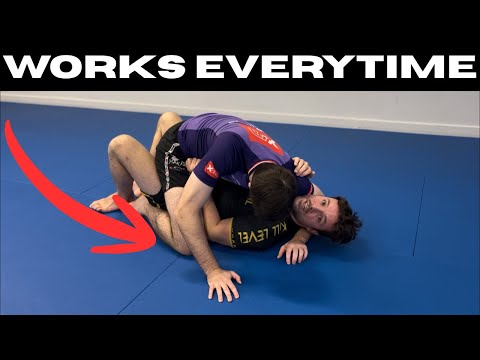
How I Escape EVERYONES Mount
0
Shoulder Walk Escape·CrashAndFlowBJJ
Escaping mount in jiu jitsu doesn’t have to feel impossible. In this video, I break down the exact method I use to escap…
Перевод: shoulder walk escape
The Shoulder Walk Escape subfamily covers back escape techniques where the defender walks the shoulders along the mat, sliding downward and out of the attacker's back control by incrementally shifting the upper body. [1] The shoulder walk uses small, alternating shoulder movements to progressively slide the defender's body downward, eventually allowing them to slip below the attacker's hooks and escape. [1],[2] The shoulder walk is particularly effective because it requires minimal explosive movement and can be performed even under heavy back control. [2],[3]
The shoulder walk escape uses shoulder-walking motion to slide out from back control toward the opponent's legs. [1]
Shoulder walking was adapted from wrestling ground escape methods into BJJ back escape technique. [1]
Used in BJJ and MMA competition. [1]
Изображений для этой техники пока нет.
Войдите, чтобы предложить изображение.
Escaping mount in jiu jitsu doesn’t have to feel impossible. In this video, I break down the exact method I use to escap…
Учебных курсов по этой технике пока нет.
Войдите, чтобы предложить курс.
Риск травмы для человека, к которому применяется техника
Back escapes must address choke threat while escaping; urgency increases injury risk
Уровень мастерства, необходимый для надёжного выполнения техники
Разрешена ли техника по основным соревновательным правилам
Jiu-Jitsu University (Saulo Ribeiro, 2008)
Alias sources — [1] Jiu-Jitsu University (Saulo Ribeiro, 2008) [2] Back Attacks: Enter the System (John Danaher, 2018) [3] Mastering Jujitsu (Renzo Gracie & John Danaher, 2003)
Effectiveness sources — [1] Jiu-Jitsu University (Ribeiro, 2008)
Standard katakana transliteration of Western martial arts terminology (外来語) — used in Japanese MMA, boxing, and BJJ communities
Alias sources — [1] Jiu-Jitsu University (Saulo Ribeiro, 2008) [2] Back Attacks: Enter the System (John Danaher, 2018) [3] Mastering Jujitsu (Renzo Gracie & John Danaher, 2003)
Effectiveness sources — [1] Jiu-Jitsu University (Ribeiro, 2008)
explosive hip bridge power, shrimping ability, timing
strong glutes and hip extensors for powerful bridges
glutes, hip extensors, core, quadriceps
Каждое движение в любом боевом искусстве обладает рядом универсальных свойств. Комбинируйте параметры ниже, чтобы найти нужный инструмент или сравнить аналоги из разных стилей.
The Short Shoulder Walk uses quick, short alternating shoulder slides to make incremental progress downward out of back control, prioritising speed of each individual shoulder shift over distance covered. [1] The short shoulder walk creates a rhythm of rapid micro-adjustments that are difficult for the attacker to counter because each movement is too small to react to individually, but the cumulative effect gradually extracts the defender from the control position. [1,2] This variation is preferred when the attacker maintains very tight control and large movements are not possible. [2,3]
The Standard Shoulder Walk alternates pressing each shoulder into the mat and sliding the body downward, using the shoulder as a pivot point while the hips shift incrementally toward the escape direction. [1] The defender presses one shoulder into the mat, shifts the hips down, then switches to the other shoulder and shifts again, creating a walking motion that gradually extracts them from the back control. [1,2] Throughout the shoulder walk, the defender maintains hand fighting defence against the choke and works to clear the bottom hook as the hips descend. [2,3]
According to CrashAndFlowBJJ, keeping your head centered prevents your opponent from cross-facing you, which allows your spine to maintain the flexion and curvature needed to execute mount escapes effectively. When you're heavily cross-faced, you lose spinal mobility and your escape options become much more limited.
CrashAndFlowBJJ advises keeping your hand across your opponent's hips to maintain your hip post, which prevents them from using the underhook to control your movement during the escape.
CrashAndFlowBJJ breaks it down as: first, get your inside position with elbows inside and hip post; second, displace your opponent; third, create a concave body shape with knee-to-thigh connection to set up your finish.
CrashAndFlowBJJ recommends learning kips by displacing your opponent to the side rather than attempting overhead kips, as side kips are significantly easier to learn and execute properly.
The Shoulder Walk Escape subfamily covers back escape techniques where the defender walks the shoulders along the mat, sliding downward and out of the attacker's back control by incrementally shifting the upper body. The shoulder walk uses small, alternating shoulder movements to progressively slide the defender's body downward, eventually allowing them to slip below the attacker's hooks and escape.
The shoulder walk escape was developed in BJJ as a methodical back escape for situations where explosive movement is not possible or advisable. Its incremental approach makes it effective even against skilled back control specialists.
Unified MMA: разрешён — Legal defensive/transitional technique; IBJJF: разрешён — Legal; IJF: разрешён — Legal; ADCC: разрешён — Legal; UWW: разрешён — Legal; FIAS Sport Sambo: разрешён — Legal
Оценка опасности 4/10. Moderate — back escapes must address choke threat while escaping; urgency increases injury risk
Стандартная цепочка подготовки: Create Space → Disrupt Control → Execute Escape → Recover Position.
Стандартные контрприёмы: Maintain Pressure — keep consistent weight distribution to limit escape space / Anticipate Direction — read escape attempt direction and block early / Transition — flow to a new position when the current one is threatened.
Распространённые варианты: Bridge and roll (upa) (explosive bridge trapping arm and leg to reverse position); Elbow-knee escape (framing and shrimping to recover guard); Foot drag escape (dragging the opponent's foot with the heel to create spac…); Combination escape (bridging to force a reaction, then shrimping when the opp…).
Used in BJJ and MMA competition.
Основные ошибки, на которые стоит обратить внимание: Walking the shoulders away from the bottom hook — always walk toward the hook you want to clear / Walking too fast and becoming predictable — vary the rhythm of the walks to prevent the opponent from adjusting / Not combining the shoulder walk with hand fighting — the walks alone don't escape; they create the conditions for escape / Expecting the escape to work in 2-3 walks — patience is required; it may take 10-15 walks.
Shoulder Walk Escape также известен как Shorudā Wōku Esukēpu, Shoulder Scoot, Walking Escape, Shoulder Slide Escape.