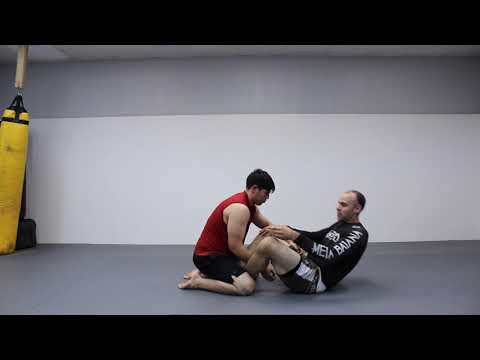
The importance of leg pummeling
0
Standard Leg Pummeling·Mastermind Martial Arts·Added by Admin
In this video, Daniel Pollaccia of Mastermind Martial Arts explains how to develop leg pummeling. Efficient leg pummeli…
Перевод: standard leg pummeling
Standard Leg Pummeling uses the free leg to swim inside or outside the opponent's controlling hooks, systematically clearing entanglements while maintaining boot defence on the endangered foot. [1] The defender uses hip movement and knee positioning to create space between the entangled legs, then threads the free leg through to clear the opponent's hooks. [1],[2] Standard leg pummelling follows a priority system: first protect the foot (boot), then clear the outside hook, then clear the inside hook, then extract the leg entirely. [2],[3]
Leg pummeling is the primary method of freeing the legs from an opponent's entanglement during leglock exchanges, using a swimming motion with the legs to extract the trapped limb and re-establish a safe position. [1] Effective leg pummeling can neutralise even deeply established leglock entries by freeing the targeted leg before the submission can be finished. [2]
Leg pummeling as a formal defensive skill was developed primarily within the modern leglock systems of John Danaher, Dean Lister, and Eddie Cummings, who systematised leg entanglements and their corresponding escapes. [1]
Leg pummeling is a critical leg lock defence skill. [1]
Изображений для этой техники пока нет.
Войдите, чтобы предложить изображение.
In this video, Daniel Pollaccia of Mastermind Martial Arts explains how to develop leg pummeling. Efficient leg pummeli…
Учебных курсов по этой технике пока нет.
Войдите, чтобы предложить курс.
Риск травмы для человека, к которому применяется техника
Submission defence involves resisting joint locks/chokes; risk of injury if defence fails or is delayed
Уровень мастерства, необходимый для надёжного выполнения техники
Разрешена ли техника по основным соревновательным правилам
Jiu-Jitsu University (Saulo Ribeiro, 2008)
Alias sources — [1] Jiu-Jitsu University (Ribeiro, 2008) [2] Fundamentals of Brazilian Jiu-Jitsu (Danaher, 2012) [3] Brazilian Jiu-Jitsu: Theory and Technique (Gracie, 2001)
Effectiveness sources — [1] Fundamentals of Brazilian Jiu-Jitsu (Danaher, 2012) [2] Jiu-Jitsu University (Ribeiro, 2008)
Standard katakana transliteration of Western martial arts terminology (外来語) — used in Japanese MMA, boxing, and BJJ communities
Alias sources — [1] Jiu-Jitsu University (Ribeiro, 2008) [2] Fundamentals of Brazilian Jiu-Jitsu (Danaher, 2012) [3] Brazilian Jiu-Jitsu: Theory and Technique (Gracie, 2001)
Effectiveness sources — [1] Fundamentals of Brazilian Jiu-Jitsu (Danaher, 2012) [2] Jiu-Jitsu University (Ribeiro, 2008)
reaction speed, structural body mechanics, defensive awareness
quick reflexes and conditioned defensive surfaces
varies — forearms (blocking), legs (movement), core (stability)
When your opponent gets their double unders, lift your hips up and pummel your legs in and out to create space and slow them down. Then hip escape out while pummeling to transition into butterfly guard with an arm trap, putting you in a strong defensive and offensive position.
Leg pummeling allows you to transition from pure defense into offense by creating space against passing attempts and positioning yourself in advantageous guards like butterfly guard, rather than getting crushed or passed.
No—leg pummeling is an important technique that many grapplers overlook, even though it's fundamental to grappling defense and wrestlers are already familiar with pummeling in the standing position.
Standard Leg Pummeling uses the free leg to swim inside or outside the opponent's controlling hooks, systematically clearing entanglements while maintaining boot defence on the endangered foot. The defender uses hip movement and knee positioning to create space between the entangled legs, then threads the free leg through to clear the opponent's hooks.
Standard leg pummelling was codified as a defensive technique through the modern leg lock era, developed as the systematic response to sophisticated leg entanglement attacks. It is now a standard component of advanced grappling defence training.
Unified MMA: разрешён — Legal defensive technique; IBJJF: разрешён — Legal — defensive techniques are fundamental to grappling; IJF: разрешён — Legal defensive action; ADCC: разрешён — Legal; UWW: разрешён — Legal defensive technique; FIAS Sport Sambo: разрешён — Legal
Оценка опасности 3/10. Moderate — submission defence involves resisting joint locks/chokes; risk of injury if defence fails or is delayed
Стандартная цепочка подготовки: Anticipate the Attack → Execute Defence → Recover Stance → Counter or Disengage.
Стандартные контрприёмы: Timing — attack when the defence is recovering or between movements / Feint — use deception to create openings in the defensive structure / Angle Change — attack from an unexpected angle that the defence does not cover.
Распространённые варианты: Standard defence (primary defensive technique from the most common position); Reactive defence (triggered by the opponent's attack, minimal movement for …); Proactive defence (anticipating the attack and positioning to neutralise it …); Counter defence (using the defensive movement to create an immediate count…).
Leg pummeling is a critical leg lock defence skill.
Основные ошибки, на которые стоит обратить внимание: Threading the knee too high (over the opponent's hip) — the knee should go between their thighs, not over them / Not hooking with the heel after achieving inside knee position — the heel hook maintains your inside position / Using the leg pummel as a static position — pummelling is active and continuous until you escape / Pummelling with a straight leg — the knee must bend to thread inside; a straight leg can't swim.
Standard Leg Pummeling также известен как Sutandādo Reggu Pameringu, Basic Leg Pummel, Standard Leg Pummeling, Inside Leg Pummel.