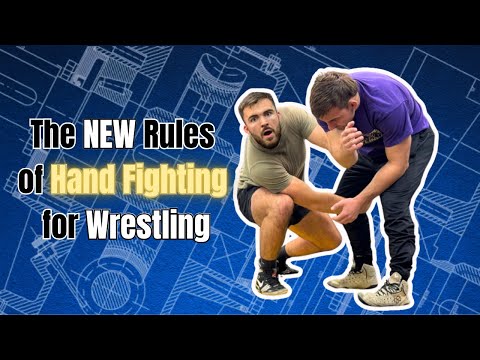
The Hand Fighting Blueprint Every Wrestler Needs | Wrestling Fundamentals: Techniques for Beginners
If you can’t win the hand fight, you’ll never win the match. In this video, I break down hand fighting in wrestling — ho…
Перевод: standard hand fighting
Standard Hand Fighting defence against chokes involves using both hands to control the opponent's choking hand — typically gripping the wrist and pulling it away from the neck while simultaneously blocking the secondary hand from completing the choke. [1] The priority hand to fight depends on the choke being applied: for the rear naked choke, the choking arm must be prevented from threading under the chin; for collar chokes, the cross-collar grip must be stripped. [1],[2] Standard hand fighting maintains constant two-on-one control of the more dangerous choking hand while monitoring the secondary hand. [2],[3]
Hand fighting is the primary defence against choke attempts from back control, as controlling the opponent's hands prevents them from establishing the choking grip. [1] The '2-on-1' principle — using both hands to control one of the attacker's hands — is the most effective hand-fighting method because it creates a numerical advantage on the choking arm. [2]
Hand fighting from back defence is a core BJJ defensive concept, detailed extensively by Saulo Ribeiro and by John Danaher's back escape systematic approach. [1]
Hand fighting is fundamental in grappling defence. [1]
Изображений для этой техники пока нет.
Войдите, чтобы предложить изображение.
Учебных курсов по этой технике пока нет.
Войдите, чтобы предложить курс.
Риск травмы для человека, к которому применяется техника
Submission defence involves resisting joint locks/chokes; risk of injury if defence fails or is delayed
Уровень мастерства, необходимый для надёжного выполнения техники
Разрешена ли техника по основным соревновательным правилам
Karate-Do Kyohan: The Master Text (Gichin Funakoshi, 1935)
Alias sources — [1] Jiu-Jitsu University (Ribeiro, 2008) [2] Fundamentals of Brazilian Jiu-Jitsu (Danaher, 2012) [3] Brazilian Jiu-Jitsu: Theory and Technique (Gracie, 2001)
Effectiveness sources — [1] Jiu-Jitsu University (Ribeiro, 2008) [2] Fundamentals of Brazilian Jiu-Jitsu (Danaher, 2012)
Standard katakana transliteration of Western martial arts terminology (外来語) — used in Japanese MMA, boxing, and BJJ communities
Alias sources — [1] Jiu-Jitsu University (Ribeiro, 2008) [2] Fundamentals of Brazilian Jiu-Jitsu (Danaher, 2012) [3] Brazilian Jiu-Jitsu: Theory and Technique (Gracie, 2001)
Effectiveness sources — [1] Jiu-Jitsu University (Ribeiro, 2008) [2] Fundamentals of Brazilian Jiu-Jitsu (Danaher, 2012)
forearm conditioning, reaction speed, structural stability
dense bone structure, strong forearms
forearm flexors/extensors, deltoids, biceps, core (absorbing impact)
The two primary ties you need to learn to clear are the collar tie and the underhook, as your opponent will be trying to establish these same controls on you to dominate position.
Spend the first three days drilling about 25 reps of collar tie clears focusing on precision over speed, then dedicate the next two days to underhook clears in isolation, and take the weekend off to let your body reset.
Two key proactive entries are the circle and snap—where you circle your opponent and snap their head hard—and going underneath the arms to take the back after defending and capturing the head.
Standard Hand Fighting defence against chokes involves using both hands to control the opponent's choking hand — typically gripping the wrist and pulling it away from the neck while simultaneously blocking the secondary hand from completing the choke. The priority hand to fight depends on the choke being applied: for the rear naked choke, the choking arm must be prevented from threading under the chin; for collar chokes, the cross-collar grip must be stripped.
Standard hand fighting for choke defence has been taught in grappling arts throughout their history, refined through competitive BJJ and MMA into systematic approaches for each choke variant. It is considered the most important active choke defence skill in modern grappling.
Unified MMA: разрешён — Legal defensive technique; IBJJF: разрешён — Legal — defensive techniques are fundamental to grappling; IJF: разрешён — Legal defensive action; ADCC: разрешён — Legal; UWW: разрешён — Legal defensive technique; FIAS Sport Sambo: разрешён — Legal
Оценка опасности 3/10. Moderate — submission defence involves resisting joint locks/chokes; risk of injury if defence fails or is delayed
Стандартная цепочка подготовки: Anticipate the Attack → Execute Defence → Recover Stance → Counter or Disengage.
Стандартные контрприёмы: Timing — attack when the defence is recovering or between movements / Feint — use deception to create openings in the defensive structure / Angle Change — attack from an unexpected angle that the defence does not cover.
Распространённые варианты: High block (forearm raised above the head to protect against overhead…); Low block (forearm driven downward to deflect kicks or body strikes); Cross block (forearm crosses the body to protect the opposite side); Double forearm block (both forearms together for maximum coverage).
Hand fighting is fundamental in grappling defence.
Основные ошибки, на которые стоит обратить внимание: Always fighting with the same hand on top — you must be able to fight with either hand in the dominant position / Controlling the opponent's hand too far from your neck — keep the fight close; controlling their hand at full arm ext… / Not recognizing when the opponent switches the choking hand — late recognition means late defence / Grip fighting without urgency — choke defence is time-critical; every second of inaction is dangerous.
Standard Hand Fighting также известен как Sutandādo Hando Faitingu, Basic Hand Fight, Standard Grip Strip, Two-On-One Hand Fight.