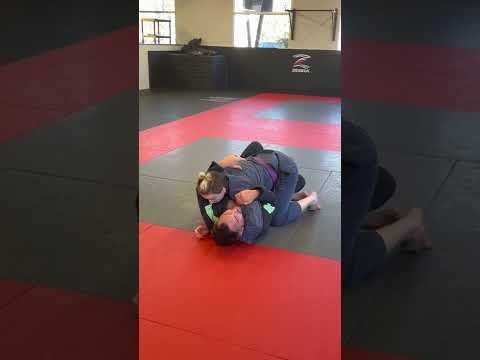
Half Guard frame recovery details
0
Standard Half Guard Recovery·The Base Jiu Jitsu·Added by Admin
Перевод: standard half guard recovery
The Standard Half Guard Recovery executes the fundamental technique of catching one of the opponent's legs with both legs during a guard pass, typically by threading the inside leg between the opponent's legs and locking the ankles or using a knee shield to prevent the opponent from completing the pass. [1] The recovery involves turning onto one hip, framing to create momentary space, and threading the bottom leg around the opponent's near leg while the top leg locks down as a secondary hook. [1],[2] Once half guard is established, the defender immediately works to establish an underhook on the near side to prevent being flattened. [2],[3]
Half guard recovery is a critical defensive skill because half guard frequently occurs as a last line of defence before an opponent completes a guard pass. [1] Roberto 'Gordo' Correa's development of an offensive half guard system demonstrated that the half guard could be more than just a recovery point — it could be a primary fighting position. [2]
The half guard evolved from a transitional, undesirable position into a full fighting system largely through the work of Roberto 'Gordo' Correa in the 1990s, who developed the position after a knee injury forced him to fight primarily from half guard. [1] The system was further developed by competitors like Lucas Leite and Bernardo Faria. [2]
Bernardo Faria won 5 IBJJF World Championship gold medals using a half guard-centric game, demonstrating the position's viability at the highest competitive level. [1]
Изображений для этой техники пока нет.
Войдите, чтобы предложить изображение.
Учебных курсов по этой технике пока нет.
Войдите, чтобы предложить курс.
Риск травмы для человека, к которому применяется техника
Guard retention uses frames and hip movement; minimal direct injury risk
Уровень мастерства, необходимый для надёжного выполнения техники
Разрешена ли техника по основным соревновательным правилам
Boxing (Edwin Haislet, 1940)
Alias sources — [1] Jiu-Jitsu University (Ribeiro, 2008) [2] Fundamentals of Brazilian Jiu-Jitsu (Danaher, 2012) [3] Brazilian Jiu-Jitsu: Theory and Technique (Gracie, 2001)
Effectiveness sources — [1] Jiu-Jitsu University (Ribeiro, 2008) [2] Fundamentals of Brazilian Jiu-Jitsu (Danaher, 2012)
Standard katakana transliteration of Western martial arts terminology (外来語) — used in Japanese MMA, boxing, and BJJ communities
Alias sources — [1] Jiu-Jitsu University (Ribeiro, 2008) [2] Fundamentals of Brazilian Jiu-Jitsu (Danaher, 2012) [3] Brazilian Jiu-Jitsu: Theory and Technique (Gracie, 2001)
Effectiveness sources — [1] Jiu-Jitsu University (Ribeiro, 2008) [2] Fundamentals of Brazilian Jiu-Jitsu (Danaher, 2012)
reaction speed, structural body mechanics, defensive awareness
quick reflexes and conditioned defensive surfaces
varies — forearms (blocking), legs (movement), core (stability)
Driving off your toes shifts your weight forward over your knees instead of your hips, which allows your opponent to off-balance you toward their head. The Base Jiu Jitsu emphasizes keeping weight over your hips to maintain control of your opponent's body.
You need to create a couple inches of space on the cross-face by grabbing your opponent's bicep, or if you can't reach it, grab the front of their shoulder and pinch your elbow. The Base Jiu Jitsu notes this prevents them from controlling your spine and weakening your bridge.
Keep your shoulder rolled forward and bring your hand in front of your forehead to frame—avoid framing underneath your opponent's chin with your arm extended, as this is ineffective. The Base Jiu Jitsu stresses that shoulder activation and proper positioning matters more than blast pressure.
Yes, triangle your legs briefly to slow the pace and solidify your half guard position after escaping side control, but don't stay there long—transition to stepping on your own ankle and lifting your hip to staple your opponent's leg to the ground. The Base Jiu Jitsu describes this as a stabilizing tool rather than an offensive position.
The Standard Half Guard Recovery executes the fundamental technique of catching one of the opponent's legs with both legs during a guard pass, typically by threading the inside leg between the opponent's legs and locking the ankles or using a knee shield to prevent the opponent from completing the pass. The recovery involves turning onto one hip, framing to create momentary space, and threading the bottom leg around the opponent's near leg while the top leg locks down as a secondary hook.
Standard half guard recovery has been a fundamental BJJ defensive skill since the position's development as a recognised guard variation in the 1990s. It is now taught as a critical defensive option when full guard recovery is not available.
Unified MMA: разрешён — Legal defensive technique; IBJJF: разрешён — Legal; IJF: разрешён — Legal defensive action; WBC/Boxing: разрешён — Legal; WKF: разрешён — Legal; WT: разрешён — Legal
Оценка опасности 2/10. Low — guard retention uses frames and hip movement; minimal direct injury risk
Стандартная цепочка подготовки: Anticipate the Attack → Execute Defence → Recover Stance → Counter or Disengage.
Стандартные контрприёмы: Timing — attack when the defence is recovering or between movements / Feint — use deception to create openings in the defensive structure / Angle Change — attack from an unexpected angle that the defence does not cover.
Распространённые варианты: Standard defence (primary defensive technique from the most common position); Reactive defence (triggered by the opponent's attack, minimal movement for …); Proactive defence (anticipating the attack and positioning to neutralise it …); Counter defence (using the defensive movement to create an immediate count…).
Bernardo Faria won 5 IBJJF World Championship gold medals using a half guard-centric game, demonstrating the position's viability at the highest competitive level.
Основные ошибки, на которые стоит обратить внимание: Not turning to your side after recovering half guard — flat half guard is easily passed / Not establishing the underhook — the underhook is what makes half guard a fighting position / Locking the half guard loosely — the opponent simply pulls their leg free / Recovering half guard but not progressing to an offensive position — immediately look for sweeps or the back.
Standard Half Guard Recovery также известен как Sutandādo Hāfu Gādo Rikabarī, Basic Half Guard Recovery, Knee-In Half Guard, Standard Half Reguard.