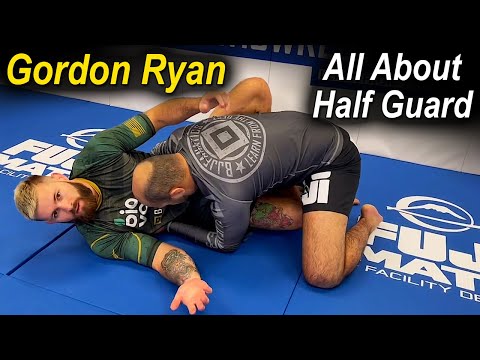
All About Jiu Jitsu Half Guard No Gi by Gordon Ryan
0
Half Guard Recovery·Bernardo Faria BJJ Fanatics
Understand how Gordon Ryan uses the half guard for no gi... - Click Here To Check Out Gordon Ryan's Instructional Videos…
Перевод: half guard recovery
The Half Guard Recovery subfamily covers techniques for establishing half guard — trapping one of the opponent's legs between the defender's legs — when full guard recovery is not possible. [1] Half guard recovery is often the more realistic defensive option when the guard is being passed, as catching one leg requires less space and movement than recovering full guard. [1],[2] The half guard position, once considered a last-resort defensive position, has evolved into a sophisticated offensive platform in modern BJJ with numerous sweeps and submissions available. [2],[3]
Half guard recovery evolved from a desperation defensive technique into a deliberate tactical choice through the work of BJJ innovators like Roberto 'Gordo' Correa, who developed the half guard into an offensive system in the 1990s after recovering from a knee injury. [1] Modern half guard players like Lucas Leite, Bernardo Faria, and Tom DeBlass further developed the position into a primary fighting platform. [2],[3]
Half guard recovery re-establishes half guard as a defensive position after the guard is partially passed. [1]
Half guard recovery became important as half guard developed into an offensive position in BJJ. [1]
Used in BJJ competition. [1]
Изображений для этой техники пока нет.
Войдите, чтобы предложить изображение.
Understand how Gordon Ryan uses the half guard for no gi... - Click Here To Check Out Gordon Ryan's Instructional Videos…
Учебных курсов по этой технике пока нет.
Войдите, чтобы предложить курс.
Риск травмы для человека, к которому применяется техника
Guard retention uses frames and hip movement; minimal direct injury risk
Уровень мастерства, необходимый для надёжного выполнения техники
Разрешена ли техника по основным соревновательным правилам
Boxing (Edwin Haislet, 1940)
Alias sources — [1] Jiu-Jitsu University (Ribeiro, 2008) [2] Fundamentals of Brazilian Jiu-Jitsu (Danaher, 2012) [3] Brazilian Jiu-Jitsu: Theory and Technique (Gracie, 2001)
Effectiveness sources — [1] Jiu-Jitsu University (Ribeiro, 2008)
Standard katakana transliteration of Western martial arts terminology (外来語) — used in Japanese MMA, boxing, and BJJ communities
Alias sources — [1] Jiu-Jitsu University (Ribeiro, 2008) [2] Fundamentals of Brazilian Jiu-Jitsu (Danaher, 2012) [3] Brazilian Jiu-Jitsu: Theory and Technique (Gracie, 2001)
Effectiveness sources — [1] Jiu-Jitsu University (Ribeiro, 2008)
reaction speed, structural body mechanics, defensive awareness
quick reflexes and conditioned defensive surfaces
varies — forearms (blocking), legs (movement), core (stability)
Каждое движение в любом боевом искусстве обладает рядом универсальных свойств. Комбинируйте параметры ниже, чтобы найти нужный инструмент или сравнить аналоги из разных стилей.
The worst outcome is starting a sweep, getting your opponent to turtle position, and then having them stand up and escape without you scoring any points. Gordon Ryan emphasizes the importance of finishing your attacks rather than leaving them incomplete.
No—to have a good and successful half guard game, you can't just be a half guard player; you have to also be able to play other positions as well.
Focus on that final five percent of execution—getting from almost completing a sweep or submission all the way to finishing it, rather than getting stuck at 95% and losing the opportunity.
The Half Guard Recovery subfamily covers techniques for establishing half guard — trapping one of the opponent's legs between the defender's legs — when full guard recovery is not possible. Half guard recovery is often the more realistic defensive option when the guard is being passed, as catching one leg requires less space and movement than recovering full guard.
Half guard recovery evolved from a desperation defensive technique into a deliberate tactical choice through the work of BJJ innovators like Roberto 'Gordo' Correa, who developed the half guard into an offensive system in the 1990s after recovering from a knee injury. Modern half guard players like Lucas Leite, Bernardo Faria, and Tom DeBlass further developed the position into a primary fighting platform.
Unified MMA: разрешён — Legal defensive technique; IBJJF: разрешён — Legal; IJF: разрешён — Legal defensive action; WBC/Boxing: разрешён — Legal; WKF: разрешён — Legal; WT: разрешён — Legal
Оценка опасности 2/10. Low — guard retention uses frames and hip movement; minimal direct injury risk
Стандартная цепочка подготовки: Anticipate the Attack → Execute Defence → Recover Stance → Counter or Disengage.
Стандартные контрприёмы: Timing — attack when the defence is recovering or between movements / Feint — use deception to create openings in the defensive structure / Angle Change — attack from an unexpected angle that the defence does not cover.
Распространённые варианты: Standard defence (primary defensive technique from the most common position); Reactive defence (triggered by the opponent's attack, minimal movement for …); Proactive defence (anticipating the attack and positioning to neutralise it …); Counter defence (using the defensive movement to create an immediate count…).
Used in BJJ competition.
Основные ошибки, на которые стоит обратить внимание: Treating half guard as a failed full guard — half guard is a complete position with its own attack system / Recovering half guard without establishing an underhook — the underhook makes half guard strong; without it, you're flat / Not turning to your side in half guard — lying flat in half guard allows the opponent to cross-face and flatten you / Trying to recover full guard immediately instead of working from half guard — establish half guard properly first.
Half Guard Recovery также известен как Hāfu Gādo Rikabarī, Half Guard Replacement, Half Guard Reguard, Knee Shield Recovery.