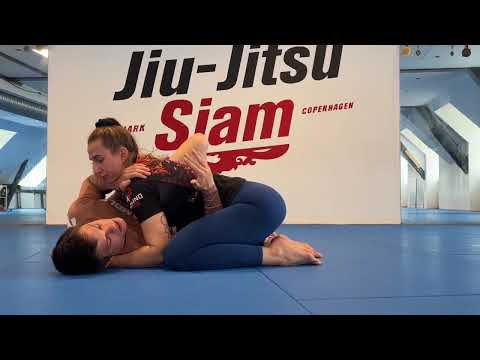
The Hip Escape Frame
0
Standard Hip Frame·The BJJ Project·Added by Admin
This essential skill is a foundation for survival, defence, sweeps and attacks taught by 2nd Degree Rickson Gracie black…
Перевод: standard hip frame
The Standard Hip Frame places the forearm across the opponent's hip bone, with the elbow braced against the defender's own hip or thigh, creating a rigid strut that prevents the opponent from closing the distance between their hips and the defender's torso. [1] The frame is maintained by keeping the arm locked at an angle that uses skeletal alignment rather than muscular effort, allowing the defender to sustain the frame with minimal energy. [1],[2] The standard hip frame is the foundational guard retention frame in BJJ and the first defensive tool taught for preventing guard passes. [2],[3]
The standard hip frame is a core BJJ defensive technique that has been taught and refined since the art's earliest competition era, recognised as one of the most fundamental skills for guard retention. [1] Every major BJJ instructional system includes hip framing as a foundational defensive concept. [2],[3]
The hip frame is a fundamental guard retention tool that prevents the top player from advancing past the defender's legs by creating structural support with the arms against the opponent's hips. [1] It is effective as a first line of defence but can be beaten by pressure passing systems that negate the frame through superior weight distribution. [2]
The hip frame is a foundational BJJ defensive concept taught across all major BJJ lineages, described as essential guard retention by both the Gracie family and modern systematisers like John Danaher. [1]
The hip frame is a standard guard retention technique in BJJ. [1]
Изображений для этой техники пока нет.
Войдите, чтобы предложить изображение.
This essential skill is a foundation for survival, defence, sweeps and attacks taught by 2nd Degree Rickson Gracie black…
In this video, I cover the fundamental elbow escape, which is the foundation of escaping a standard side control. I go o…
The standard hip frame is a foundational structural principle in guard retention and escape, emphasizing geometric alignment over raw physical attributes. The BJJ Project teaches that the hip frame operates on basic engineering principles—creating a pyramid-like structure that can bear and add weight simultaneously, applicable across all positions (standing, kneeling, or supine). This frame prioritizes connection over strength, allowing practitioners to function without relying on gas tank-dependent physical attributes. Mads H. BJJ provides complementary technical detail for side control escapes, identifying the hip frame as the critical first frame to establish before proceeding with neck frames and hip escapes. Both instructors agree that the hip frame must be created using the forearm rather than pushing with the hand, and that it serves as the foundation preventing escape failure. Mads H. BJJ emphasizes that without this initial hip frame, subsequent escape mechanics become significantly more difficult. The BJJ Project stresses the philosophical importance of understanding proper structure over strength, while Mads H. BJJ focuses on the technical sequencing and execution details within specific positions. Both instructors demonstrate that proper hip frame positioning allows practitioners to transition from flat positional vulnerability to advantageous side positioning, enabling further recovery techniques.
Сформировано на основе 2 инструкторов
Учебных курсов по этой технике пока нет.
Войдите, чтобы предложить курс.
Риск травмы для человека, к которому применяется техника
Guard retention uses frames and hip movement; minimal direct injury risk
Уровень мастерства, необходимый для надёжного выполнения техники
Разрешена ли техника по основным соревновательным правилам
Jiu-Jitsu University (Saulo Ribeiro, 2008)
Alias sources — [1] Jiu-Jitsu University (Ribeiro, 2008) [2] Fundamentals of Brazilian Jiu-Jitsu (Danaher, 2012) [3] Brazilian Jiu-Jitsu: Theory and Technique (Gracie, 2001)
Effectiveness sources — [1] Jiu-Jitsu University (Ribeiro, 2008) [2] Fundamentals of Brazilian Jiu-Jitsu (Danaher, 2012)
Standard katakana transliteration of Western martial arts terminology (外来語) — used in Japanese MMA, boxing, and BJJ communities
Alias sources — [1] Jiu-Jitsu University (Ribeiro, 2008) [2] Fundamentals of Brazilian Jiu-Jitsu (Danaher, 2012) [3] Brazilian Jiu-Jitsu: Theory and Technique (Gracie, 2001)
Effectiveness sources — [1] Jiu-Jitsu University (Ribeiro, 2008) [2] Fundamentals of Brazilian Jiu-Jitsu (Danaher, 2012)
structural arm strength, forearm density, timing
strong arms and elbows for load-bearing frames
triceps, deltoids, forearms, core
According to Mads H. BJJ, the first frame you should make is always on the hip using your forearm. This frame is critical—without it, the escape will be very difficult to execute, even if your opponent has tied up your hips.
Mads H. BJJ emphasizes that your foot must be higher than your knee when you insert it. If your knee is higher than your foot, you won't be able to slide into the crease of your opponent's hip, and stepping your foot outside your hip (rather than inside) gives you more range to pull yourself to the side.
The BJJ Project stresses that you should not have to be strong, fast, or flexible to make the hip escape frame work. Understanding the mechanics of frame and base—what they call a 'fighting base'—allows you to use connection rather than physical attributes, and this approach has no gas tank and is always available.
Mads H. BJJ explains that you should transition from being flat on your back on two shoulders and two hips to being on just one hip and one shoulder. This side-angled position makes it easier to shed your opponent's grips and set up the knee-to-elbow connection.
The Standard Hip Frame places the forearm across the opponent's hip bone, with the elbow braced against the defender's own hip or thigh, creating a rigid strut that prevents the opponent from closing the distance between their hips and the defender's torso. The frame is maintained by keeping the arm locked at an angle that uses skeletal alignment rather than muscular effort, allowing the defender to sustain the frame with minimal energy.
The standard hip frame is a core BJJ defensive technique that has been taught and refined since the art's earliest competition era, recognised as one of the most fundamental skills for guard retention. Every major BJJ instructional system includes hip framing as a foundational defensive concept.
Unified MMA: разрешён — Legal defensive technique; IBJJF: разрешён — Legal — defensive techniques are fundamental to grappling; IJF: разрешён — Legal defensive action; ADCC: разрешён — Legal; UWW: разрешён — Legal defensive technique; FIAS Sport Sambo: разрешён — Legal
Оценка опасности 2/10. Low — guard retention uses frames and hip movement; minimal direct injury risk
Стандартная цепочка подготовки: Anticipate the Attack → Execute Defence → Recover Stance → Counter or Disengage.
Стандартные контрприёмы: Timing — attack when the defence is recovering or between movements / Feint — use deception to create openings in the defensive structure / Angle Change — attack from an unexpected angle that the defence does not cover.
Распространённые варианты: Standard defence (primary defensive technique from the most common position); Reactive defence (triggered by the opponent's attack, minimal movement for …); Proactive defence (anticipating the attack and positioning to neutralise it …); Counter defence (using the defensive movement to create an immediate count…).
The hip frame is a standard guard retention technique in BJJ.
Основные ошибки, на которые стоит обратить внимание: Placing the hand on the stomach instead of the hip bone — the hip is the structural target / Extending the arm fully — a locked arm can be kimura'd or arm-barred; keep a slight bend / Not shrimping while framing — the frame alone doesn't retain guard; you must move your hips / Framing the wrong hip — frame the near-side hip (closest to you) to block the pass direction.
Standard Hip Frame также известен как Sutandādo Hippu Furēmu, Basic Hip Frame, Forearm-On-Hip Frame, Hip Post.