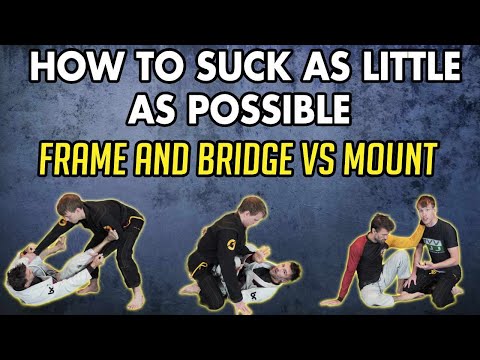
BJJ Lesson 30: How To Frame and Bridge - Fundamentals Of Escaping
0
Frame Defence·RVV BJJ
Full mount is a pain in the ass the escape. How you initially establish frames against your opponent will make all the …
Перевод: frame defence
The Frame Defence family covers ground-based defensive techniques where the fighter uses rigid arm, knee, and hip structures (frames) to create barriers that prevent the opponent from advancing their position. [1] Framing uses the body's skeletal structure rather than muscular strength to maintain defensive positions — by placing hard bone surfaces (forearms, shins, knees) against the opponent's body at optimal angles, the defender creates structural barriers that are difficult to collapse. [1],[2] Frame defences include hip frames, knee-elbow frames, and stiff arm frames, each addressing different passing and pressure scenarios. [2],[3]
Framing concepts are fundamental in BJJ and wrestling for maintaining space and preventing positional advancement. [1]
Framing is a critical defensive skill in BJJ and MMA ground fighting. [1]
Изображений для этой техники пока нет.
Войдите, чтобы предложить изображение.
Full mount is a pain in the ass the escape. How you initially establish frames against your opponent will make all the …
Учебных курсов по этой технике пока нет.
Войдите, чтобы предложить курс.
Риск травмы для человека, к которому применяется техника
Guard retention uses frames and hip movement; minimal direct injury risk
Уровень мастерства, необходимый для надёжного выполнения техники
Разрешена ли техника по основным соревновательным правилам
Boxing (Edwin Haislet, 1940)
Alias sources — [1] Jiu-Jitsu University (Ribeiro, 2008) [2] Mastering Jujitsu (Gracie & Danaher, 2003) [3] Jiu-Jitsu University (Ribeiro, 2008)
Effectiveness sources — [1] Jiu-Jitsu University (Ribeiro, 2008) [2] Mastering Jujitsu (Gracie & Danaher, 2003)
Standard katakana transliteration of Western martial arts terminology (外来語) — used in Japanese MMA, boxing, and BJJ communities
Alias sources — [1] Jiu-Jitsu University (Ribeiro, 2008) [2] Mastering Jujitsu (Gracie & Danaher, 2003) [3] Jiu-Jitsu University (Ribeiro, 2008)
Effectiveness sources — [1] Jiu-Jitsu University (Ribeiro, 2008) [2] Mastering Jujitsu (Gracie & Danaher, 2003)
structural arm strength, forearm density, timing
strong arms and elbows for load-bearing frames
triceps, deltoids, forearms, core
Каждое движение в любом боевом искусстве обладает рядом универсальных свойств. Комбинируйте параметры ниже, чтобы найти нужный инструмент или сравнить аналоги из разных стилей.
The Hip Frame subfamily covers defensive framing techniques where the fighter uses their forearm or hand placed against the opponent's hip as a primary barrier, preventing the opponent from closing distance and establishing cross-body pressure. [1] The hip frame is one of the most effective guard retention tools because controlling the opponent's hip directly controls their ability to advance — the hip is the engine of passing, and blocking it stops the pass at its source. [1,2] The hip frame is typically combined with a knee shield or foot on hip to create layered defensive barriers. [2,3]
The Knee-Elbow Frame subfamily covers the defensive position where the fighter brings the knee and elbow on the same side together, creating a compact barrier that blocks the opponent from establishing cross-body pressure or advancing through the guard. [1] The knee-elbow connection is one of the most important defensive principles in BJJ because it eliminates the space between the upper and lower body that the passer needs to exploit. [1,2] When the knee and elbow are connected, there is no gap for the opponent to thread through, forcing them to address the frame before continuing the pass. [2,3]
The Stiff Arm Frame subfamily covers defensive techniques where the fighter extends one or both arms to create maximum distance between themselves and the opponent, using the locked arm as a push-frame to prevent the opponent from closing distance or establishing pressure. [1] The stiff arm frame is most effective when the opponent is attempting to drive forward with heavy pressure, as the extended arm acts as a strut that transfers the opponent's forward force into the ground through the defender's body. [1,2] In MMA, the stiff arm frame on the ground is also used to create space for standing up. [2,3]
Framing — creating rigid structures with the forearms against the opponent — appears in 1,809 passages under 'frame' across our corpus. The most fundamental defensive concept in ground grappling. Frames create space, and space creates escape opportunities. (200+ books; Ribeiro, Jiu-Jitsu University)
According to RVV BJJ, alignment comes before everything—it's not position before submission, it's alignment before submission. Your escape attempts won't work against a skilled opponent unless you first affect your relative alignments with them.
RVV BJJ emphasizes that your elbow must frame your opponent's hip and leg—if your right elbow goes past their hip, you've given up your back. This is so critical that if you're not framing the hip properly, you're 'gonna die every time.'
RVV BJJ notes that the traditional bridge used for side control escapes won't work against a skilled opponent in mount because they can ride the bridge. Instead, you need to create a frame scaffold and use a different bridging mechanism, sometimes including a partial inversion with your head on the mat for additional support and base.
RVV BJJ points out that proper framing is critical not just in grappling but also in self-defense striking scenarios—without correct framing, your opponent can strike through you, arm you, or cause other damage.
The Frame Defence family covers ground-based defensive techniques where the fighter uses rigid arm, knee, and hip structures (frames) to create barriers that prevent the opponent from advancing their position. Framing uses the body's skeletal structure rather than muscular strength to maintain defensive positions — by placing hard bone surfaces (forearms, shins, knees) against the opponent's body at optimal angles, the defender creates structural barriers that are difficult to collapse.
Framing concepts have been central to grappling defence since the earliest documented ground-fighting systems. Brazilian Jiu-Jitsu systematised framing into a detailed defensive methodology, with specific frame positions taught for every passing and pressure scenario.
Unified MMA: разрешён — Legal defensive technique; IBJJF: разрешён — Legal — defensive techniques are fundamental to grappling; IJF: разрешён — Legal defensive action; ADCC: разрешён — Legal; UWW: разрешён — Legal defensive technique; FIAS Sport Sambo: разрешён — Legal
Оценка опасности 2/10. Low — guard retention uses frames and hip movement; minimal direct injury risk
Стандартная цепочка подготовки: Anticipate the Attack → Execute Defence → Recover Stance → Counter or Disengage.
Стандартные контрприёмы: Timing — attack when the defence is recovering or between movements / Feint — use deception to create openings in the defensive structure / Angle Change — attack from an unexpected angle that the defence does not cover.
Распространённые варианты: Standard defence (primary defensive technique from the most common position); Reactive defence (triggered by the opponent's attack, minimal movement for …); Proactive defence (anticipating the attack and positioning to neutralise it …); Counter defence (using the defensive movement to create an immediate count…).
Framing is a critical defensive skill in BJJ and MMA ground fighting.
Основные ошибки, на которые стоит обратить внимание: Framing with muscles instead of structure — align the bones; muscular framing fatigues quickly / Using a single frame when two are available — always establish multiple contact points / Framing without moving the hips — the frame creates space; the hips must use it / Pushing instead of framing — a frame holds a position; a push is a momentary exertion.
Frame Defence также известен как Furēmu Difensu, Framing, Structural Defence, Post.