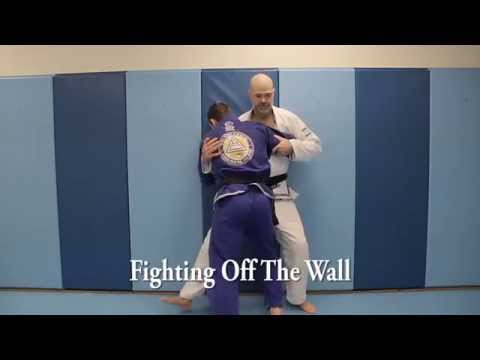
BJJ Self-Defense Course | Lesson 45: Wall Pin Defense
0
Standard Wall Pin·Gracie Schwarzwald Jiu-Jitsu
We hope everyone is enjoying our Gracie Jiu-Jitsu Self-Defense Course. We are offering these lessons for free, but If y…
Перевод: standard wall pin
The Standard Wall Pin subfamily executes the fundamental wall pin where the attacker presses the opponent against the cage using chest-to-chest or shoulder-to-chest contact, with an underhook or body lock maintaining the connection. [1] The attacker distributes weight through the opponent and into the cage, using their body as a wedge that keeps the opponent compressed. [1],[2] From the standard wall pin, the attacker can work for underhooks, body locks, takedowns, or short strikes while the opponent's movement is restricted by the fence contact. [2],[3]
Standard wall pin uses body pressure and underhooks to keep the opponent pressed against the cage or wall. [1]
A fundamental MMA cage-fighting technique. [1]
The standard wall pin is one of the most common positions in MMA cage fighting, occurring in virtually every UFC event. [1]
Изображений для этой техники пока нет.
Войдите, чтобы предложить изображение.
We hope everyone is enjoying our Gracie Jiu-Jitsu Self-Defense Course. We are offering these lessons for free, but If y…
Here are a few options to use to escape or fight off the wall or car if you get pinned.
Учебных курсов по этой технике пока нет.
Войдите, чтобы предложить курс.
Риск травмы для человека, к которому применяется техника
Cage clinch work involves grinding pressure; rib/facial abrasion risk
Уровень мастерства, необходимый для надёжного выполнения техники
Разрешена ли техника по основным соревновательным правилам
Mastering Jujitsu (Renzo Gracie & John Danaher, 2003)
Alias sources — [1] Clinch Fighting for MMA (Couture, 2011) [2] MMA Instruction Manual (UFC, 2008) [3] Wrestling for Fighting (Velasquez, 2012)
Effectiveness sources — [1] Wrestling for Fighting (Couture, 2007)
Standard katakana transliteration of Western martial arts terminology (外来語) — used in Japanese MMA, boxing, and BJJ communities
Alias sources — [1] Clinch Fighting for MMA (Couture, 2011) [2] MMA Instruction Manual (UFC, 2008) [3] Wrestling for Fighting (Velasquez, 2012)
Effectiveness sources — [1] Wrestling for Fighting (Couture, 2007)
swimming speed for inside position, shoulder drive, hip pressure
strong shoulders and low centre of gravity
deltoids, pectorals, core, quadriceps
Каждое движение в любом боевом искусстве обладает рядом универсальных свойств. Комбинируйте параметры ниже, чтобы найти нужный инструмент или сравнить аналоги из разных стилей.
Control behind the opponent's triceps and pull them into you while resting your weight against the wall to let them do the work of pinning you. Step outside their lead leg while pulling them forward to break their base, then slide your shoulder and hip along the wall as you move away. According to Gracie Schwarzwald Jiu-Jitsu, the key is to use the wall itself to do the work for you rather than trying to muscle away from it.
Many people try to muscle their opponent around or rotate into them instead of moving away. Gracie Schwarzwald Jiu-Jitsu emphasizes that you should move your hips, shoulders, and legs to turn the angle and step away, not grab and throw your opponent around.
Stepping outside their lead leg forces their back leg to step forward to catch their base, which breaks their stability and allows you to pull them off-balance. This directional control is critical to successfully escaping the pin.
No—you want to use the wall to your advantage by sliding your shoulder and hip along it as you move. Let the wall do the work for you rather than trying to stand outside it.
The Standard Wall Pin subfamily executes the fundamental wall pin where the attacker presses the opponent against the cage using chest-to-chest or shoulder-to-chest contact, with an underhook or body lock maintaining the connection. The attacker distributes weight through the opponent and into the cage, using their body as a wedge that keeps the opponent compressed.
The standard wall pin developed as a core MMA cage fighting technique, refined by wrestlers who used the fence as a tool for controlling opponents and imposing their grappling game. It became a systematic component of MMA game plans during the sport's evolution in the 2000s.
Unified MMA: разрешён — Legal — clinching is integral to MMA; IJF: разрешён — Legal — kumi-kata (grip fighting) is fundamental to judo; IBJJF: разрешён — Legal — standing grip fighting and clinch work permitted; IFMA: разрешён — Legal — the clinch is a core element of Muay Thai, clinch dominance is highly…; WBC/Boxing: ограничен — Holding is technically a foul — referee breaks clinch, excessive holding resu…; K: ограничен — 1/GLORY — One attack from clinch allowed, then referee breaks; WAKO: ограничен — Clinch generally broken by referee — limited or no clinch fighting in most fo…; UWW: разрешён — Legal — clinch is fundamental to wrestling, the primary position in Greco-Roman
Оценка опасности 4/10. Moderate — cage clinch work involves grinding pressure; rib/facial abrasion risk
Стандартная цепочка подготовки: Close Distance → Establish Primary Grip → Position the Hips → Apply Pressure.
Стандартные контрприёмы: Pummeling — fight for inside position by swimming arms under opponent's grips / Frame and Push — create distance using forearm frames against the chest or neck / Grip Break — systematically strip the opponent's controlling grips / Posture Up — straighten the spine and drive the hips forward to break clinch control.
Распространённые варианты: Single underhook (one arm inside for angle and control); Double underhooks (both arms inside for maximum inside position); Underhook with collar tie (combining the underhook with head control).
The standard wall pin is one of the most common positions in MMA cage fighting, occurring in virtually every UFC event.
Основные ошибки, на которые стоит обратить внимание: Pinning without any clinch grip — you need underhooks, body lock, or collar tie alongside the body pressure / Keeping your feet too close to the cage — step one foot between the opponent's feet for better base / Not landing any offence while pinning — the wall pin must include active damage or takedown attempts / Pressing your face into the opponent — head goes to one side for visibility and to avoid knees to the face.
Standard Wall Pin также известен как Sutandādo Wōru Pin, Standard Cage Pin, Basic Fence Pin, Wall Pressure Position.