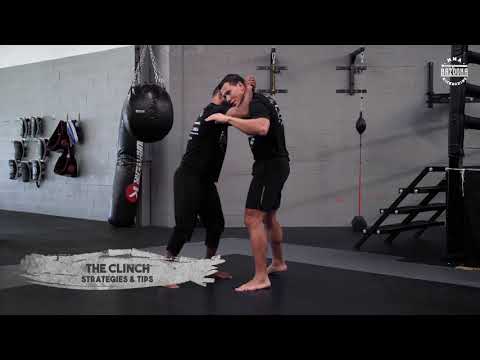
The Clinch - Episode #68
0
Double Collar Cage Clinch·Bazooka Joe Valtellini
Each week i will be releasing a video which is part of the online Bazooka Kickboxing Academy. It will start with a begin…
Перевод: double collar cage clinch
The Double Collar Cage Clinch subfamily positions the attacker with both hands gripping behind the opponent's neck (double collar tie) while the opponent's back is pressed against the cage fence. [1] The cage prevents the opponent from stepping back to relieve the collar tie pressure, amplifying the effectiveness of the double collar tie by eliminating the primary escape route. [1],[2] From the double collar cage clinch, the attacker can deliver devastating knee strikes (as in the Muay Thai plum), snap the opponent down along the fence, or transition to underhooks and body locks for cage takedowns. [2],[3]
The double collar cage clinch combines Muay Thai's plum clinch with MMA's cage wrestling, creating a hybrid position that emerged as fighters blended Thai clinch striking with fence-based control. [1] The position became a signature tool of fighters like Anderson Silva and Wanderlei Silva, who used the cage-assisted plum to devastating effect. [2],[3]
The double collar cage clinch uses two-handed collar control with the opponent pinned against the cage, enabling knee strikes and dirty boxing. [1]
Developed in MMA as a combination of Muay Thai clinch and cage positioning. [1]
Изображений для этой техники пока нет.
Войдите, чтобы предложить изображение.
Each week i will be releasing a video which is part of the online Bazooka Kickboxing Academy. It will start with a begin…
Last week on the UFC I saw a corner team shouting to their fighter "break away and strike" the fighter had double underh…
The double collar cage clinch represents a critical control position in cage wrestling where both fighters have established collar/neck ties, typically occurring when defensive framing breaks down or when aggressive clinch exchanges result in mutual high-clinch positioning. Both instructors emphasize that this position requires specific disengagement mechanics rather than simple hand separation, as the interlocked grips create a structural lock that prevents straightforward striking or striking transitions. Danny Mitchell MMA frames the double collar scenario as a high-level cage wrestling position where fighters must choose between committed takedown attempts or strategic striking resets; the key technical principle is using shoulder frames and head-fence positioning to create space for arm extraction before transitioning to strikes or level changes. Bazooka Joe Valtellini contextualizes the clinch range more broadly, stressing that fighters ending up in collar-tied positions often lack positional awareness and must immediately establish hip pressure and shoulder elevation to prevent being pulled forward—a defensive priority that shapes which offensive grips become viable. The subfamily distinguishes itself by the bilateral collar control, which creates mutual vulnerability to forward pressure, knee strikes to the body, and elbow-based exchanges, requiring practitioners to understand both offensive applications (framed striking, takedown set-ups) and defensive escapes (hand unlocking, frame positioning). Strategic selection between position variants depends on fighter height, wrestling base, and whether the clinch was entered intentionally (striking-focused) or accidentally (defensive priority).
Сформировано на основе 2 инструкторов
Учебных курсов по этой технике пока нет.
Войдите, чтобы предложить курс.
Риск травмы для человека, к которому применяется техника
Cage clinch work involves grinding pressure; rib/facial abrasion risk
Уровень мастерства, необходимый для надёжного выполнения техники
Разрешена ли техника по основным соревновательным правилам
Muay Thai: The Art of Fighting (Yod Ruerngsa, Khun Kao Charuad & James Cartmell, 2002)
Alias sources — [1] Clinch Fighting for MMA (Couture, 2011) [2] MMA Instruction Manual (UFC, 2008) [3] Anderson Silva: MMA Instruction Manual (Silva, 2008)
Effectiveness sources — [1] Wrestling for Fighting (Couture, 2007)
Official Kodokan ground technique classification system
Standard katakana transliteration of Western martial arts terminology (外来語) — used in Japanese MMA, boxing, and BJJ communities
Alias sources — [1] Clinch Fighting for MMA (Couture, 2011) [2] MMA Instruction Manual (UFC, 2008) [3] Anderson Silva: MMA Instruction Manual (Silva, 2008)
Effectiveness sources — [1] Wrestling for Fighting (Couture, 2007)
neck and bicep strength for head control, endurance for sustained clinch
longer forearms for deeper collar tie, strong neck
biceps, forearms, neck muscles, core
Каждое движение в любом боевом искусстве обладает рядом универсальных свойств. Комбинируйте параметры ниже, чтобы найти нужный инструмент или сравнить аналоги из разных стилей.
According to Bazooka Joe Valtellini, the biggest mistake is blocking with your hands, which shows a lack of experience. Instead, you should use proper positioning and footwork rather than hand defense.
Keep your shoulders up and don't let them pull your head down—that's the number one thing to avoid. Bazooka Joe Valtellini emphasizes maintaining proper posture so your opponent cannot fold you over and create space for their knees.
Never let both hands out at the same time because a smart fighter can use their elbows when your hands are disconnected, leaving you vulnerable to strikes.
You can control the inside of the elbow with one hand while gripping the hand with your lead side, which opens up round knee strikes and gives you good control. This grip also prevents your opponent from lifting their arms to create space.
The Double Collar Cage Clinch subfamily positions the attacker with both hands gripping behind the opponent's neck (double collar tie) while the opponent's back is pressed against the cage fence. The cage prevents the opponent from stepping back to relieve the collar tie pressure, amplifying the effectiveness of the double collar tie by eliminating the primary escape route.
The double collar cage clinch combines Muay Thai's plum clinch with MMA's cage wrestling, creating a hybrid position that emerged as fighters blended Thai clinch striking with fence-based control. The position became a signature tool of fighters like Anderson Silva and Wanderlei Silva, who used the cage-assisted plum to devastating effect.
Unified MMA: разрешён — Legal — clinching is integral to MMA; IJF: разрешён — Legal — kumi-kata (grip fighting) is fundamental to judo; IBJJF: разрешён — Legal — standing grip fighting and clinch work permitted; IFMA: разрешён — Legal — the clinch is a core element of Muay Thai, clinch dominance is highly…; WBC/Boxing: ограничен — Holding is technically a foul — referee breaks clinch, excessive holding resu…; K: ограничен — 1/GLORY — One attack from clinch allowed, then referee breaks; WAKO: ограничен — Clinch generally broken by referee — limited or no clinch fighting in most fo…; UWW: разрешён — Legal — clinch is fundamental to wrestling, the primary position in Greco-Roman
Оценка опасности 4/10. Moderate — cage clinch work involves grinding pressure; rib/facial abrasion risk
Стандартная цепочка подготовки: Close Distance → Establish Primary Grip → Position the Hips → Apply Pressure.
Стандартные контрприёмы: Pummeling — fight for inside position by swimming arms under opponent's grips / Frame and Push — create distance using forearm frames against the chest or neck / Grip Break — systematically strip the opponent's controlling grips / Posture Up — straighten the spine and drive the hips forward to break clinch control.
Распространённые варианты: Single collar tie (one hand on the nape controlling the head); Double collar tie (plum) (both hands behind the head for maximum control); Collar tie with wrist control (one hand on the nape, other controlling the wrist).
The double collar tie against the cage is a dominant clinch control used extensively in MMA, particularly by Muay Thai specialists who use it to set up knee strikes and elbows in UFC and ONE Championship competition.
Основные ошибки, на которые стоит обратить внимание: Holding the double collar without striking — the position exists to enable damage, not to stall / Using wide elbows — keep the elbows tight to prevent the opponent from swimming inside / Not driving knees — the double collar cage clinch is specifically for enabling knee strikes / Pulling the head straight down instead of to the side — vary the pull angle to open different targets.
Double Collar Cage Clinch также известен как Daburu Karā Kēji Kurinchi, Double Collar Cage Tie, Cage Plum, Fence Double Collar.