Ken Ken Throws
0
Right-Right Ai-Yotsu·Seiryoku Zenyo
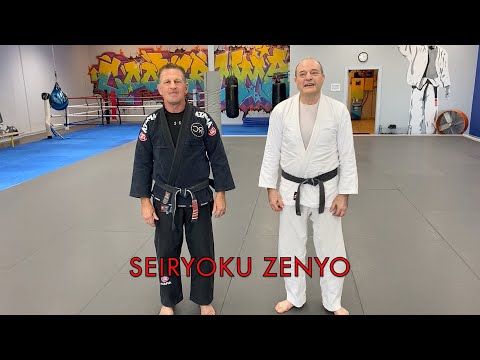
Mark Gilston, 4th degree judo black belt, demonstrates the use of "Ken Ken" or hopping foot sweep techniques in judo and…
Перевод: right-right same-side grip
The Right-Right Ai-Yotsu positions both fighters in right-handed stance, with each gripping left hand on the collar and right hand on the sleeve in a symmetrical right-side-forward configuration. [1] This is the most common matchup in judo, as the majority of competitors fight right-handed. [1],[2] Right-right ai-yotsu provides the classical platform for judo's fundamental forward throws — seoi-nage, uchi-mata, harai-goshi, osoto-gari — all of which were originally developed and refined for this symmetrical right-handed configuration. [2],[3]
Right-right ai-yotsu is the default judo matchup and the configuration for which the majority of judo techniques were originally designed and taught. [1] Jigoro Kano's original curriculum was built around right-handed technique execution, establishing right-right ai-yotsu as the foundational judo fighting stance. [2],[3]
Right-right ai-yotsu is the most common grip configuration in judo, as most fighters favour the right-handed stance. [1]
The default grip orientation in judo competition and training. [1]
Изображений для этой техники пока нет.
Войдите, чтобы предложить изображение.
Mark Gilston, 4th degree judo black belt, demonstrates the use of "Ken Ken" or hopping foot sweep techniques in judo and…
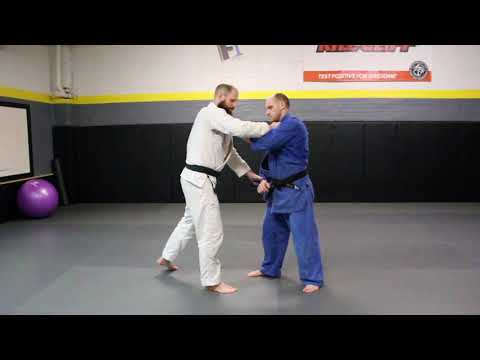
In right v. right grip fighting battles, one player will often post their left (non power) hand on thier opponents right…
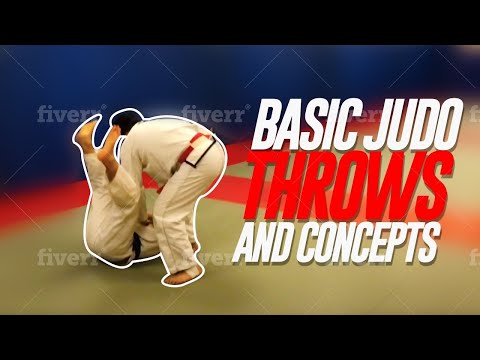
Judo Basics. Here we cover the basic Judo positions and some basic throws and combinations. Osoto 1:24 Taio 1:30 Kenkay…
Right-Right Ai-Yotsu (same-side grip, right versus right) is the foundational collar-sleeve grip configuration in judo where both practitioners lead with their right side. According to Shintaro Higashi, the grip mechanics emphasize a high lapel placement near the jaw rather than down by the chin, combined with a sleeve grip on the bicep or wrist to control the opponent's power arm and restrict elbow mobility. Higashi notes that the right leg forward with dominant right-hand posture control defines this configuration, and practitioners naturally develop preference for one direction of rotation—typically turning left with a right-leg lead—due to lifelong asymmetrical training. Rochester Judo's analysis focuses on grip-fighting dynamics within this position, highlighting the danger of the opponent's post arm (left-side blocking hand) preventing rotational attacks; they recommend shifting the engagement angle to the outside to bypass this defensive response and create space for power-hand placement before executing forward techniques like Tai Otoshi or Seoi Nage. Seiryoku Zenyo's Ken Ken throws material, while broader in scope, demonstrates how hop-and-turn adjustments amplify effectiveness in right-right configurations when initial contact fails—particularly for Osoto Gari, Ouchi Gari, and Ko Soto Gari. All three instructors agree that control of posture and timing are critical, and that understanding the opponent's natural resistance patterns informs technique selection.
Сформировано на основе 3 инструкторов
Учебных курсов по этой технике пока нет.
Войдите, чтобы предложить курс.
Риск травмы для человека, к которому применяется техника
Grip fighting is primarily positional; finger/wrist strain risk
Уровень мастерства, необходимый для надёжного выполнения техники
Разрешена ли техника по основным соревновательным правилам
Kodokan Judo (Jigoro Kano, 1986)
Alias sources — [1] Kodokan Judo (Kano, 1986) [2] Best Judo (Inokuma & Sato, 1979) [3] Kodokan New Japanese-English Dictionary of Judo (IJF, 2000)
Effectiveness sources — [1] Kodokan Judo (Kano, 1986)
Official Kodokan ground technique classification system
Established Japanese martial arts naming convention — native Japanese term (和語/漢語)
Alias sources — [1] Kodokan Judo (Kano, 1986) [2] Best Judo (Inokuma & Sato, 1979) [3] Kodokan New Japanese-English Dictionary of Judo (IJF, 2000)
Effectiveness sources — [1] Kodokan Judo (Kano, 1986)
grip strength, upper body endurance, balance under pressure
strong arms and shoulders, stable base
forearms, deltoids, core, hip muscles
Place your heel right behind your opponent's knee where it flexes backward. Their stiff-arm actually pushes them away, which you can use to your advantage. Lean forward slightly to prevent them from reversing the throw.
Pull your opponent forward to make them resist, then sweep their foot as they start to move back. Seiryoku Zenyo emphasizes that if you feel your opponent can counter you, you must abandon the throw immediately—only commit if there's no way they can reverse it.
Shintaro Higashi recommends gripping high on the lapel near the collarbone rather than low by the chin. Gripping high prevents your opponent from going underneath while maintaining better posture control.
Change your angle of attack by moving to the outside rather than staying squared up directly in front of them. By pushing their power hand toward the hip and moving to the outside, you force them to reach across their body to post, making it much harder for them to defend.
The Right-Right Ai-Yotsu positions both fighters in right-handed stance, with each gripping left hand on the collar and right hand on the sleeve in a symmetrical right-side-forward configuration. This is the most common matchup in judo, as the majority of competitors fight right-handed.
Right-right ai-yotsu is the default judo matchup and the configuration for which the majority of judo techniques were originally designed and taught. Jigoro Kano's original curriculum was built around right-handed technique execution, establishing right-right ai-yotsu as the foundational judo fighting stance.
Unified MMA: разрешён — Legal — clinching is integral to MMA; IJF: разрешён — Legal — kumi-kata (grip fighting) is fundamental to judo; IBJJF: разрешён — Legal — standing grip fighting and clinch work permitted; IFMA: разрешён — Legal — the clinch is a core element of Muay Thai, clinch dominance is highly…; WBC/Boxing: ограничен — Holding is technically a foul — referee breaks clinch, excessive holding resu…; K: ограничен — 1/GLORY — One attack from clinch allowed, then referee breaks; WAKO: ограничен — Clinch generally broken by referee — limited or no clinch fighting in most fo…; UWW: разрешён — Legal — clinch is fundamental to wrestling, the primary position in Greco-Roman
Оценка опасности 2/10. Low — grip fighting is primarily positional; finger/wrist strain risk
Стандартная цепочка подготовки: Close Distance → Establish Primary Grip → Position the Hips → Apply Pressure.
Стандартные контрприёмы: Pummeling — fight for inside position by swimming arms under opponent's grips / Frame and Push — create distance using forearm frames against the chest or neck / Grip Break — systematically strip the opponent's controlling grips / Posture Up — straighten the spine and drive the hips forward to break clinch control.
Распространённые варианты: Standard variation (primary clinch configuration from the most common entry); Gi variation (adapted with collar and sleeve grips for gi-based grappling); No-gi / MMA variation (modified for no-gi or cage fighting conditions); Offensive variation (configured to set up strikes, takedowns, or submissions f…).
Right-right ai-yotsu is the most common grip configuration in judo competition, as the majority of judoka are right-handed. This grip pattern appears in the majority of matches at Olympic and World Championship level.
Основные ошибки, на которые стоит обратить внимание: Accepting a shallow right-hand grip when the opponent has a deep one — fight to equalise or break their grip / Using only right-side throws — add left-side counters (e.g., left ouchi gari) to surprise the opponent / Standing in a static mirror with matched grips — use push-pull, circles, and feints to break the symmetry / Not training grip-break sequences for the right-right position — each side has specific vulnerabilities.
Right-Right Ai-Yotsu также известен как Migi Ai-yotsu, Migi Ai-Yotsu, Right-Handed Same Grip, Orthodox Ai-Yotsu.