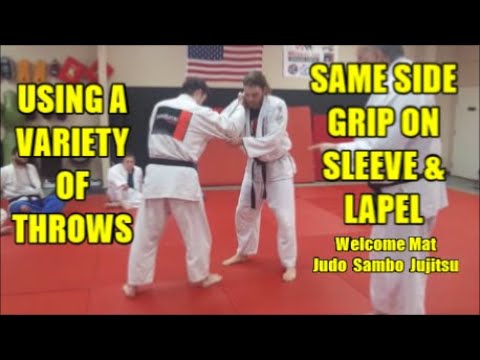
SAME SIDE GRIP ON SLEEVE & LAPEL USING A VARIETY OF THROWS
0
Same-Side Grip — Ai-Yotsu·welcomematstevescott
This video shows how to use a same side sleeve & lapel grip combined with Taisabaki footwork pattern to apply a variety …
Перевод: same-side grip
The Same-Side Grip (Ai-Yotsu) subfamily covers the gripping configuration where both fighters adopt the same stance — both right-handed or both left-handed — creating a symmetrical clinch dynamic. [1] In ai-yotsu, both fighters contest the same grip positions, making the grip fight more direct and competitive. [1],[2] Ai-yotsu dynamics favour classical forward throws like seoi-nage, uchi-mata, and harai-goshi, as the symmetrical stance provides clean entry angles for these techniques. [2],[3]
Ai-yotsu (same-side fighting) is considered the classical judo matchup, as traditional judo training assumed right-handed vs. right-handed competition. [1] The majority of judo's foundational throwing techniques were developed for the ai-yotsu configuration, making it the default tactical framework in judo instruction. [2],[3]
Ai-yotsu (same-side grip) creates parallel tension that favours classical forward throws such as seoi-nage and osoto-gari. [1]
Ai-yotsu is the most common grip configuration in judo, considered the natural starting position. [1]
Ai-yotsu matchups are the most common grip configuration in IJF competition. [1]
Изображений для этой техники пока нет.
Войдите, чтобы предложить изображение.
This video shows how to use a same side sleeve & lapel grip combined with Taisabaki footwork pattern to apply a variety …
Want to learn grip fighting drills? - here we start with the basics and move to more advanced work. https://www.youtube.…
Same-side grip (ai-yotsu) represents a departure from conventional collar-and-sleeve grip positioning, where the dominant hand controls the lapel on the same side as the sleeve grip, rather than crossing to the opposite lapel. This configuration fundamentally alters the geometry of kuzushi (balance breaking) and throws available from the clinch. WelcomeMatSteveScott emphasizes the strategic value of establishing a lower lapel grip to maximize rotational control and steering capability, describing the same-side hand as a "steering hand" that directs the opponent through tai sabaki (circular body movement) while serving simultaneously as a power source. From this grip, practitioners can execute diverse throws—including seoi nage, tai otoshi, and uchi mata—with particular effectiveness in knee drop variations where the rounded, under-the-center entry differs from upright hip-placement techniques. WelcomeMatSteveScott also demonstrates osoto gari setups by reversing the pull direction toward the sleeve hand (hiki tae) rather than the power hand, and covers deceptive foot sweeps like ko rashi barai that opponents rarely anticipate from same-side positioning. The Judo Coach's grip-fighting drills frame same-side grips within pressure-based control mechanics, stressing that effective gripping requires immediate reactionary responses once hand contact is established, leg-driven power transmission through the hips, and active hand repositioning when the opponent blocks or escapes initial grip attempts. Both instructors treat same-side grips as tactical alternatives that disrupt conventional opponent expectations while enabling powerful circular movement patterns.
Сформировано на основе 2 инструкторов
Учебных курсов по этой технике пока нет.
Войдите, чтобы предложить курс.
Риск травмы для человека, к которому применяется техника
Grip fighting is primarily positional; finger/wrist strain risk
Уровень мастерства, необходимый для надёжного выполнения техники
Разрешена ли техника по основным соревновательным правилам
Kodokan Judo (Jigoro Kano, 1986)
Alias sources — [1] Kodokan Judo (Kano, 1986) [2] Judo Formal Techniques (Otaki & Draeger, 1983)
Effectiveness sources — [1] Kodokan Judo (Kano, 1986)
Official Kodokan ground technique classification system
Established Japanese martial arts naming convention — native Japanese term (和語/漢語)
Alias sources — [1] Kodokan Judo (Kano, 1986) [2] Judo Formal Techniques (Otaki & Draeger, 1983)
Effectiveness sources — [1] Kodokan Judo (Kano, 1986)
grip strength, upper body endurance, balance under pressure
strong arms and shoulders, stable base
forearms, deltoids, core, hip muscles
Каждое движение в любом боевом искусстве обладает рядом универсальных свойств. Комбинируйте параметры ниже, чтобы найти нужный инструмент или сравнить аналоги из разных стилей.
The Left-Left Ai-Yotsu positions both fighters in left-handed stance, with each gripping right hand on the collar and left hand on the sleeve in a symmetrical left-side-forward configuration. [1] Left-left ai-yotsu is less common than right-right because traditionally most judoka train right-handed, making left-left matchups a specialist scenario. [1,2] Left-handed fighters who develop strong left-side throwing techniques often have a tactical advantage against right-handed opponents in kenka-yotsu, and the left-left ai-yotsu matchup pits two such specialists against each other. [2,3]
The Right-Right Ai-Yotsu positions both fighters in right-handed stance, with each gripping left hand on the collar and right hand on the sleeve in a symmetrical right-side-forward configuration. [1] This is the most common matchup in judo, as the majority of competitors fight right-handed. [1,2] Right-right ai-yotsu provides the classical platform for judo's fundamental forward throws — seoi-nage, uchi-mata, harai-goshi, osoto-gari — all of which were originally developed and refined for this symmetrical right-handed configuration. [2,3]
Ai-yotsu (same-side grip) is the standard judo grip configuration where both fighters grip with the same dominant hand — right vs. right or left vs. left. This symmetrical grip creates a balanced attacking position where both fighters can execute their preferred throws. (Kano, Kodokan Judo; judo coaching manuals)
Grab a lower grip on the sleeve rather than high on the lapel—this gives you significantly more room to work and execute your techniques smoothly, according to Steve Scott.
Steve Scott emphasizes that you need to position yourself with enough space to circle and move your opponent around to your power side; being too squared up limits your ability to execute the throw properly.
Use a partial circular action (sabaki) to pop your opponent around to the side, then step and follow through—this sets up throws like tai otoshi or knee drop seoi nage effectively.
The Same-Side Grip (Ai-Yotsu) subfamily covers the gripping configuration where both fighters adopt the same stance — both right-handed or both left-handed — creating a symmetrical clinch dynamic. In ai-yotsu, both fighters contest the same grip positions, making the grip fight more direct and competitive.
Ai-yotsu (same-side fighting) is considered the classical judo matchup, as traditional judo training assumed right-handed vs. right-handed competition.
Unified MMA: разрешён — Legal — clinching is integral to MMA; IJF: разрешён — Legal — kumi-kata (grip fighting) is fundamental to judo; IBJJF: разрешён — Legal — standing grip fighting and clinch work permitted; IFMA: разрешён — Legal — the clinch is a core element of Muay Thai, clinch dominance is highly…; WBC/Boxing: ограничен — Holding is technically a foul — referee breaks clinch, excessive holding resu…; K: ограничен — 1/GLORY — One attack from clinch allowed, then referee breaks; WAKO: ограничен — Clinch generally broken by referee — limited or no clinch fighting in most fo…; UWW: разрешён — Legal — clinch is fundamental to wrestling, the primary position in Greco-Roman
Оценка опасности 2/10. Low — grip fighting is primarily positional; finger/wrist strain risk
Стандартная цепочка подготовки: Close Distance → Establish Primary Grip → Position the Hips → Apply Pressure.
Стандартные контрприёмы: Pummeling — fight for inside position by swimming arms under opponent's grips / Frame and Push — create distance using forearm frames against the chest or neck / Grip Break — systematically strip the opponent's controlling grips / Posture Up — straighten the spine and drive the hips forward to break clinch control.
Распространённые варианты: Standard variation (primary clinch configuration from the most common entry); Gi variation (adapted with collar and sleeve grips for gi-based grappling); No-gi / MMA variation (modified for no-gi or cage fighting conditions); Offensive variation (configured to set up strikes, takedowns, or submissions f…).
Ai-yotsu matchups are the most common grip configuration in IJF competition.
Основные ошибки, на которые стоит обратить внимание: Not fighting for grip dominance — in ai yotsu, the deeper grip wins; passive gripping loses / Using only one throw from same-side grip — develop a combination series (e.g., uchi mata to ouchi gari) / Standing in a mirror image of the opponent without creating advantages through footwork and pull-push / Gripping at the same depth as the opponent and accepting a stalemate — always strive for a deeper grip.
Same-Side Grip — Ai-Yotsu также известен как Ai-yotsu, Ai-Yotsu, Matched Grip, Same-Side Grip, Mirror Grip.