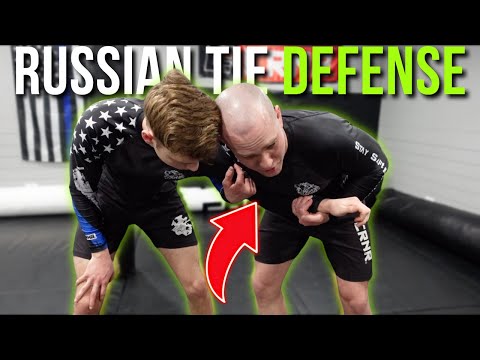
3 Ways To Defend The Russian Tie
0
Two-On-One-Russian Tie·Stay Safe Martial Arts
The last one will catch your opponent off guard every time. Social Media: Instagram: https://www.instagram.com/davidhe…
Перевод: two-on-one / Russian tie
The Two-On-One Russian Tie family covers clinch positions where the attacker controls one of the opponent's arms with both hands, creating a dominant two-against-one grip configuration. [1] The Russian tie typically involves one hand gripping the opponent's wrist while the other controls the upper arm or tricep, giving the attacker complete dominance over one side of the opponent's body. [1],[2] From the two-on-one position, the attacker can execute arm drags, snap downs, single-leg entries, and go-behinds, making it one of the most offensively versatile clinch positions. [2],[3] The Russian tie is named for its development and popularisation by Soviet wrestlers. [3]
The two-on-one or Russian tie was developed and systematised in Soviet Union wrestling programmes during the mid-20th century, where it became a cornerstone of Russian freestyle wrestling methodology. [1] Soviet coaches recognised that controlling one arm with two hands created an overwhelming positional advantage that could be exploited in multiple directions. [2] The system spread worldwide through international competition and coaching exchanges, becoming a standard component of elite wrestling training globally. [2],[3]
The Russian tie (two-on-one) is one of the most tactically versatile clinch positions in wrestling, providing dominant unilateral arm control that creates multiple attack angles. [1] Petrov describes it as a position from which the attacker can execute snap-downs, arm drags, single-leg entries, and go-behinds, making it extremely difficult for the defender to predict the direction of attack. [1] Soviet wrestling methodology recognised the two-on-one as a cornerstone position because it creates a guaranteed 2-against-1 leverage advantage. [2]
The Russian tie was systematised in Soviet wrestling programmes during the 1950s–1970s, with coaches at the Central Army Sports Club (CSKA Moscow) and Dynamo sports societies developing comprehensive attack chains from the position. [1] The technique was transmitted through the Soviet coaching pipeline to satellite states and then internationally through competition and coaching exchanges. [1] Notable lineage holders include Olympic champions such as Alexander Medved (3x Olympic gold, 1964–1972) and Ivan Yarygin (2x Olympic gold, 1972–1976), both of whom used two-on-one systems extensively. [2]
The Russian tie became a signature position for Soviet and Russian wrestlers in international competition from the 1960s onward. [1] In MMA, Georges St-Pierre frequently used the two-on-one to set up takedown entries during his UFC welterweight championship reign (2006–2013). [2] Khabib Nurmagomedov also employed the Russian tie as part of his chain wrestling approach en route to his undefeated UFC lightweight title run (2018–2020). [3]
Изображений для этой техники пока нет.
Войдите, чтобы предложить изображение.
The last one will catch your opponent off guard every time. Social Media: Instagram: https://www.instagram.com/davidhe…
Учебных курсов по этой технике пока нет.
Войдите, чтобы предложить курс.
Риск травмы для человека, к которому применяется техника
Arm control positions limit opponent's offense; low direct injury risk
Уровень мастерства, необходимый для надёжного выполнения техники
Разрешена ли техника по основным соревновательным правилам
Freestyle Wrestling: A Complete Guide for Coaches and Wrestlers (Petrov, 1977)
Alias sources — [1] Wrestling Physical Conditioning Encyclopedia (Welker, 2010) [2] NCAA Wrestling Rules and Interpretations [3] Wrestling for Fighting (Couture, 2007)
Effectiveness sources — [1] Freestyle Wrestling: A Complete Guide (Petrov, 2005) [2] Wrestling Physical Conditioning Encyclopedia (Welker, 2010)
Mixed Japanese-Western terminology — combines traditional Japanese terms with katakana loanwords
Alias sources — [1] Wrestling Physical Conditioning Encyclopedia (Welker, 2010) [2] NCAA Wrestling Rules and Interpretations [3] Wrestling for Fighting (Couture, 2007)
Effectiveness sources — [1] Freestyle Wrestling: A Complete Guide (Petrov, 2005) [2] Wrestling Physical Conditioning Encyclopedia (Welker, 2010)
grip strength, upper body endurance, balance under pressure
strong arms and shoulders, stable base
forearms, deltoids, core, hip muscles
Каждое движение в любом боевом искусстве обладает рядом универсальных свойств. Комбинируйте параметры ниже, чтобы найти нужный инструмент или сравнить аналоги из разных стилей.
The High Crotch Russian Tie subfamily covers the variation of the two-on-one position where the controlling grip is positioned high on the opponent's arm near the shoulder, with the attacker's body close to the opponent, facilitating high-crotch takedown entries. [1] This elevated grip placement allows the attacker to drive into the opponent's hip while maintaining arm control, combining upper-body dominance with lower-body attacking. [1,2] The high crotch Russian tie is a transitional position that bridges arm control and leg attack, making it particularly dangerous in freestyle wrestling. [2,3]
The Standard Russian Tie subfamily represents the classical two-on-one grip position where one hand controls the opponent's wrist and the other grips the tricep or upper arm, with the attacker's chest pressed against the controlled arm. [1] This is the foundational Russian tie position from which all two-on-one attacks originate — it provides complete control of one arm, allowing the attacker to steer the opponent, create angles, and launch attacks in multiple directions. [1,2] The standard Russian tie is characterised by chest-to-arm contact, which adds a third point of control beyond the two hand grips. [2,3]
Focus on getting heavy pressure with a good bite on the grip. You can tuck the wrist behind your elbows to make the position even tighter and more controlling.
Look for the far elbow as your main target. Close the distance with head pressure to get into position where you can reach and control it.
Pull the opponent's arm toward your stomach to break their control, then weave your bottom hand under without fighting upward. From there you can transition to the back, grab an arm drag, or go dead arm by positioning your hip close to theirs and whipping your arm free.
The Two-On-One Russian Tie family covers clinch positions where the attacker controls one of the opponent's arms with both hands, creating a dominant two-against-one grip configuration. The Russian tie typically involves one hand gripping the opponent's wrist while the other controls the upper arm or tricep, giving the attacker complete dominance over one side of the opponent's body.
The two-on-one or Russian tie was developed and systematised in Soviet Union wrestling programmes during the mid-20th century, where it became a cornerstone of Russian freestyle wrestling methodology. Soviet coaches recognised that controlling one arm with two hands created an overwhelming positional advantage that could be exploited in multiple directions.
Unified MMA: разрешён — Legal — clinching is integral to MMA; IJF: разрешён — Legal — kumi-kata (grip fighting) is fundamental to judo; IBJJF: разрешён — Legal — standing grip fighting and clinch work permitted; IFMA: разрешён — Legal — the clinch is a core element of Muay Thai, clinch dominance is highly…; WBC/Boxing: ограничен — Holding is technically a foul — referee breaks clinch, excessive holding resu…; K: ограничен — 1/GLORY — One attack from clinch allowed, then referee breaks; WAKO: ограничен — Clinch generally broken by referee — limited or no clinch fighting in most fo…; UWW: разрешён — Legal — clinch is fundamental to wrestling, the primary position in Greco-Roman
Оценка опасности 3/10. Moderate — arm control positions limit opponent's offense; low direct injury risk
Стандартная цепочка подготовки: Close Distance → Establish Primary Grip → Position the Hips → Apply Pressure.
Стандартные контрприёмы: Pummeling — fight for inside position by swimming arms under opponent's grips / Frame and Push — create distance using forearm frames against the chest or neck / Grip Break — systematically strip the opponent's controlling grips / Posture Up — straighten the spine and drive the hips forward to break clinch control.
Распространённые варианты: Standard Russian tie (two hands controlling one arm at the wrist and upper arm); Russian tie to arm drag (transitioning the two-on-one into an arm drag for angle); Russian tie to snap-down (using the two-on-one to snap the opponent's posture down).
The Russian tie became a signature position for Soviet and Russian wrestlers in international competition from the 1960s onward. In MMA, Georges St-Pierre frequently used the two-on-one to set up takedown entries during his UFC welterweight championship reign (2006–2013).
Основные ошибки, на которые стоит обратить внимание: Holding the Russian tie without attacking — it's an offensive platform, not a stalling position / Gripping only the wrist without the upper arm — both points of control are needed for the two-on-one advantage / Letting the opponent's arm separate from your chest — keep it pinned tightly / Standing square with the Russian tie — maintain a staggered stance and use footwork.
Two-On-One-Russian Tie также известен как Ni-tai-Ichi / Roshian Tai, Russian Tie, Two-On-One Control, 2-on-1.