Fencing 101: Skills to Win! The In Quartata, Passata-sotto, and Balestra
0
Балестра·RecSport Education
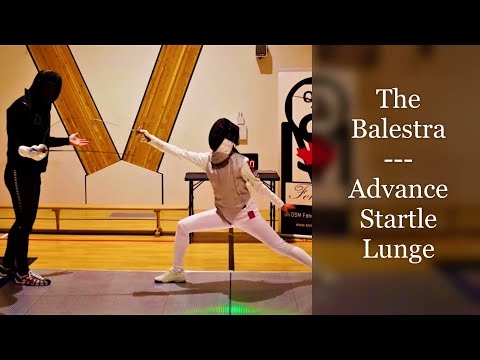
This video demos the skill based techniques known as the in quartata, passata-sotto, and the balestra. These are difficu…
Translation: Скок с изпад
Балестрата е подготвителна техника, съчетаваща напред скок (апел) с незабавен изпад, използвана за избухливо скъсяване на дистанцията при запазване на структурата на изпада. [1] Скокът изненадва противника и скъсява разстоянието, а следващият изпад нанася укола. [1] Тя е една от най-често използваните съставни атаки при фехтовката с флорет. [1]
Балестрата остава основна техника в съвременната състезателна фехтовка и историческото фехтоване. [1]
Използва се в международни фехтовални състезания на FIE
No images yet for this technique.
Sign in to suggest an image.
This video demos the skill based techniques known as the in quartata, passata-sotto, and the balestra. These are difficu…
Opponents always escaping your advance lunges? Finding it hard to surprise your opponent? Needing a new action to introd…
An examination of two classic rapier fencing techniques, the inquartata and the half inquartata including examples of th…
The balestra is an explosive footwork preparation consisting of a forward hop or jump, derived from the French word meaning 'sudden leap forward.' Instructors across RecSport Education, SSOA & Tasmanian Academy of Swordsmanship, and OSM Fencing agree on its fundamental purpose: to change timing and rhythm while closing distance more rapidly than a traditional advance. RecSport Education emphasizes that the balestra is faster than a standard advance and can be modified with variations such as leaping off the front foot, leaping off the back foot, or executing a double jump to further surprise an opponent. OSM Fencing provides detailed tactical applications, noting the balestra is most commonly used as a transition into a lunge, but also serves to disrupt opponent tempo and provoke responses. OSM Fencing distinguishes between classical and advanced forms: the classical version lands with both feet flat before lunging, while the advanced version lands on the heel only, allowing immediate explosive transition into the lunge without a pause. OSM Fencing also emphasizes that effective balesters should be short, covering roughly one foot of distance, and are used to read opponent habits and exploit weaknesses through tempo variation. All instructors stress that despite its apparent simplicity, the balestra requires significant training to apply effectively in actual bouts.
Synthesized from 3 instructors
No instructional courses yet for this technique.
Sign in to suggest a course.
Risk of injury to the person this technique is applied to
Спортна фехтовка със защитно оборудване; исторически смъртоносна с остри оръжия
Skill level needed to execute this technique reliably
Whether this technique is allowed under major competition rule sets
Fencing (Pollock, Grove & Prevost, 1902)
description, historyOrigin: sourced from Pollock, W
description, historyOrigin: sourced from Pollock, W
Изисква добро разгъване на ръката
Бърза реакция
Равновесие и работа с крака
Балестрата се среща в 5 пасажа от нашия корпус. Кратък скок напред, използван за скъсяване на дистанцията преди изпад — фехтовачът скача напред с двата крака, преди да разгъне атаката. Основен модел на работа с крака в спортната фехтовка. (Биомеханика на човешкото движение; фехтовални наръчници)
A balestra is a hopping forward movement used to close distance and prepare for a lunge while also disrupting your opponent's tempo and provoking a response. According to OSM Fencing, it allows you to change your rhythm and trigger defensive or offensive reactions from your opponent.
Instead of marching forward slowly and methodically, a balestra involves a quick hop that speeds up the transition into a lunge and gives you a wider range of tempo options in your attack sequence. OSM Fencing notes that this tempo change makes it harder for opponents to predict your timing.
According to RecSport Education, same-side opponents may be able to counter the balestra more easily, though you can attempt variations like crossing over with your rear foot—though this approach temporarily exposes more of your target.
Балестрата е подготвителна техника, съчетаваща напред скок (апел) с незабавен изпад, използвана за избухливо скъсяване на дистанцията при запазване на структурата на изпада. Скокът изненадва противника и скъсява разстоянието, а следващият изпад нанася укола.
Балестрата е кодифицирана в европейски фехтовални трактати от 16 век нататък. Италианските и френските школи развиват техниката до съвременния ѝ вид в продължение на векове на усъвършенстване.
FIE: легална — Разрешена фехтовална техника — регулирана от правилата на FIE за флорет, епе …; HEMA: легална — Разрешена в исторически фехтовални състезания
Оценка на опасност 3/10. Спортна фехтовка със защитно оборудване; исторически смъртоносна с остри оръжия
Стандартната верига за подготовка: Ан гард → Подготовка → Балестра → Възстановяване.
Стандартните контри включват: Контрапара / Управление на дистанцията / Стоп-удар.
Чести варианти: Пряка балестра; Непряка балестра; Съставна балестра.
Използва се в международни фехтовални състезания на FIE
Основни грешки, за които да внимавате: Прекомерно разтягане / Телеграфиране на действието / Слабо възстановяване на позицията.
Балестра е известна също като Baresutora, Балестра, Скок с изпад, Appel et Fente.