Introduction to Beginner MMA Fundamentals
This instructional series covers essential striking techniques and footwork for beginners entering mixed martial arts training. The lesson focuses on establishing proper stance, basic punching combinations, and fundamental kick mechanics.
Establishing the Fighting Stance
The practitioner assumes a shoulder-width stance with feet positioned so that the dominant side foot moves to the rear. The rear foot angles outward at 45 degrees to maximize stability and balance. Knees remain slightly bent while shoulders stay relaxed and unfixed, allowing fluid movement.
Footwork Fundamentals and Directional Movement
Proper footwork requires stepping with the foot in the direction of intended movement first, followed by the trailing foot, to prevent leg crossing. When advancing, the lead foot initiates movement; when retreating, the rear foot leads. This foundational principle prevents vulnerability and maintains fighting stance integrity.
The Jab and Cross Combinations
The jab extends the lead arm with a corkscrew motion, serving as the primary distance-management tool. The cross utilizes the rear hand with hip and foot rotation, generating power from ground reaction force transmitted through the kinetic chain. Both techniques maintain opposite hand guard protection and require rapid retraction to defensive position.
Hook Mechanics and Elbow Alignment
The hook maintains a 90-degree elbow bend with the arm held as if grasping an object, preventing arm-only execution. Power generation derives from hip rotation and shoulder whipping rather than isolated arm movement. Critical alignment requires the elbow positioned directly behind the fist and shoulder aligned with the elbow to prevent hand collapse upon impact.
Uppercut Execution and Hand Positioning
The uppercut employs hip rotation identical to the cross but executes vertically from hip level with minimal ground contact. Practitioners must avoid scraping knuckles on the ground by releasing at the last moment with minimal preparatory drop. The technique effectively elevates opponent head position for follow-up combinations while maintaining opposite hand guard.
Push Kick (Teep) Fundamentals
The push kick utilizes both lead and rear legs, featuring knee bend with backward upper body tilt and forward hip drive into the planted supporting foot. Practitioners may strike with flat foot for maximum surface area or concentrate force into the ball of the foot for more advanced application. The technique maintains distance, disrupts opponent balance, and establishes range control.
Roundhouse Kick Development and Training Method
The roundhouse kick targets legs, torso, or head and requires extensive repetition for proficiency, particularly using Thai-style mechanics with full hip rotation. Beginners should practice complete 360-degree motion during shadow boxing, accepting initial awkwardness as necessary for developing comfort and balance. Progressive training builds the hip mobility and timing required for effective application in combat.
Beginner's MMA Crash Course: Lesson 1 Basics
Key Takeaways
- •Introduction to Beginner MMA Fundamentals
- •Establishing the Fighting Stance
- •Footwork Fundamentals and Directional Movement
- •The Jab and Cross Combinations
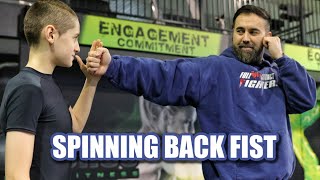
Are you interested in MMA, but don't know where to begin? Here is a beginner's crash course, starting from lesson 1 with the basic stance, punches, kicks, and defense, to build your fundamentals as a mixed martial artist! Subscribe to fightTIPS►http://bit.ly/1APnzvw FOLLOW: Facebook | http://bit.ly/fightTIPSFacebook Twitter | http://bit.ly/fightTIPSTwitter Instagram | http://bit.ly/fightTIPSInstagram
Frequently Asked Questions
What does this video teach about standard spinning backfist?
This video covers introduction to beginner mma fundamentals, establishing the fighting stance, footwork fundamentals and directional movement. It provides detailed instruction from fightTIPS.
How long does it take to learn standard spinning backfist?
The basic mechanics can be understood in a single session, but developing reliable execution requires consistent drilling over weeks of practice. This 8-part breakdown helps structure your training by isolating each phase of the technique.
What are the key details for finishing standard spinning backfist?
The push kick utilizes both lead and rear legs, featuring knee bend with backward upper body tilt and forward hip drive into the planted supporting foot. Practitioners may strike with flat foot for maximum surface area or concentrate force into the ball of the foot for more advanced application. The technique maintains distance, disrupts opponent balance, and establishes range control.
Related videos
HAMMER FIST of Legend: Utilizing Weaponry Mechanics for Empty-Hand Strikes
Coach Kurt
POWERFUL STRIKE NO SPIN BACK FIST HOW TO
PRIDE MARTIAL ARTS
Backfist Secrets
Chip Quimby & Authentic Karate Training Center
How to Do a Spinning Backfist Tutorial - Get That Flash KO!
First Strike Athletics
How To Do The Spinning Backfist | MMA
Danny Fung