Foundation: The Hammer Fist Mechanics
The hammer fist strike utilizes the bottom portion of the closed fist as the striking surface, mimicking the mechanics of stick work applications. This fundamental principle transfers weapon-based motion directly to empty-hand striking, creating efficient and powerful deliveries.
Forehand Hammer Fist: Wittic vs. Lobtic Delivery
The forehand hammer fist employs two distinct delivery methods: the wittic motion, which strikes and retracts without follow-through, and the lobtic motion, which passes through the centerline in a full slash. The practitioner can strike with either the hammer fist or forearm, depending on range and tactical objectives. Proper execution involves an ascending diagonal path from the shoulder into the center target.
Backhand Hammer Fist: Hip Rotation and Pivoting
The backhand hammer fist snaps outward with counter-rotation generated through hip movement and ball-of-foot pivoting. This fundamental mechanic allows the practitioner to extend range and generate additional power through proper weight transfer. The pivot also functions defensively as a slip against incoming strikes or as a setup mechanism for follow-up techniques.
Loaded Hammer Fist and Southeast Asian Applications
An elevated elbow position creates a loaded hammer fist delivery common in Southeast Asian striking arts and dirty boxing. This variation produces a more diagonal trajectory compared to vertical-path variants and enables a whipping or slashing motion through the centerline. The loading position also serves as a defensive structure while preparing the subsequent strike.
Upward Diagonal and Unconventional Angles
The diagonal upward hammer fist rising from underneath represents a less conventional striking angle, creating tactical opportunities for unorthodox scoring. This technique connects effectively when hinged off follow-through strikes on the same line, creating seamless combinations. The unconventional angle provides openings where orthodox attacks would be anticipated.
Combination Drills: Cob Cob and Alternating Patterns
The cob cob combination alternates consecutive forehand hammer fists through rotating mechanics derived from double-stick training. The pi pi pattern employs alternating backhand strikes, while mixed forehand-backhand combinations down a single line of attack develop consistency and flow. Practitioners should vary body rotation to modulate range and timing.
Vertical Line Combinations: Down-Up Sequences
Sequential combinations following a single vertical line—such as forehand low, backhand high, forehand—create efficient movement patterns with minimal repositioning. The hinging action between downward and upward diagonal strikes on the same side generates continuous momentum. Rolling transitions between low backhand and high forehand positions enhance fluidity and technical precision.
Training Methodology: Controlled vs. Applied Execution
Practitioners should initially perform combinations slowly and with deliberate control, focusing on movement quality and structural integrity. Progressive training advances toward increased speed and power delivery while maintaining technical precision. The final stage emphasizes realistic intent and application, translating technical proficiency into practical combat utility.
HAMMER FIST of Legend: Utilizing Weaponry Mechanics for Empty-Hand Strikes
Key Takeaways
- •Foundation: The Hammer Fist Mechanics
- •Forehand Hammer Fist: Wittic vs. Lobtic Delivery
- •Backhand Hammer Fist: Hip Rotation and Pivoting
- •Loaded Hammer Fist and Southeast Asian Applications
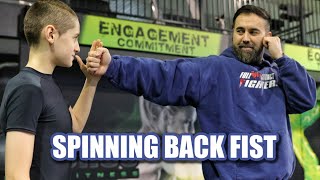
In Filipino Martial Art, the weapon “informs” the hand. This means the FMA Practitioner learns to use the weapon right away as a method of combat, but of equal importance as a method of developing body mechanics and creative striking tools. The most common application of this motion is with the Hammer Fist, where the bottom of the hand, and at times the entire forearm, is used to deliver powerful and unorthodox percussion. This video offers a tutorial on the MKGD method of some of the most common Hammer Fist punches used in Panantukan/Filipino Boxing.
Frequently Asked Questions
What does this video teach about standard spinning backfist?
This video covers foundation: the hammer fist mechanics, forehand hammer fist: wittic vs. lobtic delivery, backhand hammer fist: hip rotation and pivoting. It provides detailed instruction from Coach Kurt.
How long does it take to learn standard spinning backfist?
The basic mechanics can be understood in a single session, but developing reliable execution requires consistent drilling over weeks of practice. This 8-part breakdown helps structure your training by isolating each phase of the technique.
What are the key details for finishing standard spinning backfist?
Sequential combinations following a single vertical line—such as forehand low, backhand high, forehand—create efficient movement patterns with minimal repositioning. The hinging action between downward and upward diagonal strikes on the same side generates continuous momentum. Rolling transitions between low backhand and high forehand positions enhance fluidity and technical precision.
Related videos

Beginner's MMA Crash Course: Lesson 1 Basics
fightTIPS

POWERFUL STRIKE NO SPIN BACK FIST HOW TO
PRIDE MARTIAL ARTS

Backfist Secrets
Chip Quimby & Authentic Karate Training Center

How to Do a Spinning Backfist Tutorial - Get That Flash KO!
First Strike Athletics
How To Do The Spinning Backfist | MMA
Danny Fung