Entry and Breakdown Setup
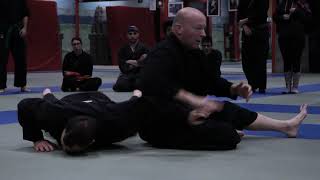
The instructor demonstrates how to establish koshi gatame by first breaking down the opponent with a double-leg technique, driving through the hips. Once the opponent is flattened, the instructor climbs up the opponent's legs methodically, positioning himself to control the hip region. This breakdown creates the foundation necessary for effective hip pin control.
Understanding Koshi Gatame
Koshi gatame, or hip pin, is a grappling position that immobilizes the opponent by controlling the hip and buttock area. This technique is a variation of mune gatame and yoko shiho gatame, though it functions effectively as a standalone pin. The position is particularly valuable because it restricts mobility and prevents the opponent from executing common escapes.
Critical Knee Placement
The fundamental principle of koshi gatame is positioning the inside knee directly under the opponent's buttocks. This knee placement serves as the primary control mechanism, preventing the opponent from rotating or reversing position. Without proper knee positioning, the pin loses its structural integrity and allows escape opportunities.
Basic Hip Control Grip
The instructor secures the opponent's belt or hip area with both arms, creating a locked position around the waist. Once the grip is established, the instructor maintains constant downward pressure while riding out the position. This grip variation is effective when the opponent is wearing a gi with a belt, though hip control is equally viable without one.
Preventing Escape Sequences
By maintaining low hip pressure and keeping the opponent compressed against the mat, the instructor effectively eliminates the opponent's leg mobility and prevents triangle escape attempts. The flat, controlled positioning requires extreme flexibility for the opponent to generate any significant counter-movement. This control of spatial awareness is essential to maintaining the pin.
Transition to Submissions
Koshi gatame serves as an effective transitional position that naturally flows into side control variations and leg lock opportunities, particularly in Sambo applications. From this hip control position, the instructor can seamlessly transition to knee reaps, toe holds, or knee bar submissions. The position's true value lies in its versatility as a control point rather than as a final submission itself.
Distinction from Wrestling Pins
Unlike traditional Western wrestling, achieving koshi gatame does not require pinning the opponent's back flat to the mat. Instead, the technique prioritizes total body immobilization and control, with the opponent held primarily on their side or stomach. The instructor emphasizes that maintaining pressure and restricting movement is the objective, rather than achieving a specific back angle.
Practical Application Summary
Koshi gatame is most effective when employed as a tactical holding pattern that keeps the opponent controlled while the instructor searches for high-percentage submissions. The position's low-profile structure and reliance on knee positioning make it particularly valuable in judo and Sambo competition. Practitioners should view this pin as a control mechanism that opens pathways to multiple finishing techniques rather than as a standalone holding pattern.
KOSHI GATAME BASICS
Key Takeaways
- •Entry and Breakdown Setup
- •Understanding Koshi Gatame
- •Critical Knee Placement
- •Basic Hip Control Grip
Koshi Gatame (Hip Hold or Pin) is not a common pinning technique but is still a basic skill that should be mastered. View hundreds of videos of judo, freestyle judo, Shingitai Jujitsu, sambo, submission grappling and sport jujitsu on our Youtube channel at http://youtube.com/user/welcomematstevescott. The Welcome Mat Judo-Jujitsu Club was founded in 1969. Please subscribe to our Youtube channel if you have not done so already. Visit our web sites at http://www.WelcomeMatJudoClub, http://www.judoblackbelt.com and visit our online store at http://www.WelcomeMatStore.com. Join our premium channel at http://www.grapplingcoach.us. Thank you for watching our video.
Related Techniques
Frequently Asked Questions
What does this video teach about ashi-gatame?
This video covers entry and breakdown setup, understanding koshi gatame, critical knee placement. It provides detailed instruction from welcomematstevescott.
How long does it take to learn ashi-gatame?
The basic mechanics can be understood in a single session, but developing reliable execution requires consistent drilling over weeks of practice. This 8-part breakdown helps structure your training by isolating each phase of the technique.
What are the key details for finishing ashi-gatame?
Unlike traditional Western wrestling, achieving koshi gatame does not require pinning the opponent's back flat to the mat. Instead, the technique prioritizes total body immobilization and control, with the opponent held primarily on their side or stomach. The instructor emphasizes that maintaining pressure and restricting movement is the objective, rather than achieving a specific back angle.
Related videos
PIN FOR TIME AND APPLY THE SUBMISSION TECHNIQUE 2 Pins and 3 Armlocks
welcomematstevescott
TWO SUBMISSION TECHNIQUES FROM BOTTOM JUJI GATAME & SANKAKU JIME
welcomematstevescott
Katame Waza || Grappling Techniques - 32 Holds, Strangles/Chokes and Armlocks
The Judo Way of Life
Waki Gatame - when and how to use it.
Robert Silas (Aiki_and_Jiu)
Waki Gatame into Ura Oni Kudaki - Yossi Sheriff in Madrid
AKBAN Ninjutsu – Yossi Sheriff