Introduction to the Cross Collar Choke
The cross collar choke is a fundamental Brazilian Jiu-Jitsu technique that most beginners execute incorrectly until reaching purple belt level. While it appears to be a simple arm squeeze, the technique contains numerous technical details that determine its effectiveness against both novice and advanced practitioners. This guide deconstructs the mechanics of hand placement, blade positioning, and finishing sequences to develop mastery of this essential submission.
Critical Hand Placement and First Grip Depth
The first grip is the most crucial element of the cross collar choke. The executing hand must cross the opponent's body diagonally to the opposite side and penetrate deeply into the lapel, opening it with the non-gripping hand to maximize depth. The grip is considered sufficient when the thumb, if extended upward, sits well behind the opponent's ear—a depth that most beginners fail to achieve. This deep penetration is necessary because the wrist blade must contact the carotid artery, not the gi material itself.
The Fundamental Principle: Blade Positioning Over Gi Control
A common misconception is that the gi material itself delivers the choke. In reality, the gi serves only as a leverage and fulcrum point, while the bony blade of the wrist executes the actual carotid compression. The blade must span from the wristwatch area approximately four inches along the carotid artery to be effective. Gripping with the softer, muscular portions of the forearm renders the technique ineffective against skilled opponents.
Blade Rotation: The Second Critical Step
After establishing a deep first grip, the practitioner must rotate the blade into direct contact with the carotid artery. Initially, the blade faces upward toward the ceiling, positioning it against ineffective soft tissue. By rotating the wrist so the palm faces upward, the bony blade rotates into the artery's location. This rotation alone begins restricting blood flow, often causing the opponent to begin defending before pressure is even applied.
Securing the Second Grip with Proper Hand Path
The second hand follows a specific path determined by its palm orientation. When executing a palm-up second grip, the hand must pass under the first arm before penetrating as deeply as possible into the lapel. Conversely, a palm-down grip requires passing over the first arm. The second grip does not require the same depth as the first since even partial blade contact on the artery contributes to the overall compression.
Step Three: The Hammer Motion for Compression
Once both hands achieve proper depth and blade rotation, the practitioner executes a ripping motion with the grip as if attempting to tear the gi in half. This action drives the wrist blades deeper into the opponent's neck with maximum intensity. This hammer-like compression, combined with the prior blade rotations, typically initiates active choking even without additional finishing pressure.
Final Control: Closing the Cage and Forcing Submission
The fourth and final step involves bringing both elbows down to the hips while simultaneously pulling the opponent's forehead into the attacker's chest. This creates a progressively tightening cage around the opponent's neck with no escape route. The combination of deep blade pressure, wrist rotation, hammer compression, and directional pulling forces submission before structural damage occurs.
Everything You Need to Know About the Cross Collar Choke | Jiu Jitsu Fundamentals #bjj
Key Takeaways
- •Introduction to the Cross Collar Choke
- •Critical Hand Placement and First Grip Depth
- •The Fundamental Principle: Blade Positioning Over Gi Control
- •Blade Rotation: The Second Critical Step
Join My Online Academy to Improve Your Jiu Jitsu FAST!!! http://academy.mattarroyo.com/home Welcome to your ultimate guide to one of the most classic and effective submissions in Brazilian Jiu-Jitsu — the Cross Collar Choke from closed guard, mount, and beyond. In this masterclass, we break down the hidden details that make this seemingly simple choke devastatingly effective, whether you’re a white belt building fundamentals or a seasoned grappler sharpening your finish rate. 👊 In this video, you’ll learn: ✅ Key grip placements for maximum pressure ✅ Angle, posture breaks, and how to set the trap ✅ Common mistakes and how to fix them ✅ Variations from closed guard, mount, and back control ✅ Timing, pressure, and clean finishes This is essential knowledge for building a dangerous gi game and developing a submission system that works at every level. 🔥 Choke smart. Choke smooth. Choke sharp. 👉 Like, drop a comment, and subscribe for more BJJ technique breakdowns and strategy. #BJJ #JiuJitsu #CrossCollarChoke #ChokeMasterclass #GiChokes #BrazilianJiuJitsu #BJJTechniques #SubmissionGrappling #BJJFundamentals #SelfDefense #JiuJitsuLifestyle
Frequently Asked Questions
What does this video teach about cross collar choke?
This video covers introduction to the cross collar choke, critical hand placement and first grip depth, the fundamental principle: blade positioning over gi control. It provides detailed instruction from Matt Arroyo Jiu Jitsu .
How long does it take to learn cross collar choke?
The basic mechanics can be understood in a single session, but developing reliable execution requires consistent drilling over weeks of practice. This 7-part breakdown helps structure your training by isolating each phase of the technique.
What are the key details for finishing cross collar choke?
Once both hands achieve proper depth and blade rotation, the practitioner executes a ripping motion with the grip as if attempting to tear the gi in half. This action drives the wrist blades deeper into the opponent's neck with maximum intensity. This hammer-like compression, combined with the prior blade rotations, typically initiates active choking even without additional finishing pressure.
Related videos
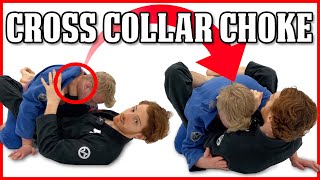
How to Actually FINISH The Cross Collar Choke from Guard
Stephan Kesting

Cross Collar Choke - Fundamentals Made Easy
Jordan Teaches Jiujitsu
A Better Way to Do the Cross Collar Choke- Greg Melita
Bernardo Faria BJJ Fanatics
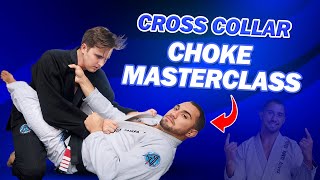
Everything You Need to Know About the Cross Collar Choke | Jiu Jitsu Fundamentals #bjj
Matt Arroyo Jiu Jitsu
Head And Arm Rear Naked Choke by Heath Pedigo
BJJ Fanatics