Body Triangle Fundamentals
The body triangle is the most controlling position available while attacking from the back. Unlike cranking pressure, proper body triangle control relies on a light lock combined with a knee pinch that restricts the opponent's diaphragm. This technique allows sustained control with minimal energy expenditure.
Foot Placement and Ankle Security
Proper foot positioning prevents the opponent from rolling to the other side or applying leverage against the ankle. The lock should be placed high enough to prevent the opponent from stepping over it, while maintaining control without exposing the foot to dangerous counter-pressure. If the lock is compromised low, the defender can insert their heel into their own knee to prevent leg extension.
Attacking from the Body Triangle
The ideal scenario occurs when the opponent goes belly-down, exposing their back completely. From this position, the attacker can use a tight hand grip to drive the opponent backward and control their posture. Going belly-down is dangerous for the defender as it concentrates all upper body weight on the diaphragm, risking both submission and serious injury.
Positional Framework: High Lock, Low Underhooks
Maintain the body triangle lock on the high side of the opponent's torso while keeping underhooks on the low side. Keep the head positioned below the opponent's head to prevent escape. This framework prevents the opponent from controlling the attacker's position or escaping to a dominant side.
Adaptation for Shorter Legs
Practitioners with shorter leg length can substitute a foot placement with hand control to achieve similar compression. By stepping on the foot and pinching the knee, the attacker maintains excellent positional control without requiring full diaphragm compression. This variation provides equivalent control while working within physical limitations.
Switching the Body Triangle
When the opponent attempts to rotate to escape, the attacker maintains the lock while pushing the feet backward. The feet should be drawn close to the body before pushing straight back to smoothly transition the lock to the opposite side. This switching motion maintains continuous control without breaking position.
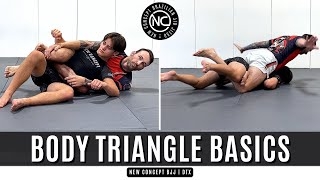
New Concept BJJ | Body Triangle Basics | NoGi Coach Caleb Flippin
Key Takeaways
- •Body Triangle Fundamentals
- •Foot Placement and Ankle Security
- •Attacking from the Body Triangle
- •Positional Framework: High Lock, Low Underhooks
Body Triangle Basics with NoGi Coach Caleb Flippin @NewConceptBJJ Dallas, TX #grappling #bjj #jiujitsu #newconceptbjj #nogi #bjjmoves #bjjtechniques #dallas #grapplingskills #jiujitsutraining #ajj #americanjiujitsu
Related Techniques
Frequently Asked Questions
What does this video teach about over body triangle?
This video covers body triangle fundamentals, foot placement and ankle security, attacking from the body triangle. It provides detailed instruction from New Concept BJJ .
How long does it take to learn over body triangle?
The basic mechanics can be understood in a single session, but developing reliable execution requires consistent drilling over weeks of practice. This 6-part breakdown helps structure your training by isolating each phase of the technique.
What are the key details for finishing over body triangle?
Practitioners with shorter leg length can substitute a foot placement with hand control to achieve similar compression. By stepping on the foot and pinching the knee, the attacker maintains excellent positional control without requiring full diaphragm compression. This variation provides equivalent control while working within physical limitations.
Related videos
Vagner Rocha Savage Body Triangle
Digitsu
Body Triangle Concepts - Code "BLACKFRIDAY" 25% OFF
RVV BJJ
New Concept BJJ | Body Triangle Basics | NoGi Coach Caleb Flippin
New Concept BJJ
Body Triangle Concepts - Code "BLACKFRIDAY" 25% OFF
RVV BJJ
Escape the Body Triangle Every Time in Jiu Jitsu | Jiu Jitsu Tutorial | Matt Arroyo
Matt Arroyo Jiu Jitsu