Foot Placement Errors in Guard Defense
When defending against an opponent in guard position, placing the feet on the hips is a critical mistake that allows for rapid compression lock techniques. Attempting to grab the opponent's feet is ineffective, as they can easily escape with a scissor kick motion. Punching through the pressure created by feet on the hips is also impractical due to the distance control maintained by the opponent.
Basic Knee Compression Mechanics
The compression lock begins by threading one hand through the back of the opponent's knee while placing the other hand on top of their foot. The defender then steps back, driving the opponent's leg between their own legs while sitting on it for control. From this position, the defending hand grasps the femur while the other secures a tight Kimura grip on the wrist before applying sustained pressure.
Two Finishing Variants
The first variant involves falling backward while maintaining hand position inside the knee to maximize mechanical advantage. The second variant uses a stepping motion over the opponent's leg while keeping the hand positioned internally, allowing the defender to crank the submission while remaining upright. Both methods apply direct pressure to the knee joint through the combined leverage of hand and body weight.
Safe Foot Positioning from Guard
Placing feet on the floor leaves them vulnerable to being stepped on, which facilitates the opponent's transition to mount position. The safest guard position requires placing both feet behind and around the opponent's knees, which prevents both foot stomping and easy leg extraction. From this configuration, if the opponent attempts to remove the legs, the defender can grab the ankles and strike with the knees.
Compression Lock on the Arm
When the defender achieves inside control but cannot obtain mount, a compression lock can be applied to the opponent's arm using a Kimura grip on the wrist. Most opponents will clasp their own hands defensively, anticipating an armbar attempt. Once the Kimura grip is secured, the defender sits to one hip and throws the opposite leg over the opponent's arm to apply compression.
Enhanced Arm Compression with Double-Leg Squeeze
If single-leg compression proves insufficient against a strong opponent, a triangle formation can be added using the second leg to create dual-leg pressure that is extremely difficult to resist. The triangle prevents the opponent from posting their arm underneath to relieve pressure. This combined compression targets both the arm and shoulder joint simultaneously.
Sambo-Style Single Leg Takedown Setup
The takedown begins with weight distributed primarily on the back leg, similar to testing thin ice, which keeps the head offline from incoming strikes. As the opponent commits to a punch, the defender slips and steps with the heel aligned to the opponent's heel or foot center. Weight shifts forward as the shoulder strikes the opponent's hip while hands lock in a gable grip with palms facing upward on the back hand.
Takedown Execution and Transition
The defender pushes down with the shoulder while pulling upward with the hands to drive the takedown. Upon landing, one hand is already positioned through the opponent's legs to access the femur. The defender locks both hands around the thigh and either falls backward or throws a leg over the hip to secure the compression lock position.
Achilles Tendon Compression Alternative
If the initial leg takedown fails due to the opponent's defensive hip movement, the defender can switch both hands to target the Achilles tendon area while maintaining shoulder pressure. This technique is particularly effective once the opponent's weight has fully loaded onto that leg, making it difficult to extract or escape. The switch between techniques flows naturally when the initial takedown is defended.
Grip Security for Compression Techniques
Proper grip configuration requires the thumb and fingers to be positioned on opposite sides of the target limb to prevent the opponent from breaking the hold. As the defender sinks the position, they pull the grip while controlling the opponent's leg trajectory. Once sufficient control is established, the leg can be collected to fully secure the compression lock position.
Compression Lock Basics for MMA (Combat Sambo Based)
Key Takeaways
- •Foot Placement Errors in Guard Defense
- •Basic Knee Compression Mechanics
- •Two Finishing Variants
- •Safe Foot Positioning from Guard
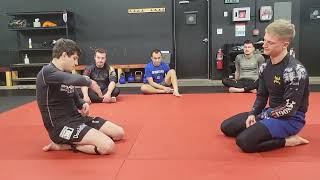
Some basics on compression locks and knee compressions. Combat Sambo based. The Hudson Combat Academy www.HudsonCombat.com FB: https://www.facebook.com/HudsonCombatAcademy IG: https://www.instagram.com/hudsoncombatacademy/ Twitter: https://twitter.com/Combathudson TikTok: https://www.tiktok.com/@hudson.combat Tapology: https://www.tapology.com/gyms/7514-hudson-combat-academy
Frequently Asked Questions
What does this video teach about compression lock?
This video covers foot placement errors in guard defense, basic knee compression mechanics, two finishing variants. It provides detailed instruction from Hudson Combat Academy.
How long does it take to learn compression lock?
The basic mechanics can be understood in a single session, but developing reliable execution requires consistent drilling over weeks of practice. This 10-part breakdown helps structure your training by isolating each phase of the technique.
What are the key details for finishing compression lock?
If the initial leg takedown fails due to the opponent's defensive hip movement, the defender can switch both hands to target the Achilles tendon area while maintaining shoulder pressure. This technique is particularly effective once the opponent's weight has fully loaded onto that leg, making it difficult to extract or escape. The switch between techniques flows naturally when the initial takedown is defended.
Related videos
KNEE COMPRESSION LOCK FROM BACK MOUNT
Alpha BJJ
Head And Arm Rear Naked Choke by Heath Pedigo
BJJ Fanatics
How To Do Rear Ezekiel Choke In Gi & No-Gi
Resenha BJJ
Sode Guruma Jime || Sleeve Wheel Choke
The Judo Way of Life
High Wrist Guillotine Choke Submission in Turtle. Arm In, High Elbow, Side Control, Mount, Butterfly
Pica Pau Jiu Jitsu & Grappling