Introduction to Advanced Triangle Mechanics
The instructor outlines a comprehensive exploration of the triangle choke, focusing on mechanics, control, and variations rather than basic setup. The video emphasizes that while entry techniques are important, the mechanical execution and finishing details are the primary subject matter.
Foundational Triangle Positioning from Closed Guard
The triangle submission is typically initiated from closed guard after controlling opponent posture through methods such as overhook guard or shoulder pin control. The instructor notes that recognizing and countering opponent reactions—including posture recovery, stacking, and pressure—is essential to successful triangle application.
Anti-Stacking Posture and Body Mechanics
To prevent stacking, the practitioner should maintain a hollow-back position with shoulders and head flat on the mat, making it mechanically difficult for the opponent to apply downward pressure. Conversely, rolling up or grabbing the opponent's head creates vulnerability to stacking and should be avoided.
Leg Positioning and Hip Rotation Mechanics
After securing the triangle position with one arm inside, the practitioner places their foot on the opponent's hip and lifts the opponent's leg upward rather than curling with the heel. The hips and entire body rotate to create proper angle, with the calf positioned above the skull base rather than on the neck or back.
Knee Compression and Arm Trapping
Pressing the knees together creates compression pressure on both sides of the opponent's neck while simultaneously trapping the arm—the closer the knees, the greater the pressure and control. The foot on the hip provides additional pressure that makes stacking mechanically ineffective.
Finishing Without Swinging the Top Leg
Rather than swinging the top leg over the opponent's body, the practitioner keeps knee pressure constant and maintains leg alignment in a single line. The finishing technique involves squeezing the legs together to close lateral spaces around the opponent's neck rather than pulling downward on a single angle.
Hand Control of the Shin for Posture Management
One hand controls the practitioner's own shin rather than the foot, preventing ankle injury if the opponent aggressively bases out. The controlling hand is placed as high as possible on the shin, then the knee and elbow are brought together to tighten the triangle further.
Adapting to Arm Movement and Alternative Finishes
If the opponent moves their trapped arm across their body to escape, the triangle remains effective if sufficiently tight. The practitioner can then insert their shoulder into the space created by the arm movement to apply finishing pressure, requiring a tap even if the opponent lifts their head.
Sit-Up Triangle with Full Postural Control
Rather than immediately closing the triangle, the practitioner maintains knee pressure and uses their hands to sit up and slide backward, using the hip foot to prevent the opponent from following. The top leg position is maintained underneath the opponent to increase pressure difficulty the further the practitioner slides away.
Triangle choke advanced details and mixups
Key Takeaways
- •Introduction to Advanced Triangle Mechanics
- •Foundational Triangle Positioning from Closed Guard
- •Anti-Stacking Posture and Body Mechanics
- •Leg Positioning and Hip Rotation Mechanics
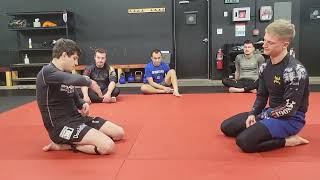
Triangle choke advanced details and mixups Let's look at the sankaku-jime! A well known strangle/submission from various positions and with tons of mixups, details and mechanics. Today we'll show you a few of these from closed guard. Besides control- and finishing mechanics we also take a look at mixing it up with other submissions to expand your game. Chapters 0:00 - Start 0:45 - Introduction 2:01 - Setup and control 3:57 - Finishing mechanics 5:27 - Troubleshooting 6:14 - Triangle weave variation 8:44 - Adding the arms 10:29 - Adding the legs 12:20 - Summary ! Remember to put on notifications to receive an update anytime we drop a new video ! For more content, videos, solo drills and behind the scenes click on this link: https://www.patreon.com/Energia_martialarts?fan_landing=true Visit BJJ Fanatics for Leglocks Unlocked: https://bjjfanatics.com/collections/all/products/the-keys-to-leg-locks-by-tum-energia-voorn To check out our gear go to: https://www.energia-martialarts.com/gear Instagram: @Tumenergia Instruction: Tum Energia Assisting: Tom Holthausen Video and editing: Bastiaan Rijkse Music: Mr. Ortiz #triangle #sankaku #triangle choke #kimura #bjj #submission #energiamartialarts #strangle #submissiongrappling #mma #brazilianjiujitsu #UFC #submission #leglock #rearnaked choke #headlock
Related Techniques
Frequently Asked Questions
What does this video teach about choke and strangle lock?
This video covers introduction to advanced triangle mechanics, foundational triangle positioning from closed guard, anti-stacking posture and body mechanics. It provides detailed instruction from Energia Martial Arts.
How long does it take to learn choke and strangle lock?
The basic mechanics can be understood in a single session, but developing reliable execution requires consistent drilling over weeks of practice. This 9-part breakdown helps structure your training by isolating each phase of the technique.
What are the key details for finishing choke and strangle lock?
If the opponent moves their trapped arm across their body to escape, the triangle remains effective if sufficiently tight. The practitioner can then insert their shoulder into the space created by the arm movement to apply finishing pressure, requiring a tap even if the opponent lifts their head.
Related videos
How To Improve Your Baseball Choke In Less Than One Week | BJJ
BIG OSS Jiu-Jitsu Channel
Head And Arm Rear Naked Choke by Heath Pedigo
BJJ Fanatics
How To Do Rear Ezekiel Choke In Gi & No-Gi
Resenha BJJ
Sode Guruma Jime || Sleeve Wheel Choke
The Judo Way of Life
High Wrist Guillotine Choke Submission in Turtle. Arm In, High Elbow, Side Control, Mount, Butterfly
Pica Pau Jiu Jitsu & Grappling