Initial Approach and Setup
The instructor began without formal instruction, setting an initial goal of consistently striking a wooden target from 10 feet away with three consecutive throws. A wooden target was prepared on the floor to begin practice.
Problem Identification: Angle and Rotation
Early attempts revealed that the shuriken rarely adhered to the target. The floor-mounted target created a downward angle that, combined with the shuriken's forward rotation, caused the blade to strike at oblique angles and bounce away rather than penetrate.
Technical Refinement: Momentum and Release
To improve penetration, the instructor adopted a straight rocking motion during the throw to generate forward momentum. Careful attention was paid to release timing, and the blades were sharpened to increase the likelihood of successful stick. Despite these modifications, consistent three-strike success remained elusive.
Grip Techniques: Trigger vs. Pinch
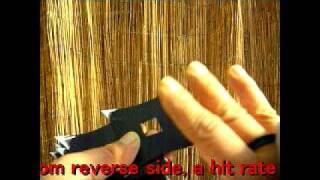
Two primary grip methods exist in shuriken throwing. The trigger grip, similar to holding a firearm, offers less accurate aiming despite the ability to use arm alignment as reference. The pinch grip, holding one point between thumb and index finger with alignment to the thumb, is the preferred alternative method.
Fundamental Throwing Motion
Regardless of grip selection, the core technique requires bringing the shuriken to ear level, then executing a straight forward motion as if pointing at the target. This controlled, linear movement forms the foundation of accurate shuriken throwing.
Initial Success: Board Strikes
After consistent practice and refinement of technique, the instructor successfully achieved three consecutive strikes on the wooden board. This milestone demonstrated that proper form and repetition yielded measurable improvement.
Advanced Challenge: Moving Target
To develop greater precision, the instructor established a secondary objective of striking a stationary apple from 15 feet away. The significantly reduced target size and distance presented a notable difficulty increase compared to the wooden board.
Mastery and Conclusion
After extended practice with the smaller target, the instructor successfully struck the apple with clean penetration. This achievement demonstrated that proper technique, combined with focused repetition on progressively difficult targets, produces reliable accuracy in shuriken throwing.
Learning to Throw Shuriken with no Experience
Key Takeaways
- •Initial Approach and Setup
- •Problem Identification: Angle and Rotation
- •Technical Refinement: Momentum and Release
- •Grip Techniques: Trigger vs. Pinch
Want to call me to talk about learning this or other skills? - https://clarity.fm/leobigio I try learning a new skill every week documenting the entire process! Subscribe for more content like this here: https://www.youtube.com/channel/UCe9Lq-GT2LG-ZQ9jjtayO_w?sub_confirmation=1 I post on Instagram too ► @skillsleo Business Inquiries ► [email protected]
Frequently Asked Questions
What does this video teach about standard hira-shuriken?
This video covers initial approach and setup, problem identification: angle and rotation, technical refinement: momentum and release. It provides detailed instruction from SkilLeo.
How long does it take to learn standard hira-shuriken?
The basic mechanics can be understood in a single session, but developing reliable execution requires consistent drilling over weeks of practice. This 8-part breakdown helps structure your training by isolating each phase of the technique.
What are the key details for finishing standard hira-shuriken?
To develop greater precision, the instructor established a secondary objective of striking a stationary apple from 15 feet away. The significantly reduced target size and distance presented a notable difficulty increase compared to the wooden board.