Setup: Defending the Underhook from Guard
When an opponent secures an underhook while in the guard, they gain a pathway to the practitioner's back through the shrimp escape. To prevent this transition, the top player cups the opponent's shoulder and prepares to transition into the scissor lock position.
Initial Leg Placement and Base Control
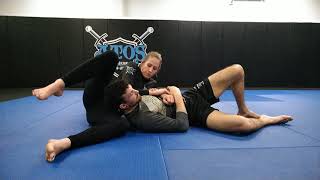
The practitioner places their bottom leg on the mat as a root point, then falls to their side. The top leg comes over and across, turning the opponent's face toward the practitioner while preventing them from sitting up or pulling their elbow back. This positioning isolates the opponent's arm for the finish.
Securing the Shoulder Lock Position
With the opponent's face turned inward, the practitioner makes a fist at the opponent's wrist and brings their elbow forward while driving their hips into the opponent's body. This creates strong hip penetration and keeps the shoulder pinned down throughout the transition.
Leg Configuration and Hip Rotation
The practitioner maintains a bend in the top leg and walks it out toward the opponent's elbow while keeping the bottom leg positioned underneath. By squeezing the legs together with internal hip rotation, the bottom leg pins the shoulder while the top leg isolates and twists the arm, creating pressure on the shoulder joint.
Critical Detail: Maintaining Bend in the Leg
Many practitioners make the mistake of straightening their top leg, which eliminates lifting power. The practitioner must keep a significant bend in this leg to generate the upward force needed to lift the opponent's elbow while simultaneously keeping the shoulder pinned to the mat.
Foot Placement Under the Head
The practitioner's foot placement is crucial for maintaining control. The foot must go under the opponent's head and be positioned underneath the top leg, creating a wall that prevents the opponent from opening space or creating leverage to escape.
Responding to the Leg Push Defense
When the opponent pushes the top leg over their head to sit up and unwind, the practitioner immediately straightens the bottom leg and places their boot on the opponent's torso. This heavy pressure prevents sitting up while still allowing the opponent to turn inward.
The Scooping Hook and Toe Placement
As the opponent turns into the lock, the practitioner scoops their head with their foot while posting the toe into the mat. This toe placement generates internal hip rotation that keeps the shoulder pinned down—without it, the practitioner loses pressure on the shoulder and the opponent can escape.
The Finishing Sequence
With the arm isolated and the shoulder pinned, the practitioner grabs the opponent's shoulder, drives their hips forward, and brings their elbow in. The top leg comes out with a 90-degree bend maintained while the practitioner internally rotates the hips to finish the shoulder lock submission.
Head Position and Choke Variations
The direction the opponent's head faces determines the type of finish. With the head facing the practitioner, a controlled choke finish is most effective. If the opponent looks straight up, they receive a trachea crush; if they look away, the calf pressure still applies, making the bottom leg-on-top configuration essential for maintaining control.
04 Crusafix shoulder lock and straight headscissor
Key Takeaways
- •Setup: Defending the Underhook from Guard
- •Initial Leg Placement and Base Control
- •Securing the Shoulder Lock Position
- •Leg Configuration and Hip Rotation
This is a sneaky little submission off of the darce defense. The important details are maintaining control til you get the tap. The escape here is pretty easy if you don't: 1) lock with the correct ankle 2) maintain top leg pressure 3) react if and when he passes your leg up to start to turn in and sit up 4) move your leg when he start to sit up Watch that your submitting leg is bent Telegram Chat: https://t.me/joinchat/LAQGexayTdmvHYBWuSbH_g The Facebook Group: https://www.facebook.com/groups/Gaywrestlingcommunity/ The videos on this channel are intended to be viewed in order, please go through the play lists in their numbered order as well as the videos in their numbered order. The whole point of this channel is to improve your wrestling and grow community. The content you see is influenced by you so don't be shy about asking questions or making suggestions. Feel free to ask the become a contributor if you have a skillset which you think will be valuable. The channel e-mail is [email protected] so shoot me a line if you don't want to ask in public.
Related Techniques
Frequently Asked Questions
What does this video teach about headscissors from guard?
This video covers setup: defending the underhook from guard, initial leg placement and base control, securing the shoulder lock position. It provides detailed instruction from Gay Wrestling classes.
How long does it take to learn headscissors from guard?
The basic mechanics can be understood in a single session, but developing reliable execution requires consistent drilling over weeks of practice. This 10-part breakdown helps structure your training by isolating each phase of the technique.
What are the key details for finishing headscissors from guard?
With the arm isolated and the shoulder pinned, the practitioner grabs the opponent's shoulder, drives their hips forward, and brings their elbow in. The top leg comes out with a 90-degree bend maintained while the practitioner internally rotates the hips to finish the shoulder lock submission.
Related videos
FALLON gets SUBMITTED by two girls 👯♀️| with beginner tips and narration
Fallon Fratone
BJJ Defended Arm Bar Alternate Submissions Tutorial
Stuart Tomlinson
Reverse Headscissors - NAGA Grappling Competition Classic
Judo Queens Only
MUST SEE Head Scissor Choke
Brandon Quick
Scissor Choke Tutorial by Nikki Sullivan
nicsulli