Opening Direct Attack
The opponent opens with a fast, committed attack. The instructor could have countered with a hanging guard parry but allows the exchange to develop naturally.
Hand Cut and Guard Selection
A cut targets the hand from the opponent. The instructor demonstrates awareness of defensive options, such as the hanging guard, while choosing to engage differently based on tactical considerations.
Extended Reach Through Lowered Angles
The opponent executes a quick cut to the legs by lowering the blade angle to gain additional reach. This tactical adjustment showcases dynamic footwork and creative distance management.
Student-to-Opponent Dynamic
The opponent was formerly the instructor's student before pursuing competitive longsword fencing. The match carries additional competitive tension given their shared training history.
Hanging Guard Transition to Countercut
The instructor executes a high cut from a hanging guard position, then smoothly transitions into a cut to the hand. This combination demonstrates efficient guard switching and technical fluency.
Leaving the Line Risks
The instructor notes that disengaging and leaving the line of attack does not always provide adequate defense against highly dynamic opponents. Footwork quality and timing prove more decisive than simple evasion.
Moulinet into Thrust—Cut to Thrust Transition
The opponent executes a signature technique: a cut that transitions into a thrust via a curved blade rotation, similar to a longsword moulinet. The instructor identifies this as a cut followed by a thrust in second position.
Interception Under Flying Attack
When the opponent launches an aggressive flying attack, the instructor responds with a dig and countercut. The defensive action successfully disrupts the opponent's follow-up attack.
Parry-Riposte in Quarte
The instructor achieves a clean scoring touch through a parry in quarte position followed by an inside-head riposte. This classical response demonstrates the effectiveness of proper defensive positioning.
HEMA traditionalist vs. tournament fighter - who would win in sparring? What is better in bouting?
Key Takeaways
- •Opening Direct Attack
- •Hand Cut and Guard Selection
- •Extended Reach Through Lowered Angles
- •Student-to-Opponent Dynamic
At the Kontrafechten fencing gathering of @die.freifechter I meet an old student of mine. Tobias Thomé from the Karlsgarde in Aachen focuses more and successfully on his carrier in HEMA longsword tournaments (but I suggest he would participate in sabre competitions for historical fencing as well). So he adapted his style of fencing for competitive fighting especially his footwork which changed from the more linear old school saber footwork to what you find in boxing (a method which worked before when the world war II instructions for bajonette fighting starts to use boxing footwork instead of fencing, because it was more common these days). So you could see a clash of styles when I as a traditionalist fight against him. But after all both of us could be satisfied, maybe we should reduce our doubles ;-) but it was very interesting! So if you want to learn HEMA in Aachen Germany you can come to Mispeldorn and learn what you see most on this channel, from now on you could also join the Karlsgarde with Tobias and his friends for Longsword in Aachen city. (Of course there are still Milites Liberi and Brückenschlag) See some of our books and translations here: https://www.epubli.de/shop/autor/Oliver-Janseps/30604 https://www.lulu.com/spotlight/oliverjanseps
Frequently Asked Questions
What does this video teach about standard military sabre guard?
This video covers opening direct attack, hand cut and guard selection, extended reach through lowered angles. It provides detailed instruction from Oliver Janseps.
How long does it take to learn standard military sabre guard?
The basic mechanics can be understood in a single session, but developing reliable execution requires consistent drilling over weeks of practice. This 9-part breakdown helps structure your training by isolating each phase of the technique.
What are the key details for finishing standard military sabre guard?
When the opponent launches an aggressive flying attack, the instructor responds with a dig and countercut. The defensive action successfully disrupts the opponent's follow-up attack.
Related videos

Lesson 24 - Royal Rap - Form 1 Basic Outside Arm Parry
Rogue Saber Academy

Infantry Sword Exercise Manual, 1817, by Henry Angelo
Academy of Historical Fencing
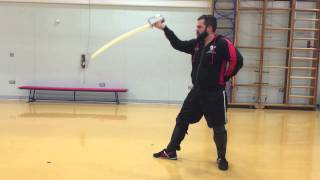
Military sabre guards lesson 2
Academy of Historical Fencing
Military Sabre Fencing - Grips and Disarms
scholagladiatoria
British Military Sabre Instruction - Cut 3 and 4
Espada Negra