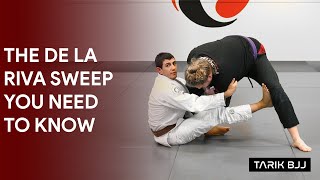
De La Riva Foundation & Back Take Objective
The Baby Bolo sweep is an advanced De La Riva technique that transitions into a back take when executed properly. This follow-up assumes the practitioner understands basic De La Riva structure and positioning. Understanding the fundamental mechanics allows the student to pursue the optimal outcome: a clean back take from bottom position.
Controlling the Collar & Upper Body Dominance
Establishing collar control is essential for maintaining upper body control in De La Riva. The practitioner should consistently seek collar control as it limits the opponent's escape options and creates maximum attacking opportunities. When the opponent inevitably grips back, the instructor can elect to transition directly to a sweep or pursue the back take variation.
The Belt Grip Setup
As the opponent defends by pushing outward, they expose their hip line and abdomen, creating the window for the belt grip. The practitioner cups the hip bone using the elbow and palm, securing the grip directly in front of the opponent's hip. In live training, practitioners may grab the waistband or pants if the belt is unavailable, maintaining arm-to-hip-bone contact as a reference frame to control the opponent's hips.
Forcing the Hip Escape & Creating Space
The practitioner initiates movement by stepping away from the mat while maintaining belt control, forcing the opponent to step backward to avoid being swept. The directional pressure should come at approximately 45 degrees behind the opponent's body, a direction that is mechanically difficult to resist. This positioning allows the practitioner to maintain ankle connection while controlling the opponent's stepping pattern.
Ankle Control & Preventing Reversal
Once the opponent steps back, the practitioner transfers ankle control to the far side, gripping the front of the ankle rather than the heel or pants. Controlling the front ankle prevents the opponent from kicking the leg forward to regain their original angle. This diagonal control (hip on near side, ankle on far side) locks down the opponent's lower body and prevents reversal attempts.
Positioning & Hip Adjustments
The practitioner advances their position incrementally, using flexibility or bicycle kicks with the bottom leg to create space for the top leg entry. As the left leg extends, the head moves left to open the hip and make room for proper positioning. These small adjustments ensure the practitioner achieves optimal leverage before executing the sweep.
Executing the Reverse Hip Escape & Belt Grip
From the advanced position, the practitioner performs a reverse hip escape to create another control point on the opponent's far-side knee. The practitioner then sits up and reaches the far-side belt with the elbow, securing the grip with careful timing. The near-side hip control is maintained throughout this transition to prevent the opponent from escaping.
The Finishing Flip & Back Take
As the practitioner pulls with the belt grip, they simultaneously extend their legs to flip the opponent over their body. It is critical to ensure the opponent's weight is properly distributed on the practitioner's chest to prevent the opponent from falling face-first. Once the opponent is flipped to their back, the practitioner immediately adjusts their level and position to secure the back take.
Alternative: Double Ankle Sweep When Standing
If the opponent stands tall and escapes the belt grip, the practitioner can transition to a double ankle sweep by releasing the hip control and securing both ankles. The practitioner drives forward to place the opponent on hands and knees, then immediately transitions to back control. This alternative maintains pressure when the primary back take is unavailable.
Misdirection Through Opposite-Direction Pressure
Throughout the sequence, the practitioner applies pressure in the opposite direction of their intended attack to keep the opponent reactive and off-balance. By bringing the opponent's collar either to the mat or creating stepping pressure, the practitioner forces the opponent into defensive positions. This misdirection maximizes the effectiveness of the subsequent back take attack.
Beginners MUST KNOW This One!!: BABY-BOLO - Taking the Back from De La Riva
Key Takeaways
- •De La Riva Foundation & Back Take Objective
- •Controlling the Collar & Upper Body Dominance
- •The Belt Grip Setup
- •Forcing the Hip Escape & Creating Space
Channel membership:https://www.youtube.com/channel/UCfh3HutIO8BkpPbRvV8T1rw/join I wear @shoyoroll kimonos in all videos!: https://shoyoroll-uk.myshopify.com/ Chapters: - 00:00 Intro - 00:22 Baby-Bolo Entry - 03:18 Bolo Back Take - 05:08 Double Ankle Pick - 06:22 Bolo with the Belt Grip - 07:47 Sit Up Sweep - 10:56 Outro My Gadgets: - Main Camera: https://amzn.to/3scRpMv - Second Camera: https://amzn.to/3vOf5ZD - Wireless Microphone: https://amzn.to/2OOVUhP - Second Microphone: https://amzn.to/2NIzdLF - Lighting: https://amzn.to/31bWBnC - Sd Card: https://amzn.to/2OQcL3T - Micro Sd Card: https://amzn.to/3d1DT7Z - Sd Card Reader: https://amzn.to/3sdtkFc Inquiry of private lesson and seminar: [email protected] #BJJin4K #DeLaRIva #BackTake #BJJ #Jiujitsu
Related Techniques
Frequently Asked Questions
What does this video teach about baby bolo sweep?
This video covers de la riva foundation & back take objective, controlling the collar & upper body dominance, the belt grip setup. It provides detailed instruction from 玉木強 / YOSHI JIU-JITSU TECH.
How long does it take to learn baby bolo sweep?
The basic mechanics can be understood in a single session, but developing reliable execution requires consistent drilling over weeks of practice. This 10-part breakdown helps structure your training by isolating each phase of the technique.
What are the key details for finishing baby bolo sweep?
If the opponent stands tall and escapes the belt grip, the practitioner can transition to a double ankle sweep by releasing the hip control and securing both ankles. The practitioner drives forward to place the opponent on hands and knees, then immediately transitions to back control. This alternative maintains pressure when the primary back take is unavailable.