Introduction to Butterfly Guard Belt Grip
The butterfly guard is a fundamental position for smaller or lighter practitioners seeking to control distance and maintain leverage against larger opponents. This instructional sequence demonstrates how to establish a secure belt grip from butterfly guard, a critical prerequisite for executing the over-under sweep effectively.
Foundational Butterfly Guard Positioning
Proper butterfly guard mechanics require bent knees positioned at an optimal angle, with heels maintained at a specific distance from the buttocks to maintain a strong base without becoming vulnerable to leg straightening. The practitioner should maintain a lower head position than the opponent, ideally positioned under the opponent's chin to establish dominance in the upper body positioning.
The Modified Arm Drag Setup
Rather than attempting a direct underhook or belt grab against a resisting opponent, the arm drag creates an opening through baiting behavior. The practitioner initiates the arm drag by securing the bicep and tricep area with a C-clamp grip (monkey grip), pulling the opponent's arm toward the sternum to fold and control their posture.
Exploiting the Opponent's Counter-Pull
When the opponent resists the arm drag by pulling backward, this counter-movement creates the ideal opportunity to transition underneath. While the opponent is focused on their counter-pull, the practitioner slides underneath and secures the belt grip with their hips switched, achieving a buried chest position close to the opponent's center of mass.
Controlling the Post and Grip Points
Once the belt grip is established, the practitioner must control the opponent's posting arm by gripping the tricep. The sweep direction follows a linear path along the opponent's body from buttocks through the lat muscle to the shoulder, with the opponent's arm post being the primary defensive concern during execution.
Generating Lift Through Shoulder Dip Mechanics
The critical technical detail involves dipping the shoulder downward to elevate the opponent's center of gravity and lift their buttocks off the mat. This anatomically sound approach differs from attempting to lift solely with the leg and arm, as the shoulder dip automatically compromises the opponent's base structure.
Execution and Leg Drive
With the shoulder dip applied and the opponent's base disrupted, the practitioner plants their driver leg on the knife edge of the foot and initiates lifting action. The driver leg provides the mechanical leverage necessary to complete the sweep rotation, allowing the practitioner to advance to side control or scarfhold position.
Threading the Needle—Timing and Positioning
The needle threading technique (double underhook position) provides additional lift and base stability but must be timed correctly. Premature threading allows the opponent to grip the pants leg and neutralize the sweep momentum, so threading should only be initiated after establishing initial lifting momentum or when encountering significant base defense.
Butterfly Guard - Obtaining the Belt Grip
Key Takeaways
- •Introduction to Butterfly Guard Belt Grip
- •Foundational Butterfly Guard Positioning
- •The Modified Arm Drag Setup
- •Exploiting the Opponent's Counter-Pull
Butterfly guard theory and using the arm drag threat to get the underhook and the sweep
Related Techniques
Frequently Asked Questions
What does this video teach about standard front belt grip?
This video covers introduction to butterfly guard belt grip, foundational butterfly guard positioning, the modified arm drag setup. It provides detailed instruction from Grove City Brazilian Jiu Jitsu Academy.
How long does it take to learn standard front belt grip?
The basic mechanics can be understood in a single session, but developing reliable execution requires consistent drilling over weeks of practice. This 8-part breakdown helps structure your training by isolating each phase of the technique.
What are the key details for finishing standard front belt grip?
With the shoulder dip applied and the opponent's base disrupted, the practitioner plants their driver leg on the knife edge of the foot and initiates lifting action. The driver leg provides the mechanical leverage necessary to complete the sweep rotation, allowing the practitioner to advance to side control or scarfhold position.
Related videos
Aikido: Koryu Dai Roku - 26. Kote-mawashi (Defensive Knife)
Kaze Uta Budo Kai / Windsong Dojo
Aikido: Koryu Dai Roku - 26. Kote-mawashi (Defensive Knife)
Kaze Uta Budo Kai / Windsong Dojo
Grip Fighting: Drills for Self Defense
Stay Safe Martial Arts
1 Rule for Grip Fighting Every White Belt Should Know
Chewjitsu
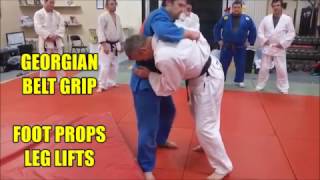
GEORGIAN BELT GRIP FOOT SWEEPS LEG LIFT THROWS
welcomematstevescott