Technique Overview: Kote-mawashi
Kote-mawashi is a defensive response to a downward knife strike followed by a recovery attempt. Unlike the previous two techniques where the attacker simply strikes downward, here the attacker resets and prepares to strike again. The defender must intercept at the end of the attacking arm and execute a circular wrist control to neutralize the threat.
Common Error: Attempting Mawashi Behind the Arm
A frequent mistake occurs when the defender attempts to control the mawashi by positioning behind the attacker's arm. This approach becomes problematic against larger or stronger opponents, as the defender lacks sufficient mechanical advantage to bend the wrist effectively. The position is biomechanically unsound and relies entirely on superior strength.
Correct Hand Placement: Alignment with the Arm
Instead of circling behind the arm, the defender should align their hand with the attacker's arm and apply pressure across the palm. This alignment allows the defender to control the shoulder rotation and generate power along the natural line of the mawashi technique. The hand remains flat against the palm rather than attempting to grip around the wrist.
Dynamic Execution and Cyclical Motion
The mawashi technique functions most effectively when applied with dynamic, flowing movement rather than static force. The defender cycles their hand back and forward, maintaining contact with the attacker's palm to guide the arm into the proper position. Proper timing and continuous motion prove more effective than relying on physical strength alone.
Disarming Through Finger Extension
Once the mawashi controls the wrist, continued pressure bends the hand downward, forcing the fingers to splay open naturally. This mechanical response causes the knife to release from the attacker's grip, allowing the defender to safely disarm and control the weapon. The technique mirrors the disarming principle from Sankata, utilizing hand extension rather than grip strength.
Alternative Disarming Against Resistant Opponents
Against an exceptionally strong or resistant opponent whose fingers do not readily release the knife, the defender may use controlled foot pressure on the attacker's fingers to force the grip open. This escalation requires careful control to avoid unnecessary injury, though street applications may demand more aggressive force. The defender maintains arm control while using the foot to separate the attacker from the weapon.
Complete Technique Sequence
The defender steps off the line to the inside and grabs the opposite hand, then trades hand position to establish better control during the cyclic motion. The non-controlling hand pushes continuously as the defender cycles backward until achieving full mawashi control. This hand transition provides stability and control throughout the technique's execution, representing the most challenging aspect of proper application.
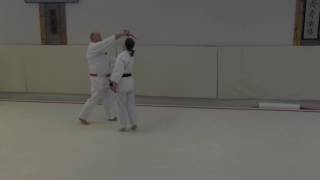
Aikido: Koryu Dai Roku - 26. Kote-mawashi (Defensive Knife)
Key Takeaways
- •Technique Overview: Kote-mawashi
- •Common Error: Attempting Mawashi Behind the Arm
- •Correct Hand Placement: Alignment with the Arm
- •Dynamic Execution and Cyclical Motion
Exploration of the techniques in aikido's Koryu Dai Roku kata. This is the 6th advanced kata in Tomiki aikido. Tanto Dori (Section D – Standing Techniques, Hand against Knife) - Kote-mawashi (Defensive Knife) http://www.windsongdojo.com http://www.kazeutabudokai.com
Related Techniques
Frequently Asked Questions
What does this video teach about mawashi grip?
This video covers technique overview: kote-mawashi, common error: attempting mawashi behind the arm, correct hand placement: alignment with the arm. It provides detailed instruction from Kaze Uta Budo Kai / Windsong Dojo.
How long does it take to learn mawashi grip?
The basic mechanics can be understood in a single session, but developing reliable execution requires consistent drilling over weeks of practice. This 7-part breakdown helps structure your training by isolating each phase of the technique.
What are the key details for finishing mawashi grip?
Against an exceptionally strong or resistant opponent whose fingers do not readily release the knife, the defender may use controlled foot pressure on the attacker's fingers to force the grip open. This escalation requires careful control to avoid unnecessary injury, though street applications may demand more aggressive force. The defender maintains arm control while using the foot to separate the attacker from the weapon.
Related videos
Aikido: Koryu Dai Roku - 26. Kote-mawashi (Defensive Knife)
Kaze Uta Budo Kai / Windsong Dojo
Butterfly Guard - Obtaining the Belt Grip
Grove City Brazilian Jiu Jitsu Academy
Grip Fighting: Drills for Self Defense
Stay Safe Martial Arts
1 Rule for Grip Fighting Every White Belt Should Know
Chewjitsu
GEORGIAN BELT GRIP FOOT SWEEPS LEG LIFT THROWS
welcomematstevescott