Setup and Initial Positioning
The instructor begins from a collar-and-sleeve grip with one foot forward and one foot back. The practitioner takes a deliberate step around the opponent while dragging the sleeve grip to force the opponent to step with their opposite leg, walking them into position for the technique.
Transition from Inside Hook Sweep
This technique serves as a continuation when the inside hook sweep setup fails to sufficiently off-balance the opponent. When the opponent takes a large step back and escapes the hook position, the practitioner must immediately transition to the ankle pick counter.
Establishing the Ankle Pick
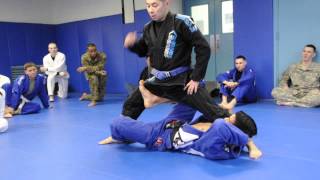
Once the hook position is lost, the instructor grabs the opponent's ankle while maintaining the collar grip. The practitioner off-balances the opponent backward, creating an unstable single-leg position where the opponent has only one foot on the floor while the practitioner maintains a two-foot base.
Positional Advantage and Takedown Mechanics
From the ankle pick position, the practitioner can either step behind the opponent's leg or apply pressure through the collar while maintaining the ankle grip. The key principle is maintaining balance superiority: the practitioner remains upright on both feet while the opponent is compromised on a single leg, creating the mechanical advantage needed for the takedown.
The Drive and Leg Removal
As the takedown initiates, the practitioner pushes their hips forward while walking the opponent's leg around their body. This hip pressure combined with leg control allows the practitioner to complete the technique without landing directly in the opponent's guard, instead finishing in side control or knee-on-belly position.
Pushing vs. Pulling Mechanics
A critical distinction in the ankle pick is the direction of force applied. When the opponent's weight shifts, the practitioner must push the opponent away rather than pull them closer, which would enable the opponent to lift their leg. By driving the opponent backward while controlling the ankle, the leg becomes heavy and difficult to defend.
Completion and Follow-up Positioning
The practitioner steps behind the opponent and completes the takedown by walking them all the way through to the ground. Whether finishing in side mount, knee-on-belly, or guard position, the outcome remains favorable—the opponent is grounded, and the practitioner maintains top position and control.
Application in Self-Defense Context
In self-defense scenarios, the ankle pick takedown provides a safe, controlled method of neutralizing threats without striking. Rather than punching or kicking, the practitioner uses the ground itself as the defensive tool, allowing the opponent's own momentum to absorb impact during the takedown.
Fundamental Jiu-jitsu - Ankle Pick Takedown
Key Takeaways
- •Setup and Initial Positioning
- •Transition from Inside Hook Sweep
- •Establishing the Ankle Pick
- •Positional Advantage and Takedown Mechanics
Fundamental Jiu-jitsu - ankle Pick from failed Hook sweep To schedule a Free intro class go to www.BrownsvilleBJJ.com or call us at 956 254 3988. Galvan's Martial Arts 2310 N. Expressway 83 Suite A1 Brownsville, Texas
Related Techniques
Frequently Asked Questions
What does this video teach about ankle pick x-guard?
This video covers setup and initial positioning, transition from inside hook sweep, establishing the ankle pick. It provides detailed instruction from Galvan's Martial Arts in Brownsville.
How long does it take to learn ankle pick x-guard?
The basic mechanics can be understood in a single session, but developing reliable execution requires consistent drilling over weeks of practice. This 8-part breakdown helps structure your training by isolating each phase of the technique.
What are the key details for finishing ankle pick x-guard?
The practitioner steps behind the opponent and completes the takedown by walking them all the way through to the ground. Whether finishing in side mount, knee-on-belly, or guard position, the outcome remains favorable—the opponent is grounded, and the practitioner maintains top position and control.