Initial Control Position
The practitioner establishes control by gripping the opponent's gi at the elbow and tucking their arm into their body. This positioning creates the foundation for executing sweep variations based on the opponent's defensive responses.
Standard Butterfly Sweep Setup
The first technique attempted is a standard butterfly sweep. The practitioner places one foot on the opponent's hip while the other rests on the inside of the knee, creating an angled position for the sweep entry.
Sweep Execution and Point Scoring
The practitioner leans to their shoulder while pulling with the collar grip and sweeps the leg over. By maintaining leg contact after the initial sweep, the practitioner can score five points even if the opponent achieves a partial guard position.
Recognizing the Crush Defense
When the initial sweep fails and the opponent postures forward to crush the guard, the practitioner must quickly transition. The key indicator is when the opponent's hand approaches the practitioner's back, a common defensive positioning.
Overhook and Leg Hook Grip
As the opponent's hand contacts the back, the practitioner immediately secures an overhook on the arm while simultaneously hooking the swept leg on the opposite side. This grip structure prevents the opponent from passing the guard by collapsing forward.
Forcing the Hand Trap
The practitioner pushes into the opponent's body to encourage them to tighten their grip, then leans back sharply to trap their hand on the floor. This manipulation removes the opponent's base and creates the opening for the reverse sweep.
Reverse Sweep Execution
With the opponent's hand trapped and their base compromised, the practitioner lifts with the hooked leg to execute the reverse sweep. Immediately upon completion, the practitioner prepares to control the opponent's leg as they attempt to turn into the guard.
Follow-Up Control and Sequence Awareness
The practitioner catches the opponent's leg as they turn inward and drives forward with head pressure. The instructor emphasizes that repetition of this sequence develops into a recognizable pattern that becomes part of the practitioner's established game.
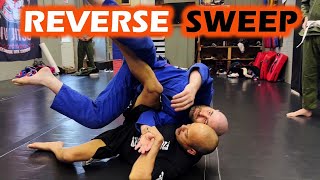
33a Reverse Butterfly Sweep
Key Takeaways
- •Initial Control Position
- •Standard Butterfly Sweep Setup
- •Sweep Execution and Point Scoring
- •Recognizing the Crush Defense
Related Techniques
Frequently Asked Questions
What does this video teach about reverse butterfly sweep?
This video covers initial control position, standard butterfly sweep setup, sweep execution and point scoring. It provides detailed instruction from Pathfinder Jiu-Jitsu Team.
How long does it take to learn reverse butterfly sweep?
The basic mechanics can be understood in a single session, but developing reliable execution requires consistent drilling over weeks of practice. This 8-part breakdown helps structure your training by isolating each phase of the technique.
What are the key details for finishing reverse butterfly sweep?
With the opponent's hand trapped and their base compromised, the practitioner lifts with the hooked leg to execute the reverse sweep. Immediately upon completion, the practitioner prepares to control the opponent's leg as they attempt to turn into the guard.
Related videos
Reverse Butterfly Sweep | 33f
Pathfinder Jiu-Jitsu Team
X-GUARD: Sweep #1
BJJ Joe
3 Butterfly Guard Concepts That’ll Make Your Sweeps More Technical
Chewjitsu
The Most Basic Principles Of Butterfly And Open Guard by Gordon Ryan
Bernardo Faria BJJ Fanatics
BJJ X-Guard Technical Stand up Sweep Tutorial
Stuart Tomlinson