Fundamental Concept
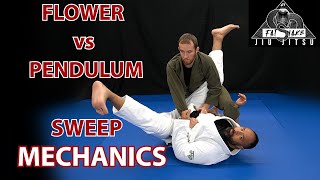
The pendulum sweep is an efficient technique that exploits an opponent's reliance on the guard player as their base while in guard position. When an opponent leans forward with their knees planted, they depend on the guard player's upper body to maintain stability. This sweep removes that base, causing them to fall forward uncontrollably.
Base Analysis
A properly postured opponent in guard has two primary bases: their knees and the guard player's torso. Attempting to knock them sideways fails because they can easily post their hand. Similarly, pulling them forward only reinforces their stability as they use the guard player's body as an anchor point.
Upper Body Mechanics
The guard player initiates the sweep by moving their upper body sideways through a side bend or crunch motion, keeping the hips flat on the mat. One hand controls the opponent's sleeve or wrist to prevent them from posting and stopping the sweep. The opposite hand reaches under the opponent's leg to facilitate rotation and assist with the sweep completion.
Lower Body Mechanics
The legs perform the 'pendulum' action by first pulling the opponent forward, then opening wide with straight legs. The top leg kicks up behind the opponent's shoulder to disrupt their balance. The bottom leg circles underneath and away, ensuring the opponent falls completely over rather than landing on the guard player's leg and stopping the sweep.
Synchronized Execution
The upper and lower body movements work in conjunction: as the torso rotates away and removes the base, the legs windmill in a continuous motion to complete the sweep. The final position should show the top leg perpendicular and the bottom leg bent, both fully cleared from the opponent's path.
Optimal Positioning
The sweep is particularly effective when the opponent pressures forward with their full weight or establishes a tripod base with extended legs. By removing themselves as the base point when the opponent is already committed forward, the guard player requires minimal additional force to complete the sweep.
Solo Training Methods
Without a partner, practitioners can simulate the sweep using a heavy bag or gummy dummy by grabbing the sleeves, hooking underneath an imaginary leg, and executing the windmill motion. Alternatively, a kicking shield or duffel bag approximates the opponent's torso while the practitioner performs the hip elevation and leg rotation.
Common Mistake
The primary error occurs when the bottom leg becomes lazy and fails to circle away, remaining in place while the top leg executes the sweep. This allows the opponent to land on the bottom leg, regain balance, and defend the sweep. The bottom leg must complete its full windmill motion to clear the opponent's path completely.
Pendulum Sweep for BJJ
Key Takeaways
- •Fundamental Concept
- •Base Analysis
- •Upper Body Mechanics
- •Lower Body Mechanics
How to practice this sweep with a partner or a training dummy
Frequently Asked Questions
What does this video teach about standard pendulum sweep?
This video covers fundamental concept, base analysis, upper body mechanics. It provides detailed instruction from Phoenix Fitness & Martial Arts.
How long does it take to learn standard pendulum sweep?
The basic mechanics can be understood in a single session, but developing reliable execution requires consistent drilling over weeks of practice. This 8-part breakdown helps structure your training by isolating each phase of the technique.
What are the key details for finishing standard pendulum sweep?
Without a partner, practitioners can simulate the sweep using a heavy bag or gummy dummy by grabbing the sleeves, hooking underneath an imaginary leg, and executing the windmill motion. Alternatively, a kicking shield or duffel bag approximates the opponent's torso while the practitioner performs the hip elevation and leg rotation.