The Top Turtle Control Problem
Practitioners often struggle to maintain control once they establish top turtle position, as opponents frequently attempt to pull guard, stand up, execute wrestling movements like switches or sit-outs, or escape the position entirely. This instructional focuses on the fundamental concepts needed to control the top turtle effectively across multiple scenarios.
Hip Connection as Primary Control
The cornerstone of maintaining top turtle position is establishing and maintaining a strong hip connection with the opponent. Rather than relying solely on traditional grips like seatbelts or arm control, the instructor emphasizes that hip connection—keeping the practitioner's ribs and hips aligned with the opponent's hip line—is an underrated but essential control mechanism.
Why Opponents Need Hip Freedom
Opponents cannot execute any escape or reversal without freedom of movement in their hips, whether attempting to sit through for guard, perform a Peterson roll, or crawl forward to reposition. By restricting hip movement through direct connection, the top player dramatically limits the opponent's options and makes their movements highly predictable.
Hip Connection Against Guard Pull
When an opponent attempts to pull guard while the top player maintains hip connection, the practitioner can easily follow the opponent's hip movement and either establish back control or maintain dominance by re-turtling on the opposite side. This hip-to-hip contact makes it mechanically difficult for the opponent to complete the guard pull successfully.
Hip Connection Against Roll Escapes
When an opponent grabs the top player's arm and attempts a Peterson roll-style escape, maintaining hip connection dramatically reduces their rotational ability. By driving the hips into the opponent's hip, the top player creates a mechanical barrier that prevents the opponent's hip from elevating, making the roll escape nearly impossible to complete.
Hip Connection Against Forward Crawl Escapes
When an opponent attempts to crawl forward or run away from the position, maintaining hip connection causes them to drag the top player along with them, inadvertently improving the top player's position. This allows the top player to establish superior positioning without expending additional effort or energy.
Mechanics of Hip Connection
Hip connection is established by pressing one's hip directly against the opponent's hip while wrapping the near-side arm around their back and applying pressure with the near-side leg. The top player maintains active but relaxed pressure that allows them to feel and respond to the opponent's movement initiation, which always begins with hip movement.
Reading Opponent Movement Through Hip Connection
Because all successful escapes and reversals require hip movement to complete, maintaining hip connection allows the top player to feel and anticipate the opponent's techniques before they fully develop. This makes the opponent's actions predictable and gives the top player the ability to counter or adjust before the opponent achieves their objective.
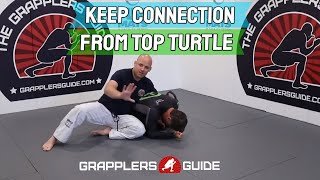
Keep Connection From Top Turtle Against Your Opponent by Jason Scully - BJJ Grappling
Key Takeaways
- •The Top Turtle Control Problem
- •Hip Connection as Primary Control
- •Why Opponents Need Hip Freedom
- •Hip Connection Against Guard Pull
The Grapplers Guide is the longest running and most recommended premium BJJ and grappling learning site ever created. Learn first hand from top BJJ experts and submission grapplers in the world! We have thousands of members from over 102 countries and growing. Here is list of just SOME of the experts you get access to who have shared over 7,000 video with the Grapplers Guide community! Craig Jones Michelle Nicolini Lachlan Giles Mikey Musumeci Josh Hinger Vladislav Koulikov Jonathan Thomas Reilly Bodycomb Andris Brunovskis Jason Scully Jared Weiner Michael Perez Dan Covel Aaron Milam Travis Stevens Shintaro Higashi Wilson Reis Emily Kwok JM Holland Zach Maslany Trenton Cooke Isaac Doederlien Michael Liera Jr. Alex Ecklin And More! Join for life now at https://grapplersguide.com!
Related Techniques
Frequently Asked Questions
What does this video teach about cradle from turtle?
This video covers the top turtle control problem, hip connection as primary control, why opponents need hip freedom. It provides detailed instruction from The Grapplers Guide by Jason Scully.
How long does it take to learn cradle from turtle?
The basic mechanics can be understood in a single session, but developing reliable execution requires consistent drilling over weeks of practice. This 8-part breakdown helps structure your training by isolating each phase of the technique.
What are the key details for finishing cradle from turtle?
Hip connection is established by pressing one's hip directly against the opponent's hip while wrapping the near-side arm around their back and applying pressure with the near-side leg. The top player maintains active but relaxed pressure that allows them to feel and respond to the opponent's movement initiation, which always begins with hip movement.
Related videos
The 2 Easiest Attacks Against the Turtle Position
Stephan Kesting

The Crossface Cradle - Yes, it is Osaekomi
The Judokai Network
Keep Connection From Top Turtle Against Your Opponent by Jason Scully - BJJ Grappling
The Grapplers Guide by Jason Scully
Catch Them by SURPRISE in Half Guard!!
TeachMeGrappling Coach Brian
Triangle Set Up From Half Guard While Overhooked - Jason Scully BJJ Grappling
The Grapplers Guide by Jason Scully