The Defensive Mount Problem
When an opponent achieves a tight defensive posture from the bottom of mount, they eliminate attacking angles by clamping their arms and creating a compact frame. Standard striking and positional pressure become ineffective against this defense. This technique addresses how to systematically break through that resistance.
Testing the Defense
Before committing to a specific attack, the instructor administers controlled strikes to evaluate where openings might exist. If no vulnerabilities emerge from these probe shots, a systematic approach using lapel control becomes necessary to create space for hand placement.
The Lapel Lift Entry
The instructor grabs the same-side lapel (right hand to opponent's left lapel) and lifts vertically as if lifting heavy grocery bags. This upward motion creates just enough separation to knife the attacking hand deep across the opponent's chest, establishing a dominant grip behind the head. The opponent's connection to their own gi works against them, providing the traction needed for this entry.
Transitioning to S-Mount Position
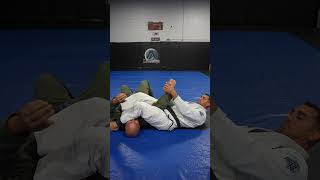
With a deep cross grip secured, the instructor places their fist or elbow against the opponent's ear on the opposite side to prevent head movement. The attacking leg then drags upward to the crown of the head, forcing the opponent's arm to expose itself naturally. The mounting position shifts to S-mount, which isolates the arm for finishing.
S-Mount Control and Positioning
Critical positioning details include keeping the outside leg (rudder) extended outward rather than tucked under the body to prevent being dislodged by explosive bridge attempts. The instructor leans heavily onto the opponent's ribcage to distribute weight and activate their hips and toes. This aggressive pressure prevents the opponent from rotating into the attacker while maintaining control of the trapped arm.
The Standard Arm Lock Finish
From S-mount, the free arm hooks the opponent's arm using an arm-on-arm grip. The instructor leans onto the ribcage to lighten the load on the mounted leg before extending the leg over the opponent's body to complete the armlock. This mechanical leverage combined with positional pressure creates an inescapable finish.
Defense Against Arm Lock: The Reverse Cross Face
If the opponent successfully defends the armlock by gripping and refusing to expose their arm, the instructor pivots to a choke finish instead. An elbow or forearm is driven upward against the opponent's face in a reverse shaving motion, turning their head to create space for a collar or shoulder grip. This seamless transition exploits the opponent's defensive focus.
The Simple Choke Finish
Once the reverse cross face has created a landing spot, the instructor either secures a thumb grip in the collar or grabs the material at the top of the shoulder. The S-mount position is unwound by straightening the leg and rotating the hips backward while leaning the head toward the floor. This simple choke capitalizes on the positional control already established.
Double Attack Integration
The arm lock and simple choke function as complementary attacks within a single positional framework, creating a true double attack system. The critical foundation is the initial lapel lift entry, which provides deep hand placement necessary for all subsequent techniques. Mastering this entry point allows all defensive options to collapse under systematic pressure.
Double Attack from Mount
Key Takeaways
- •The Defensive Mount Problem
- •Testing the Defense
- •The Lapel Lift Entry
- •Transitioning to S-Mount Position
This double attack strategy from the mounted position pairs the simple cross choke with the standard mounted armlock to create a solid strategy that can quickly finish any match. -------------------------------------------------------------------------------------------------------- Gracie NEPA was first established in 2005. Since then, Jeff Reese and his talented assistants have been relentlessly working to educate students in the art of Gracie Brazilian Jiu-Jitsu. Gracie NEPA headquarters is located in Scranton but it’s influence has spread across Pennsylvania as assistants and students have opened schools of their own. For more information call: 570-963-9739 or visit us on the web at http://www.gracienepa.com To enjoy more video be sure to visit and subscribe to us at: https://www.youtube.com/channel/UCj9-QA8g9Xj_iIEojgC0gAQ https://youtu.be/KWscO9341GY
Frequently Asked Questions
What does this video teach about double attack mount?
This video covers the defensive mount problem, testing the defense, the lapel lift entry. It provides detailed instruction from Gracie NEPA.
How long does it take to learn double attack mount?
The basic mechanics can be understood in a single session, but developing reliable execution requires consistent drilling over weeks of practice. This 9-part breakdown helps structure your training by isolating each phase of the technique.
What are the key details for finishing double attack mount?
Once the reverse cross face has created a landing spot, the instructor either secures a thumb grip in the collar or grabs the material at the top of the shoulder. The S-mount position is unwound by straightening the leg and rotating the hips backward while leaning the head toward the floor. This simple choke capitalizes on the positional control already established.
Related videos
Double Attack from Mount: Bow & Arrow or Armbar
ATHLAS TRAINING TEAM
Jiu Jitsu Techniques - Double attack from the mount and scape
Ricardo Cavalcanti BJJ
DOUBLE THREAT from the MOUNT!
Satori BJJ
Great Options From Mount Position by Gordon Ryan
Bernardo Faria BJJ Fanatics
7 submissions from the mount! #jiujitsu #jiujitsutips
Matt Arroyo Jiu Jitsu