Training Philosophy: Focused Skill Development
Rather than relying on established strengths when rolling with lower-ranked partners, advanced practitioners should deliberately practice techniques they are still developing. The instructor recommends selecting a single technique—such as a komora or switch—and committing to executing it repeatedly throughout an entire roll, regardless of initial failures. This deliberate practice method accelerates technical proficiency by forcing continuous problem-solving within a specific movement pattern.
Setup: Back Step Position from Half Guard
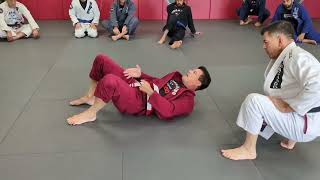
The switch entry begins from a half guard configuration where the top player initiates a back step to transition into leg lock systems. As the bottom player attempts to underhook the top player's arm, the top player steps back and positions themselves perpendicular to their opponent. This position is increasingly common in modern jiu-jitsu due to the popularity of leg lock attacks from the back step entry.
Initial Escape Mechanics: Underhook and Scooting
When the bottom player wraps the top player's waist, the top player responds by underhooking the bottom player's leg rather than attempting an arm underhook. The fundamental objective is to scoot backward while stepping on the opponent's leg to create space for escape. Successfully executing this escape results in the top player achieving a dominant position, typically transitioning to side control or mount.
Elbow Positioning Safety: Avoiding Submission Vulnerabilities
Placing the right elbow on the bottom player's side creates significant danger, as the bottom player can bridge and attempt a neck lock or triangle choke. Instead, the top player should position their elbow in front of the opponent's neck to defend against submission attempts. From this defensive position, the top player has multiple options: passing underneath the neck, inserting the arm into the armpit, or executing a knee slice pass.
The Switch: Hand Placement and Entry
From the back step position with the opponent's arm wrapped around the waist, the top player executes the switch by bringing their arm under the opponent's neck and inserting their hand inside the opponent's grip. This hand placement is critical for controlling the opponent's movement and preventing them from establishing a dominant position on top. The switch must be executed with awareness of the opponent's potential counterattacks.
Countering the Reverse Butterfly Hook Threat
A skilled bottom player may establish a reverse butterfly hook when the top player attempts the switch, using hip escape timing to create the hook before being controlled. If the opponent successfully places the hook, they gain the ability to lift and unbalance the top player, facilitating a sweep into top position. To prevent this defensive sequence, the top player must maintain constant pressure on the opponent's leg with their left hand while pulsing to disrupt the opponent's setup timing.
Preemptive Switch Execution During Guard Pass Attempts
When passing half guard, if the bottom player pummels for an underhook and wraps the top player's waist, the top player should immediately implement the switch rather than waiting for the opponent to complete their movement. This preemptive timing prevents the opponent from sliding underneath and establishing a dominant bottom position. The top player maintains pressure on the opponent's shoulder and leg while executing the switch entry.
Managing Positional Danger: Back Control Vulnerability
A skilled opponent who recognizes the switch attempt may sit out and rotate toward the top player's back before the switch is fully secured. Once the opponent obtains back control with hooks in, the top player's arm becomes trapped regardless of whether the opponent completes the grip or simply maintains control behind the back. Despite this apparent disadvantage, understanding advanced switch mechanics allows the skilled practitioner to recover and eventually win the position.
Pressure Maintenance: Shoulder Control During the Switch
As the opponent attempts to sweep and establish top position, the top player performs a hip escape while maintaining substantial pressure on the opponent's shoulder through their hand and body weight. This continuous pressure makes it significantly more difficult for the opponent to rotate behind the top player's back and achieve dominance. By keeping the opponent compressed and preventing their hip rotation, the top player gains positional control and can transition back toward leg attacks.
Advanced Positioning: Turning Into the Opponent
After successfully defending the sweep and maintaining shoulder pressure, the top player turns toward the opponent while keeping their body compressed against them. This positioning allows the top player to transition their focus back toward attacking the opponent's legs while minimizing exposure to submissions like the calf slicer. Practitioners should be aware that maintaining this turned position can leave the top player's arm vulnerable to certain submission attacks, requiring continuous situational awareness.
Hit the SWITCH From the Back Step!
Key Takeaways
- •Training Philosophy: Focused Skill Development
- •Setup: Back Step Position from Half Guard
- •Initial Escape Mechanics: Underhook and Scooting
- •Elbow Positioning Safety: Avoiding Submission Vulnerabilities
PLEASE Click this link to SUPPORT the TeachMeGrappling Channel!!! https://www.patreon.com/TeachMeGrappling or https://www.paypal.me/CoachBrianPeterson Your contribution is much appreciated and will help me continue to bring you content! 🙏 www.NextLevelGuy.com The NextLevelGuy Podcast with Coach Brian Peterson has been released!! Check it out! http://teachmegrappling.com This video I breakdown a switch entry from the backstep or reverse half guard. Check out the details and you are sure to find something useful! Enjoy! If you have any questions, comments, or suggestions, please comment below. More videos to come! Please like, share, and subscribe!!
Related Techniques
Frequently Asked Questions
What does this video teach about goes guard switch sweep?
This video covers training philosophy: focused skill development, setup: back step position from half guard, initial escape mechanics: underhook and scooting. It provides detailed instruction from TeachMeGrappling Coach Brian.
How long does it take to learn goes guard switch sweep?
The basic mechanics can be understood in a single session, but developing reliable execution requires consistent drilling over weeks of practice. This 10-part breakdown helps structure your training by isolating each phase of the technique.
What are the key details for finishing goes guard switch sweep?
As the opponent attempts to sweep and establish top position, the top player performs a hip escape while maintaining substantial pressure on the opponent's shoulder through their hand and body weight. This continuous pressure makes it significantly more difficult for the opponent to rotate behind the top player's back and achieve dominance. By keeping the opponent compressed and preventing their hip rotation, the top player gains positional control and can transition back toward leg attacks.
Related videos
The First 4 Sweeps You Need To Know | Jiu-Jitsu Basics
Knight Jiu-Jitsu
Closed Guard | Scissor Sweep, Push Sweep and Spider Guard Sweep with Kris Kim
BJJ Joe
Mounted Rubber Guard - 10th Planet Jiu Jitsu
Brandon Mccaghren
Quick Guide to Open Guard Systems | No Gi Edition
Knight Jiu-Jitsu
The Half Guard Masterclass
JeanJacquesMachado