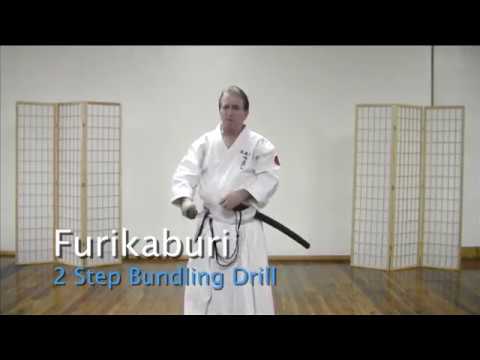
How to connect the Japanese Sword from the draw to the cut!
0
Rising Draw Cut·Roger Wehrhahn
How to connect the Japanese Sword from the draw to the cut! This month we will be covering the "furikaburi" or the move…
Translation: Reverse Kesa Draw
The Rising Draw Cut is an iaidō nukitsuke variant in which the blade is drawn upward in a rising arc rather than horizontally, cutting from the opponent's lower body toward the upper body or face. [1] This draw-cut is used in specific iaidō kata that address threats from a low or seated position, where the upward trajectory exploits the attacker's proximity. [1],[2] The rising draw-cut requires precise coordination of sayabiki and blade extraction, as the upward motion demands different timing than the standard horizontal nukitsuke. [2],[3]
Rising draw-cut variations appear in several koryū iaidō kata and in specific forms within the Seitei Iai set, reflecting the tactical need to address attackers from different positions. [1] These upward nukitsuke actions demonstrate the art's versatility in responding to threats from any angle. [2],[3]
The rising draw cut was part of the multi-directional cutting curriculum in classical kenjutsu schools, complementing the descending cuts. [1]
Rising cuts are demonstrated in iaidō kata competition and tameshigiri events. [1]
No images yet for this technique.
Sign in to suggest an image.
How to connect the Japanese Sword from the draw to the cut! This month we will be covering the "furikaburi" or the move…
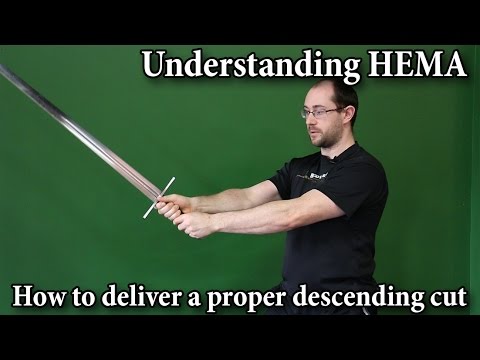
Hosts Nicole Smith and Sean Franklin go in depth with some of the technical aspects of throwing a proper descending cut …
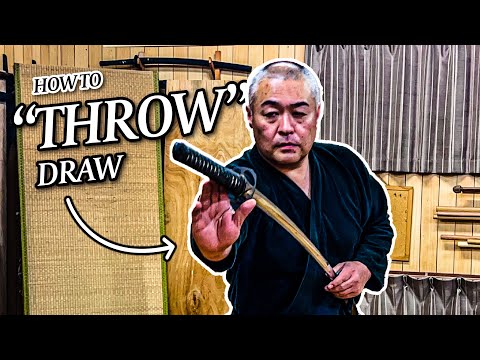
🎫Purchase Your Ticket to the Annual Asayama Ichiden Ryu Training Camp in Japan: https://asayamaichidenryu.shop/products…
The rising draw cut integrates the draw (nukitsuke) with an upward cutting motion, requiring precise coordination between blade trajectory, body mechanics, and hand positioning. Roger Wehrhahn provides the most detailed technical breakdown, emphasizing eight key points in the furika-buri (raising movement): bringing the elbow inward while keeping the hand level, bending the wrist inward, positioning the hand inside the center line with the blade outside the shoulder, returning the left hand (saiya) to its natural position, directing the right hand upward, and having the left hand trail to join at the tsuka for the two-handed overhead attack in jodan position. Wehrhahn stresses that the right hand must remain higher than the left and that the movement should flow continuously without stopping—the furika-buri functions as a connective transition to enable swift follow-up attacks. Let's Ask Seki Sensei contributes practical tactical context, highlighting that in Asaemi Shindu methodology, the left hand controls the draw entirely by managing the sheath, allowing the right hand to remain relaxed on the handle. This approach maintains a forward safety zone and enables rapid response to enemy attacks, including the ability to reverse-draw in close combat or release the handle for defensive movements. Blood and Iron HEMA's Shawn Franklin and Nicole Smith address broader cutting principles applicable across blade arts: power derives from hip rotation synchronized with footfall, edge alignment is critical for effective cutting, and the blade must rotate rather than merely push through the target. These instructors collectively teach that rising draw cuts demand disciplined hand positioning, continuous flowing motion, and integration of lower-body power through rotational mechanics.
Synthesized from 3 instructors
No instructional courses yet for this technique.
Sign in to suggest a course.
Risk of injury to the person this technique is applied to
Edged weapons cause fatal lacerations; historical battlefield mortality rates >30% (Amberger 1999)
Skill level needed to execute this technique reliably
Whether this technique is allowed under major competition rule sets
The Book of Five Rings (Miyamoto Musashi, 1645)
Alias sources — [1] Japanese Swordsmanship (Warner & Draeger, 1982) [2] Secrets of the Samurai (Ratti & Westbrook, 1973) [3] Secrets of the Samurai (Ratti & Westbrook, 1973)
Effectiveness sources — [1] Classical Bujutsu (Draeger, 1973) [2] Classical Fighting Arts of Japan (Mol, 2001)
Established Japanese martial arts naming convention — native Japanese term (和語/漢語)
Alias sources — [1] Japanese Swordsmanship (Warner & Draeger, 1982) [2] Secrets of the Samurai (Ratti & Westbrook, 1973) [3] Secrets of the Samurai (Ratti & Westbrook, 1973)
Effectiveness sources — [1] Classical Bujutsu (Draeger, 1973) [2] Classical Fighting Arts of Japan (Mol, 2001)
wrist control for edge alignment, grip endurance, footwork precision
quick wrists, strong forearms, good posture
forearm extensors/flexors, deltoids, core, calves
According to Roger Wehrhahn, a frequent error is dropping the hand down as you bring the sword across, which moves the sword away from the attack. Instead, keep your hand level with your elbow as you bring the elbow in, ensuring the elbow stays against your body and in line with your shoulder.
Seki Sensei explains that a firm grip prevents you from letting go quickly to dodge attacks, and it also prevents you from immediately reversing the draw in close combat by turning your thumb to reverse the blade—something that takes much longer if you have to fully release and re-grip.
Roger Wehrhahn emphasizes that the furikaburi (the motion leading into the cut) is a transition that should flow continuously—bring the elbow in, hand up to the top, then attack immediately without stopping between movements, using the pattern: in, up and out.
Blood and Iron HEMA stresses that practicing with sharps or test cutting is important because you can only truly verify proper alignment and cutting success when the blade is functioning as intended, rather than relying solely on practice with training swords.
The Rising Draw Cut is an iaidō nukitsuke variant in which the blade is drawn upward in a rising arc rather than horizontally, cutting from the opponent's lower body toward the upper body or face. This draw-cut is used in specific iaidō kata that address threats from a low or seated position, where the upward trajectory exploits the attacker's proximity.
Rising draw-cut variations appear in several koryū iaidō kata and in specific forms within the Seitei Iai set, reflecting the tactical need to address attackers from different positions. These upward nukitsuke actions demonstrate the art's versatility in responding to threats from any angle.
FIE Sabre: legal — Legal cutting technique to upper body target area; FIK Kendo: legal — Legal if targeting valid area with correct form; WEKAF: legal — Legal striking technique; HEMA: legal — Legal in applicable weapon categories
Danger rating 9/10. Extreme — edged weapons cause fatal lacerations; historical battlefield mortality rates >30% (Amberger 1999)
The standard setup chain: Ready Position → Distance Control → Execute Technique → Return to Guard.
Standard counters include: Parry (Absetzen) — deflect the incoming blade with a counter-displacement / Void (Step Back) — withdraw from measure to avoid the cutting arc / Counter-Cut (Nachreisen) — strike into the opponent's opening during their attack.
Common variants: Standard cut (primary cutting angle from the ready stance); Thrust (tsuki) (straight thrust targeting the throat, chest, or face); Rising cut (kiri-age) (upward diagonal cut from low to high); Diagonal cut (kesa-giri) (downward diagonal cut following the kimono line).
Rising cuts are demonstrated in iaidō kata competition and tameshigiri events.
Top errors to watch for: Using the same body mechanics as the horizontal draw — the rising cut requires upward hip drive and different arm pos… / Not directing the blade along the ascending diagonal — the cut must follow the rising kesa line from hip to shoulder / Drawing the blade horizontally instead of ascending — the direction must be upward from the start of the draw / Not using saya-biki appropriate for the rising angle — the scabbard pull must accommodate the upward blade path.
The Rising Draw Cut is also known as Gyaku Kesa Nuki, Upward Battojutsu, Rising Iaijutsu.