"Horizontal Cuts are the Strongest!" ...THINK AGAIN!!
0
Horizontal Draw Cut·Let's ask Seki Sensei | Online Katana Lessons
🎫Purchase Your Ticket to the Annual Asayama Ichiden Ryu Training Camp in Japan: https://asayamaichidenryu.shop/products…
Translation: Horizontal Line Draw
The Horizontal Draw Cut (nukitsuke) is the standard opening action of iaidō: from seiza or standing, the right hand draws the blade while the left hand pulls the saya rearward (sayabiki), and the blade is delivered in a horizontal cut to the opponent's temple or eyes at the moment of full extraction. [1] The cutting action is powered by hip rotation and the expansion of the arms, not by arm strength alone, and the blade must leave the saya with the kissaki tracing a straight horizontal line. [1],[2] This draw-cut is the defining technique of iaidō, embodying the principle that the first strike from a seemingly passive state can be decisive. [2],[3]
The horizontal draw-cut is the foundational technique of iaidō, developed by Hayashizaki Jinsuke Shigenobu in the mid-sixteenth century and transmitted through both Musō Shinden-ryū and Musō Jikiden Eishin-ryū. [1] The AJKF's Seitei Iai set begins each kata with a variation of this nukitsuke action. [2],[3]
The horizontal draw cut uses a pulling motion along the blade's edge to create a slicing wound, exploiting the katana's curvature for maximum cutting efficiency. [1]
Draw cutting technique was developed in classical kenjutsu and iaidō as part of the Japanese understanding of how the curved katana blade functions optimally. [1]
Horizontal draw cuts are demonstrated in iaidō competition (AJKF and ZNKR) and tameshigiri events. [1]
No images yet for this technique.
Sign in to suggest an image.
🎫Purchase Your Ticket to the Annual Asayama Ichiden Ryu Training Camp in Japan: https://asayamaichidenryu.shop/products…
www.freestylecutting.com https://www.facebook.com/FreestyleCutting
Sorry I have been in and out of my normal post schedule recently. I've been super busy with school, work and life. But i…
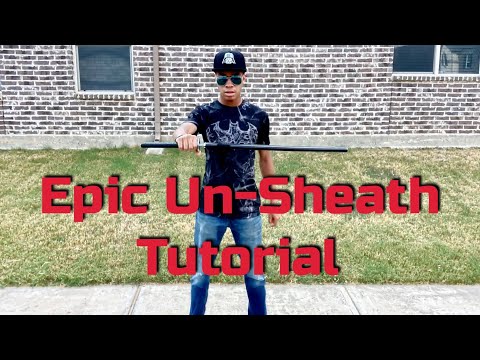
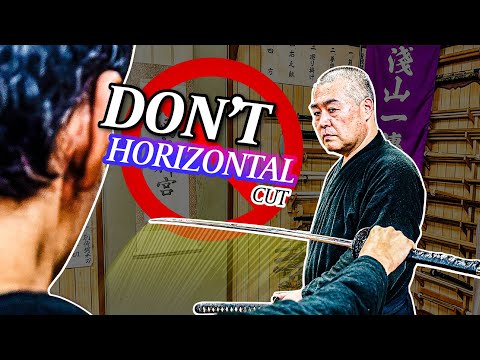
The horizontal draw cut (or closed horizontal cut) is executed through coordinated footwork, hip rotation, and upper-body engagement, with instructors emphasizing distinct defensive and offensive applications. Let's Ask Seki Sensei focuses on the technique's vulnerability: horizontal cuts gain power through rotational energy, but if interrupted before full extension or after the blade passes the opponent's centerline, they become mechanically weak. The instructor stresses that defensive practitioners must either block before the swing generates full energy or counterattack after the cutting plane has passed, teaching multiple kata (Yai, Genjutsu, Jo's Staff, and Kamasiko) that exploit these windows. CuttingMechanics provides detailed biomechanical instruction, beginning from a neutral stance with bent knees, stepping feet together, then stepping into a horse stance (10/30 angle) while turning the hips and shoulders to generate full-body power. The instructor emphasizes edge alignment as fundamental, with the mune (spine of the blade) touching the shoulder as a kinesthetic cue, and recommends using primarily the pinky and ring finger for grip support. Modern Ninja addresses the theatrical draw-cut variation used for performance, focusing on explosive speed during unsheathe to separate blade from scabbard, though this represents a stylized rather than traditional martial application. All three instructors converge on the importance of engaging the entire body through hip and shoulder rotation, with Let's Ask Seki Sensei and CuttingMechanics offering complementary perspectives on mechanics and timing.
Synthesized from 3 instructors
No instructional courses yet for this technique.
Sign in to suggest a course.
Risk of injury to the person this technique is applied to
Edged weapons cause fatal lacerations; historical battlefield mortality rates >30% (Amberger 1999)
Skill level needed to execute this technique reliably
Whether this technique is allowed under major competition rule sets
The Book of Five Rings (Miyamoto Musashi, 1645)
Alias sources — [1] Japanese Swordsmanship (Warner & Draeger, 1982) [2] Secrets of the Samurai (Ratti & Westbrook, 1973) [3] Secrets of the Samurai (Ratti & Westbrook, 1973)
Effectiveness sources — [1] Classical Bujutsu (Draeger, 1973)
Established Japanese martial arts naming convention — native Japanese term (和語/漢語)
Alias sources — [1] Japanese Swordsmanship (Warner & Draeger, 1982) [2] Secrets of the Samurai (Ratti & Westbrook, 1973) [3] Secrets of the Samurai (Ratti & Westbrook, 1973)
Effectiveness sources — [1] Classical Bujutsu (Draeger, 1973)
wrist control for edge alignment, grip endurance, footwork precision
quick wrists, strong forearms, good posture
forearm extensors/flexors, deltoids, core, calves
According to Seki Sensei, you must stop the opponent's attack before the energy is born, and you should swing the tsuka handle towards the opponent before he swings so that he can't do anything.
CuttingMechanics emphasizes starting with bent knees, stepping out into a horse stance, and keeping your back straight while engaging your whole body from your feet through your shoulders and arms. The pinky and ring finger should be your main supports on the handle.
CuttingMechanics stresses that edge alignment and allowing the cut to pass cleanly through the target without beginning your second cut halfway through are fundamental. Drilling these basics thoroughly prevents bad habits in more complex cutting.
The Horizontal Draw Cut (nukitsuke) is the standard opening action of iaidō: from seiza or standing, the right hand draws the blade while the left hand pulls the saya rearward (sayabiki), and the blade is delivered in a horizontal cut to the opponent's temple or eyes at the moment of full extraction. The cutting action is powered by hip rotation and the expansion of the arms, not by arm strength alone, and the blade must leave the saya with the kissaki tracing a straight horizontal line.
The horizontal draw-cut is the foundational technique of iaidō, developed by Hayashizaki Jinsuke Shigenobu in the mid-sixteenth century and transmitted through both Musō Shinden-ryū and Musō Jikiden Eishin-ryū. The AJKF's Seitei Iai set begins each kata with a variation of this nukitsuke action.
FIE Sabre: legal — Legal cutting technique to upper body target area; FIK Kendo: legal — Legal if targeting valid area with correct form; WEKAF: legal — Legal striking technique; HEMA: legal — Legal in applicable weapon categories
Danger rating 9/10. Extreme — edged weapons cause fatal lacerations; historical battlefield mortality rates >30% (Amberger 1999)
The standard setup chain: Ready Position → Distance Control → Execute Technique → Return to Guard.
Standard counters include: Parry (Absetzen) — deflect the incoming blade with a counter-displacement / Void (Step Back) — withdraw from measure to avoid the cutting arc / Counter-Cut (Nachreisen) — strike into the opponent's opening during their attack.
Common variants: Standard cut (primary cutting angle from the ready stance); Thrust (tsuki) (straight thrust targeting the throat, chest, or face); Rising cut (kiri-age) (upward diagonal cut from low to high); Diagonal cut (kesa-giri) (downward diagonal cut following the kimono line).
Horizontal draw cuts are demonstrated in iaidō competition (AJKF and ZNKR) and tameshigiri events.
Top errors to watch for: Drawing the sword upward instead of horizontally — the blade must track a horizontal path for this specific draw cut / Not pulling the scabbard back (saya-biki) — the scabbard must be pulled away from the blade for a clean, fast draw / Drawing too slowly — the draw cut must be sudden; speed is the essence of iaido / Cutting too high or too low — the target is the eyes or chest; maintain the correct height.
The Horizontal Draw Cut is also known as Yoko Ichimonji, Horizontal Battojutsu, Level Draw Cut.