Rapier Champion Teaches how to Disengage & Stab!
0
Disengage·Blood and Iron HEMA
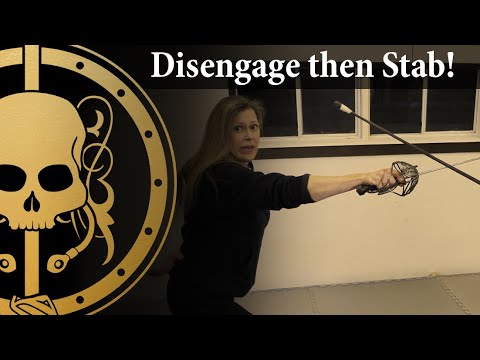
Rapier champion Nicole Smith teaches you how to disengage and then deliver a thrust. Stabby Stabby! Patreon: - https://…
Translation: Disengage — from the French dégagement (disengagement/release) — a blade movement that passes the point under (or over) the opponent's blade to change the line of attack, deceiving the opponent's parry
The Disengage is the most fundamental indirect attack in Western fencing — a blade movement that passes the point under the opponent's blade to change the line of attack from one side to the other, deceiving the opponent's parry by moving the attack to the line they leave open when they attempt to defend the original line. [1] The disengage is the fencer's primary tool for defeating a parry: if the opponent tries to parry quarte (defending the inside), the fencer disengages to the outside; if they try to parry sixte (defending the outside), the fencer disengages to the inside. [1],[2] The mechanical execution is deceptively simple: the point drops under the opponent's blade in the smallest possible circular movement (an inverted U or a small oval), passing from one side of the blade to the other, then continues toward the target on the new line. [1] The critical principle is ECONOMY OF MOTION: the disengage must be the smallest circle possible — a wide, looping disengage is slow and telegraphed, while a tight, finger-controlled disengage is nearly invisible and arrives before the opponent can adjust their parry. [1] Pollock, Grove, and Prevost wrote in 1902 that the disengage 'must be executed with minimal blade movement' and that the point 'describes the smallest arc consistent with clearing the opponent's blade.' [1] The disengage is the building block of all compound attacks: a one-two (feint-disengage) uses a feinted straight attack to draw the parry, then a disengage to the opened line. A double (feint-disengage-disengage) adds another layer of deception. [1],[2] In competitive fencing, the disengage is the single most commonly used indirect attack at all levels from beginner to Olympic competition — mastery of the disengage's timing and economy is what separates elite fencers from competent ones. [1],[3]
The disengage was developed during the evolution of European swordsmanship from cutting to thrusting in the 16th-17th centuries. [1],[2] As fencers developed parrying systems to defend against straight thrusts, the disengage was created to circumvent those parries — an arms race between attack and defence that drove the development of increasingly sophisticated blade work. [2] Italian masters including Agrippa (1553) and Capo Ferro (1610) documented early forms of the disengage (cavazione), and the French school refined the technique to its modern form emphasising minimal blade movement. [2] Pollock, Grove, and Prevost noted in 1902 that the development of the disengage was a pivotal moment in fencing history: it transformed sword combat from a simple game of 'who can thrust faster' into a complex tactical contest of deception, anticipation, and timing. [1] The disengage is the technique that makes fencing a 'game of the mind' rather than merely a test of speed and strength. [1],[2]
The disengage is the most commonly used indirect attack in competitive fencing, appearing in approximately 60-70% of all attack sequences in foil competition. [3] Its effectiveness comes from the fundamental truth that the defender must move their blade to parry — and any movement creates an opening that the disengage exploits. [1] At the highest levels (Olympic fencing), the difference between a mediocre fencer and a world champion often comes down to the quality of their disengage: how small is the circle, how precise is the timing, and how seamlessly does it integrate with the forward extension. [3] The disengage is also the foundation of all compound attacks — without the ability to disengage, a fencer is limited to direct attacks, which an experienced opponent will parry consistently. [1],[2]
The disengage (in various forms — simple, compound, as part of one-two attacks) appears in approximately 60-70% of all attack sequences in Olympic foil fencing. It is the most commonly used indirect attack at all competitive levels. Every Olympic fencing medallist has relied on disengage attacks as a core scoring method. The technique has been central to competitive fencing for over 400 years.
No images yet for this technique.
Sign in to suggest an image.
Rapier champion Nicole Smith teaches you how to disengage and then deliver a thrust. Stabby Stabby! Patreon: - https://…
No instructional courses yet for this technique.
Sign in to suggest a course.
Risk of injury to the person this technique is applied to
In modern sport fencing with protective equipment, the disengage is safe. In historical context with sharp weapons, the disengage-attack was a lethal technique because it delivered the point to an undefended target while the opponent's blade was committed to the wrong line.
Skill level needed to execute this technique reliably
Whether this technique is allowed under major competition rule sets
Fencing (Pollock, Grove & Prevost, 1902)
description: [1] Pollock 1902, [2] Castle 1885
Standard katakana transliteration of Western martial arts terminology (外来語) — used in Japanese MMA, boxing, and BJJ communities
description: [1] Pollock 1902, [2] Castle 1885
Requires fine finger control (doigté) — the thumb and index finger manipulate the blade in small circles
Good hand-eye coordination for timing the disengage to the opponent's parry
No strength, flexibility, or conditioning requirements
Accessible to all body types
The technique can be learned in the first few fencing lessons and refined over a lifetime — the difference between a beginner's disengage and a master's is the size of the circle and the precision of the timing
Disengage appears in 279 passages across our corpus. In fencing, the disengage (dégagement) passes the blade under or over the opponent's blade to attack a different line — the most fundamental offensive blade action. (279 passages; fencing technique manuals; Biomechanics of Human Motion)
You should disengage as soon as you feel your opponent taking your tip off line and creating a wedge with their blade. Once you're clear of their sword, immediately create a wedge of your own and progress to your thrust.
Relax your grip and let the tip of your sword drop beneath their blade—this is a relaxation motion, not a wrist motion. Using your wrist will make the disengage slow and ineffective.
Have a partner (called a 'Steve') create a wedge with their sword, then practice disengaging around their blade and lunging at your favorite target to build the timing and footwork.
The Disengage is the most fundamental indirect attack in Western fencing — a blade movement that passes the point under the opponent's blade to change the line of attack from one side to the other, deceiving the opponent's parry by moving the attack to the line they leave open when they attempt to defend the original line. The disengage is the fencer's primary tool for defeating a parry: if the opponent tries to parry quarte (defending the inside), the fencer disengages to the outside; if they try to parry sixte (defending the outside), the fencer disengages to the inside.
The disengage was developed during the evolution of European swordsmanship from cutting to thrusting in the 16th-17th centuries. As fencers developed parrying systems to defend against straight thrusts, the disengage was created to circumvent those parries — an arms race between attack and defence that drove the development of increasingly sophisticated blade work.
FIE: legal — Legal fencing technique — governed by FIE rules for foil, épée, and sabre; HEMA: legal — Legal in historical fencing competition
Danger rating 3/10. In modern sport fencing with protective equipment, the disengage is safe. In historical context with sharp weapons, the disengage-attack was a lethal technique because it delivered the point to an undefended target while the opponent's blade was committed to the wrong line.
The standard setup chain: En garde → Extend the arm toward the opponent's target (presenting the attack in one line) → Opponent reacts with a parry to defend that line → At the moment the parry begins: fingers drop the point UNDER (or lift it OVER) the opponent's blade → Point passes to the opposite side of the blade in the smallest possible circle → Arm continues extending toward the now-OPEN line → Point arrives at the target before the opponent can adjust their parry → Touch scores → If the opponent doesn't parry → the feint was not convincing enough; try a more committed feint next time → If the opponent counter-parries (circular parry) → counter-disengage to return to the original line.
Standard counters include: Counter-parry (circular parry) — a circular blade movement that catches the disengaging blade by completing a full ci… / Counter-disengage — the attacker anticipates the circular parry and counter-disengages (completes their own circle), … / Don't parry — if the defender does not react to the feint (stays still), the disengage arrives at a defended line and… / Beat-attack — beating the attacking blade aside before the disengage can be executed.
Common variants: Simple disengage (under the blade) (the point drops under the opponent's blade, the most comm…); Coupé (disengage over the blade) (the point lifts OVER the opponent's blade rather than und…); Counter-disengage (circular disengage) (a full circular blade movement that deceives the opponent…); Double disengage (two successive disengages creating a feint-disengage-dise…); Disengage in tempo (timing the disengage to coincide with the opponent's blad…); Half-disengage (an abbreviated disengage that barely clears the opponent'…).
The disengage (in various forms — simple, compound, as part of one-two attacks) appears in approximately 60-70% of all attack sequences in Olympic foil fencing. It is the most commonly used indirect attack at all competitive levels.
Top errors to watch for: Wide, looping disengage — the most fundamental error: a wide circular blade movement is slow, visible, and gives the … / Using the wrist/arm instead of the fingers — the disengage should be a FINGER movement; engaging the wrist or arm cre… / Stopping the arm's extension during the disengage — the arm must continue advancing throughout; pausing the forward e… / Disengaging before the opponent's parry — the disengage must be timed to the opponent's parrying motion; disengaging ….
The Disengage is also known as Degajuman (from French: dégagement), Disengagement, Dégagement (French), Cavazione (Italian), Change of Line.