Instructional clip: Aikido Tanto Dori
0
Standard Tanto Technique·BUDO INTERNATIONAL (OFFICIAL)
In this DVD Master Kenneth Furuya presents us with his first DVD, an extensive and detailed work on Aikido techniques fo…
Translation: Tanto Art Technique
The Standard Tantō Technique genus encompasses the fundamental offensive and defensive actions with the tantō — the direct thrust (tsuki), the slash (kiri), and the defensive response (tantō-dori). [1] In koryū practice these are performed as prearranged kata in which the attacker delivers a committed strike and the defender enters, redirects, and controls the weapon arm. [1],[2] Aikidō's tantō-dori techniques, tested from 3rd kyū onward, are among the most widely practised tantō defence methods in the world. [2],[3]
Tantō kata appear in the curricula of numerous koryū schools dating to the sixteenth century, and were adopted by modern budō arts in the twentieth century as a means of preserving weapon-awareness training. [1] Morihei Ueshiba's aikidō incorporated tantō-dori as a core component, ensuring the continued practice of tantō defence techniques worldwide. [2],[3]
Standard tantō techniques include thrusts, slashes, and defensive applications at close range, where the short blade excels for stabbing and concealment. [1]
Tantō techniques are demonstrated at koryū embu events in Japan. There is no standardised tantō competition format. [1]
No images yet for this technique.
Sign in to suggest an image.
In this DVD Master Kenneth Furuya presents us with his first DVD, an extensive and detailed work on Aikido techniques fo…
🎫Purchase Your Ticket to the Annual Asayama Ichiden Ryu Training Camp in Japan: https://asayamaichidenryu.shop/products…
The Japanese Tanto is the short knife. In this video Harden Sensei demonstrates two beginner movements for students to …
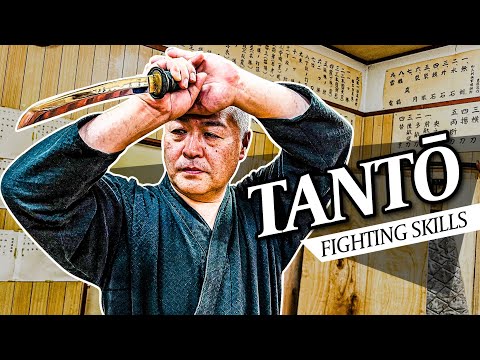
Standard tanto technique encompasses the fundamental principles and applications of the Japanese short blade within formalized martial contexts. Let's ask Seki Sensei emphasizes the tanto's historical role as a concealable weapon worn by both samurai and commoners, highlighting its utility in indoor combat and as a substitute for longer weapons. The instruction centers on kata practice within the Shinkakariu style, where practitioners draw the tanto from the left side with superior speed compared to longer swords, employ the distinctive sagi chodan stance (named for its resemblance to a heron's beak), and execute chiburi (handle strike) before sheathing. Unique to tanto work are the ability to draw inward without self-injury and to deliver thrusts through voluminous sleeves without exposing the blade until commitment. Harden Martial Arts—Western Masters provides foundational mechanics: the tanto begins at a 45-degree angle before the obi knot, with the cutting edge (hakamai) oriented upward rather than downward, differentiating Oriental weapon principles from Western knife handling. Practitioners progress through nigi hanmi no kamai positioning into thrust strikes while maintaining awareness of hand placement to avoid self-laceration. BUDO INTERNATIONAL (OFFICIAL) addresses tanto defense in Aikido contexts, distinguishing quick jabbing attacks from lethal slashing motions and demonstrating koregashi (disarm techniques) with emphasis on timing options—practitioners may intercept during the attack, the retraction phase, or fade back to create distance and identify optimal intervention points across multiple attack cycles.
Synthesized from 3 instructors
No instructional courses yet for this technique.
Sign in to suggest a course.
Risk of injury to the person this technique is applied to
Knives and short blades are the most common weapon in real-world assaults; high lethality
Skill level needed to execute this technique reliably
Whether this technique is allowed under major competition rule sets
Bubishi: The Classic Manual of Combat (Patrick McCarthy, 2008)
Alias sources — [1] Japanese Swordsmanship (Warner & Draeger, 1982) [2] Secrets of the Samurai (Ratti & Westbrook, 1973) [3] Secrets of the Samurai (Ratti & Westbrook, 1973)
Effectiveness sources — [1] Classical Fighting Arts of Japan (Mol, 2001)
Established Japanese martial arts naming convention — native Japanese term (和語/漢語)
Alias sources — [1] Japanese Swordsmanship (Warner & Draeger, 1982) [2] Secrets of the Samurai (Ratti & Westbrook, 1973) [3] Secrets of the Samurai (Ratti & Westbrook, 1973)
Effectiveness sources — [1] Classical Fighting Arts of Japan (Mol, 2001)
wrist control for edge alignment, grip endurance, footwork precision
quick wrists, strong forearms, good posture
forearm extensors/flexors, deltoids, core, calves
Make sure you understand where the knife position is and where your hand is—you don't want to cut your own wrists. According to Harden Martial Arts, always return the weapon to its proper position after each movement.
In the Orient, you want the cutting edge up so that if someone tries to grab it, they risk cutting their fingers. Harden Martial Arts emphasizes this safety principle for proper weapon handling.
Begin in the nigi hanmi no kamai position, then perform a punch-like movement similar to a karate punch, which changes your position and moves you from one line to another. Harden Martial Arts teaches this as a simple foundational exercise.
No—while both are short swords, they are very different weapons with unique techniques that require dedicated training, according to Seki Sensei. There are specific skills you must practice that are unique to the tanto.
The Standard Tantō Technique genus encompasses the fundamental offensive and defensive actions with the tantō — the direct thrust (tsuki), the slash (kiri), and the defensive response (tantō-dori). In koryū practice these are performed as prearranged kata in which the attacker delivers a committed strike and the defender enters, redirects, and controls the weapon arm.
Tantō kata appear in the curricula of numerous koryū schools dating to the sixteenth century, and were adopted by modern budō arts in the twentieth century as a means of preserving weapon-awareness training. Morihei Ueshiba's aikidō incorporated tantō-dori as a core component, ensuring the continued practice of tantō defence techniques worldwide.
Traditional martial arts: legal — Practiced in traditional kata/forms and weapon-specific competition under var…; IWUF: legal — Legal in wushu taolu if applicable; HEMA: legal — Legal in applicable historical weapon categories
Danger rating 9/10. Extreme — knives and short blades are the most common weapon in real-world assaults; high lethality
The standard setup chain: En Garde → Advance/Lunge Preparation → Attack → Recovery.
Standard counters include: Beat Parry — deflect the blade with a sharp lateral beat before it reaches target / Displacement — move the body off the line while threatening with the point / Counter-Thrust — extend into the attacker's line during their advance.
Common variants: Standard cut (primary cutting angle from the ready stance); Thrust (tsuki) (straight thrust targeting the throat, chest, or face); Rising cut (kiri-age) (upward diagonal cut from low to high); Diagonal cut (kesa-giri) (downward diagonal cut following the kimono line).
Tantō techniques are demonstrated at koryū embu events in Japan. There is no standardised tantō competition format.
Top errors to watch for: Stepping straight back instead of to the outside — stepping offline is essential; straight retreat keeps you in the w… / Not redirecting the wrist before applying the lock — the wrist must be guided outward first; trying to lock it immedi… / Using only the hands without body movement — the tai-sabaki (body turning) provides the power for the lock; hands alo… / Applying the lock upward instead of downward — kote-gaeshi rotates the wrist outward and downward; wrong direction re….
The Standard Tanto Technique is also known as Basic Tanto Waza, Tanto Tsuki, Standard Knife Technique — Japanese.