Knife Disarms Part 1 | Sean Elders
0
Standard Knife Disarm·PINNACLE COMBAT ARTS
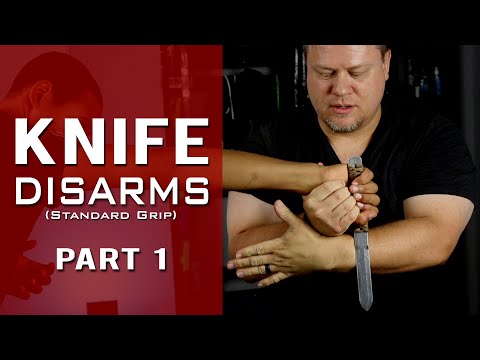
This is a comprehensive lesson on the technical method of a standard grip Knife disarm. We will explore the various type…
Translation: standard knife disarm
The Standard Knife Disarm is a technique that intercepts an incoming knife attack, controls the weapon arm through a joint lock or wrist manipulation, and strips the knife from the attacker's grip. [1] The most common method involves redirecting the attack offline, securing a two-hand grip on the weapon wrist, and applying a rotational force against the thumb to break the attacker's hold. [1],[2] Training emphasises the importance of simultaneous body movement (getting off the line of attack) and weapon-arm control. [2],[3]
Knife disarm methodology has been taught in Filipino martial arts for centuries and was adapted into military combatives by instructors such as William Fairbairn and Rex Applegate during World War II. [1] Modern Krav Maga, Systema, and Filipino martial arts all teach variations of the standard disarm principle. [2],[3]
Standard knife disarming techniques use leverage and joint manipulation to strip the knife from the opponent's hand. [1]
Standard knife disarms were systematised within FMA systems as core defensive techniques against blade attacks. [1]
Standard knife disarms are demonstrated at FMA events and self-defence training. [1]
No images yet for this technique.
Sign in to suggest an image.
This is a comprehensive lesson on the technical method of a standard grip Knife disarm. We will explore the various type…
Learn More About The Filipino Martial Art Pintados: https://budobrothers.tv/pages/pintados The best defense is offense …
Get the NEW Kali Apex training course here: https://www.kaliapex.com/ For 1 on 1 Kali Coaching go here: https://www.pat…
The standard knife disarm, taught across Filipino Martial Arts traditions, centers on controlling an attacker's weapon hand through positional entry, strikes to create openings, and mechanical extraction techniques. Pinnacle Combat Arts (Sean Elders) emphasizes a two-phase approach: first, defenders enter the attack line, strike the eyes or face to disrupt the attacker's focus, then execute either an ejection disarm (shooting the knife hand outward) or a peel disarm (peeling fingers away from the blade by targeting the thumb and rolling down with the pinky). Elders stresses monitoring the non-knife hand, maintaining head positioning below the weapon line, and following up with cuts to the bicep or chokes. Budo Brothers adds mechanical body-weight shifting as central to disarm success, emphasizing that weight transference backward combined with palm-up hand positioning prevents the attacker from withdrawing the weapon and enables clean disarmament. Both instructors agree disarms work across multiple angles and attack types (slashes, thrusts) when practitioners understand the core mechanics. Kali Center (Paul Ingram) focuses less on the disarm mechanics themselves and more on foundational knife-fighting timing and combinations—angle-one and angle-two slashes with thrusts—providing the offensive context that disarm defenses must counter. All three stress this is technical drill work requiring slow, deliberate practice before pressure testing, and unanimous emphasis on running first as the primary defense.
Synthesized from 3 instructors
No instructional courses yet for this technique.
Sign in to suggest a course.
Risk of injury to the person this technique is applied to
Knives and short blades are the most common weapon in real-world assaults; high lethality
Skill level needed to execute this technique reliably
Whether this technique is allowed under major competition rule sets
Bubishi: The Classic Manual of Combat (Patrick McCarthy, 2008)
Alias sources — [1] Filipino Martial Arts (Wiley, 1994) [2] Hoplology (Burton, 1884) [3] Hoplology (Burton, 1884)
Effectiveness sources — [1] Filipino Martial Arts (Wiley, 1997)
Mixed Japanese-Western terminology — combines traditional Japanese terms with katakana loanwords
Alias sources — [1] Filipino Martial Arts (Wiley, 1994) [2] Hoplology (Burton, 1884) [3] Hoplology (Burton, 1884)
Effectiveness sources — [1] Filipino Martial Arts (Wiley, 1997)
wrist control for edge alignment, grip endurance, footwork precision
quick wrists, strong forearms, good posture
forearm extensors/flexors, deltoids, core, calves
According to Sean Elders at Pinnacle Combat Arts, the first rule is to run if you can. If you can't run, find an equalizer—these are your primary options before attempting a technical disarm.
Sean Elders explains to start by peeling with your pinky finger first, then bring your remaining fingers down the blade while grabbing the thumb. Place your thumb on the back end of the attacker's hand to control it and prevent counterattacks.
Sean Elders outlines two main options: you can either eject the knife away, or you can peel it and cut the attacker's bicep to further disable them.
Sean Elders emphasizes that knife disarm techniques are technical pieces of a fight, not necessarily how an actual encounter would unfold—they should be understood as isolated technical components rather than complete fight scenarios.
The Standard Knife Disarm is a technique that intercepts an incoming knife attack, controls the weapon arm through a joint lock or wrist manipulation, and strips the knife from the attacker's grip. The most common method involves redirecting the attack offline, securing a two-hand grip on the weapon wrist, and applying a rotational force against the thumb to break the attacker's hold.
Knife disarm methodology has been taught in Filipino martial arts for centuries and was adapted into military combatives by instructors such as William Fairbairn and Rex Applegate during World War II. Modern Krav Maga, Systema, and Filipino martial arts all teach variations of the standard disarm principle.
WEKAF: legal — Legal in padded stick competition; HEMA: legal — Legal in applicable weapon categories
Danger rating 9/10. Extreme — knives and short blades are the most common weapon in real-world assaults; high lethality
The standard setup chain: Ready Position → Distance Control → Execute Technique → Return to Guard.
Standard counters include: Guard Position — return to a defensive ready stance / Distance Management — control the measure to avoid being in range / Counter-Attack — strike during the opponent's recovery or between movements.
Common variants: Standard cut (primary cutting angle from the ready stance); Thrust (tsuki) (straight thrust targeting the throat, chest, or face); Rising cut (kiri-age) (upward diagonal cut from low to high); Diagonal cut (kesa-giri) (downward diagonal cut following the kimono line).
Standard knife disarms are demonstrated at FMA events and self-defence training.
Top errors to watch for: Attempting the disarm before establishing arm control — rushing to disarm without controlling the arm risks getting cut / Using only one hand on the weapon arm — two-on-one leverage is essential; single-hand control is insufficient against… / Applying the wrist lock slowly — the wrist rotation must be sharp and fast to overcome the attacker's grip before the… / Not moving off the attack line — the defender must step offline; staying in the direct path invites being stabbed.
The Standard Knife Disarm is also known as Sutandādo Naifu Buki-tori, Basic Blade Strip, Standard Knife Takeaway, Disarma de Kutsilyo.