The Naginata
0
Naginata Cut·I Talk About Stuff
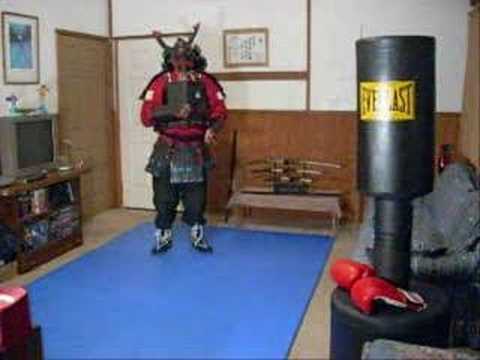
Today we will be talking about the naginata, a highly effective Japanese polearm, favored by men and women, samurai and …
Translation: Naginata Cut
The Naginata Cut subfamily covers all cutting (slashing) techniques with the naginata, exploiting the weapon's curved blade to deliver sweeping cuts to the opponent's body, legs, and head. [1] Naginata cuts are distinguished from straight-bladed polearm techniques by the drawing-cut motion enabled by the curved blade — the naginata's curve allows the edge to slice through the target rather than simply impacting, similar to katana cutting mechanics but at polearm range. [1],[2] Standard naginata cuts include men-uchi (strike to the head), kote-uchi (strike to the wrist), sune-uchi (strike to the shin — unique to naginata among Japanese martial arts), and do-uchi (strike to the torso). [2],[3]
Naginata cutting technique was developed through centuries of battlefield use in Japan, where the curved blade proved devastating against both armoured and unarmoured opponents. [1] The inclusion of sune (shin) as a valid target in modern naginata competition reflects the weapon's historical use to sweep opponents' legs — a tactic unique to the naginata among Japanese martial arts. [2],[3]
Naginata cuts use the curved blade on a long shaft to deliver powerful sweeping and hooking cuts with excellent reach, particularly effective against legs and lower body. [1]
Naginata competition is governed by the International Naginata Federation, with World Naginata Championships held since 1995. Japan dominates international competition. [1]
No images yet for this technique.
Sign in to suggest an image.
Today we will be talking about the naginata, a highly effective Japanese polearm, favored by men and women, samurai and …
THIS IS A SUPER OLD VID. I WILL KEEP IT UP BUT IT IS VERY OLD AND NOT A GOOD REPRESENTATION. CHECK OUT MY NEW VIDS TO SE…
No instructional courses yet for this technique.
Sign in to suggest a course.
Risk of injury to the person this technique is applied to
Spears, halberds, and naginata; maximum reach with lethal cutting/thrusting capability
Skill level needed to execute this technique reliably
Whether this technique is allowed under major competition rule sets
The Book of Five Rings (Miyamoto Musashi, 1645)
Alias sources — [1] Japanese Swordsmanship (Warner & Draeger, 1982) [2] Comprehensive Asian Fighting Arts (Draeger & Smith, 1969) [3] Comprehensive Asian Fighting Arts (Draeger & Smith, 1969)
Effectiveness sources — [1] Classical Bujutsu (Draeger, 1973)
Established Japanese martial arts naming convention — native Japanese term (和語/漢語)
Alias sources — [1] Japanese Swordsmanship (Warner & Draeger, 1982) [2] Comprehensive Asian Fighting Arts (Draeger & Smith, 1969) [3] Comprehensive Asian Fighting Arts (Draeger & Smith, 1969)
Effectiveness sources — [1] Classical Bujutsu (Draeger, 1973)
wrist control for edge alignment, grip endurance, footwork precision
quick wrists, strong forearms, good posture
forearm extensors/flexors, deltoids, core, calves
Every move, in any martial art, shares a few universal traits. Mix and match below to pinpoint the right tool — or compare equivalents across styles.
The 8 basic directions of cut are: cut down, cut up at an angle, cut down at an angle, cut sideways (twice), cut up, and thrust. These fundamental cuts form the foundation of naginata technique and are practiced from various stance positions (kamae).
The naginata remained a prominent battlefield weapon for hundreds of years without losing favor, even surviving the introduction of firearms in 1543 and continuing into the modern era as a weapon regarded for great soldiers.
During the Edo period (1600–1868), as warfare greatly decreased, the naginata became known as a weapon used by women of nobility for self-defense rather than primarily as a battlefield weapon.
The Naginata Cut subfamily covers all cutting (slashing) techniques with the naginata, exploiting the weapon's curved blade to deliver sweeping cuts to the opponent's body, legs, and head. Naginata cuts are distinguished from straight-bladed polearm techniques by the drawing-cut motion enabled by the curved blade — the naginata's curve allows the edge to slice through the target rather than simply impacting, similar to katana cutting mechanics but at polearm range.
Naginata cutting technique was developed through centuries of battlefield use in Japan, where the curved blade proved devastating against both armoured and unarmoured opponents. The inclusion of sune (shin) as a valid target in modern naginata competition reflects the weapon's historical use to sweep opponents' legs — a tactic unique to the naginata among Japanese martial arts.
FIE Sabre: legal — Legal cutting technique to upper body target area; FIK Kendo: legal — Legal if targeting valid area with correct form; WEKAF: legal — Legal striking technique; HEMA: legal — Legal in applicable weapon categories
Danger rating 9/10. Extreme — spears, halberds, and naginata; maximum reach with lethal cutting/thrusting capability
The standard setup chain: Ready Position → Distance Control → Execute Technique → Return to Guard.
Standard counters include: Parry (Absetzen) — deflect the incoming blade with a counter-displacement / Void (Step Back) — withdraw from measure to avoid the cutting arc / Counter-Cut (Nachreisen) — strike into the opponent's opening during their attack.
Common variants: Standard cut (primary cutting angle from the ready stance); Thrust (tsuki) (straight thrust targeting the throat, chest, or face); Rising cut (kiri-age) (upward diagonal cut from low to high); Diagonal cut (kesa-giri) (downward diagonal cut following the kimono line).
Naginata competition is governed by the International Naginata Federation, with World Naginata Championships held since 1995. Japan dominates international competition.
Top errors to watch for: Cutting with only the tip — the effective cutting zone is the forward third of the blade; tip-only contact lacks cutt… / Not rotating the hips — the long handle amplifies hip rotation; without it, cuts lack force / Cutting at incorrect distance — the blade must contact the target in the effective cutting zone, not too close or too… / Using the same cut repeatedly — vary between men, kote, do, and sune to keep the opponent guessing.
The Naginata Cut is also known as Naginata Kiri, Glaive Cut, Naginata Uchi.